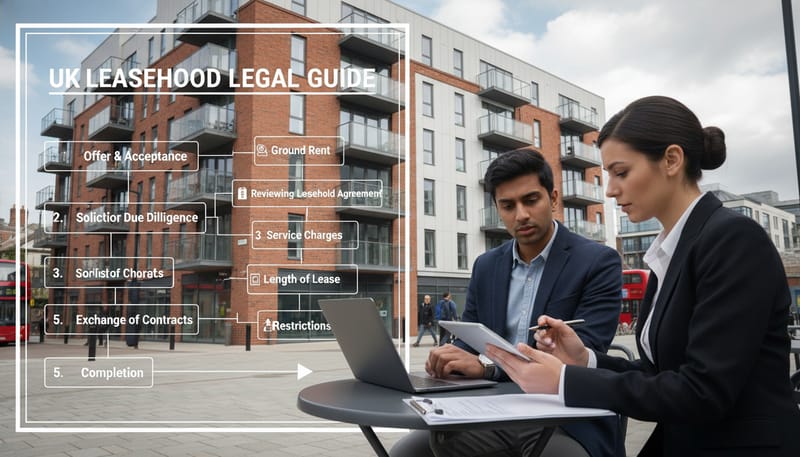
Understanding the Leasehold Structure for New Build Apartments
When you purchase a new build apartment in England & Wales, you are almost certainly buying a leasehold interest rather than outright ownership of the land. This is fundamentally different from buying a freehold house, and it is essential that you understand the legal framework before committing to a purchase. Unlike freehold ownership – where you own the property and the land it sits on indefinitely – a leasehold gives you the right to occupy and use the property for a fixed period, subject to the terms set out in the lease.
The lease is the single most important legal document you will encounter when buying a new build apartment. It governs your rights, your obligations, and the extent of your ownership. Your solicitor will review this document in detail during the conveyancing process, but you should also familiarise yourself with the key concepts so that you can ask the right questions and make an informed decision.
In practical terms, when you buy a leasehold apartment, you are purchasing a long tenancy from the freeholder (also called the landlord). The freeholder owns the building and the land, and grants you a lease that allows you to live in your specific apartment. This arrangement is necessary for apartment blocks because multiple owners share the same building structure, communal areas, and services – someone needs to hold overall responsibility for the building, and that entity is the freeholder or their appointed management company.
This guide covers every critical legal aspect of buying a new build leasehold apartment, from lease length and ground rent to service charges, management companies, and your rights under recent legislation. Whether you are a first-time buyer or an experienced property investor, understanding these legal fundamentals will help you avoid costly mistakes and protect your investment.
Please note: This article provides general guidance on leasehold law in England & Wales. It is not a substitute for professional legal advice. Always instruct a qualified solicitor or licensed conveyancer when purchasing a leasehold property. Scottish and Northern Irish property law differs significantly – leasehold residential tenure has largely been abolished in Scotland.
Lease Length: Why It Matters and What to Expect
The lease length is one of the most significant factors when purchasing a new build apartment. It determines how long your legal interest in the property lasts and directly affects the property’s value and mortgageability. New build apartments in England & Wales are typically granted with lease lengths ranging from 125 years to 999 years, though practices vary between developers.
Historically, 99-year leases were common, but the industry has moved towards longer terms. Many major developers now grant 999-year leases on new build apartments, which effectively provides near-permanent ownership without the complexities of diminishing lease terms. However, some developers still grant 125-year or 250-year leases, so it is important to check the specific term being offered.
Why Lease Length Affects Property Value
A lease is a wasting asset – it decreases in value as the term shortens. While a 999-year lease will not meaningfully diminish in your lifetime, a shorter lease can create problems sooner than you might expect. Most mortgage lenders require a minimum unexpired lease term of 80–85 years at the point the mortgage would end. This means that if you are buying with a 25-year mortgage, the lease typically needs to have at least 105–110 years remaining.
Once a lease falls below 80 years, the cost of extending it increases substantially because “marriage value” becomes payable – an additional premium reflecting the increase in property value that the extension creates. The Leasehold Reform (Ground Rents) Act 2022 and forthcoming reforms under the Leasehold and Freehold Reform Act 2024 are set to abolish marriage value for future lease extensions, but the timeline for implementation remains uncertain.
| Remaining Lease Length | Impact on Value | Mortgage Availability | Action Required |
|---|---|---|---|
| Over 250 years | Negligible impact | No restrictions | None |
| 125–250 years | Minimal impact | No restrictions | Monitor periodically |
| 90–125 years | Slight discount possible | Most lenders accept | Consider extending before selling |
| 80–90 years | Noticeable reduction | Some lenders restrict | Extend as soon as possible |
| Below 80 years | Significant reduction – marriage value payable | Difficult to obtain | Urgent extension needed |
For new build apartments, the lease length should not be an immediate concern provided it is at least 125 years. However, you should still verify the exact term and consider how it may affect resale value in the long term. If a developer is offering anything less than 125 years on a new build, your solicitor should query this and advise whether it is acceptable. Understanding these nuances is a key part of the legal checklist before exchanging on any new build property.
Ground Rent Obligations After the 2022 Reforms
Ground rent has been one of the most contentious issues in leasehold property law. Historically, many new build leases included escalating ground rent clauses that saw charges double every 10–25 years, creating a significant financial burden for leaseholders and making properties difficult to sell or remortgage. The Leasehold Reform (Ground Rents) Act 2022, which came into force on 30 June 2022, fundamentally changed the landscape.
What the 2022 Act Changed
For any new residential long lease granted on or after 30 June 2022, ground rent is legally restricted to a “peppercorn” – effectively £0 per year. This means that if you are buying a new build apartment today, you should not be paying any ground rent at all. The Act applies to:
- New long leases of residential property (over 21 years)
- Leases granted by way of a voluntary lease extension (where no statutory right is being exercised)
- Retirement home leases (from 1 April 2023)
There are certain limited exceptions, including community housing leases and leases of non-residential parts of a building, but for standard new build apartments, the peppercorn rent requirement applies. For a detailed exploration of how ground rent legislation affects new build purchases, see our dedicated guide.
What If You Bought Before June 2022?
The 2022 Act does not apply retrospectively to existing leases. If you purchased a new build apartment before this date, the ground rent provisions in your lease still apply. However, the Government has indicated its intention to cap ground rents on existing leases to a peppercorn through future legislation under the Leasehold and Freehold Reform Act 2024, though a specific implementation date has not yet been confirmed.
If you are purchasing a new build apartment now, your solicitor should verify that the lease complies with the 2022 Act by including a peppercorn ground rent. Any attempt by a developer to charge ground rent on a new qualifying lease is a breach of the Act, and the leaseholder can apply to the First-tier Tribunal for a determination.
Service Charges, Sinking Funds & Reserve Funds
While ground rent on new leases is now a peppercorn, service charges remain a significant ongoing cost for apartment owners. Unlike ground rent, service charges are not capped by legislation – they reflect the actual costs of managing, maintaining, repairing, and insuring the building and communal areas. Understanding your service charge obligations before purchasing is essential.
What Service Charges Cover
Service charges typically cover a wide range of building-related costs:
- Building insurance – the freeholder arranges buildings insurance for the entire block, and the cost is passed through to leaseholders
- Communal area maintenance – cleaning, lighting, and upkeep of hallways, stairwells, lifts, and entrance areas
- Grounds maintenance – landscaping, car park maintenance, and external lighting
- Repairs and maintenance – ongoing and periodic maintenance of the building structure, roof, and shared services
- Management fees – fees charged by the managing agent or management company for administering the building
- Sinking fund/reserve fund contributions – money set aside for major future works
- Lift maintenance and servicing – for buildings with lifts
- Fire safety compliance – fire risk assessments, alarm maintenance, and any remediation works
- Concierge or security services – where applicable
Sinking Fund and Reserve Fund Explained
A sinking fund (sometimes called a reserve fund) is a pot of money collected from leaseholders over time to pay for major future expenditure, such as roof replacement, external redecoration, or lift renewal. The purpose is to spread the cost of large works over many years rather than demanding a single large payment when the work becomes necessary.
Your solicitor should request details of the current sinking fund balance and recent expenditure. A healthy sinking fund is a positive sign – it suggests the building is being well managed. Conversely, a depleted sinking fund may indicate that major works are imminent or that past management has been inadequate.
| Service Charge Component | Typical Annual Cost (per flat) | Who Determines the Amount |
|---|---|---|
| Buildings insurance | £200–£800 | Freeholder/management company |
| Communal area cleaning & maintenance | £300–£1,200 | Managing agent |
| Grounds maintenance | £100–£500 | Managing agent |
| Management company fees | £200–£600 | Management company/freeholder |
| Sinking fund/reserve fund | £200–£1,000 | Management company |
| Lift maintenance | £100–£400 | Managing agent |
| Typical total | £1,500–£4,500+ | – |
Your legal rights regarding service charges are protected by the Landlord and Tenant Act 1985 (as amended). Service charges must be reasonable, and the costs must be incurred to a reasonable standard. You have the right to request a summary of costs and inspect receipts. If you believe charges are unreasonable, you can challenge them at the First-tier Tribunal (Property Chamber). A thorough review of anticipated service charges should be part of your pre-exchange legal checklist.
Management Company Structure & Communal Responsibilities
Every new build apartment development requires a structure for managing the building and communal areas. Understanding who manages the building, how decisions are made, and what your role is within this structure is vital. The management company setup for new build estates can take several forms, and the legal implications of each differ considerably.
Common Management Structures
There are three main management structures you may encounter:
- Developer-controlled management company – The developer sets up a management company and retains control, often appointing a professional managing agent. Leaseholders may have limited influence over decisions and costs until the development is fully completed and the management company is transferred.
- Resident Management Company (RMC) – The lease requires each apartment buyer to become a member (and usually a shareholder) of the management company. Once the development is complete, the leaseholders collectively control the management of the building. This is generally considered the most favourable structure for leaseholders.
- Right to Manage (RTM) company – Even if the original structure places control with the freeholder, leaseholders have a statutory right under the Commonhold and Leasehold Reform Act 2002 to take over management by forming an RTM company. No fault needs to be demonstrated – it is an absolute right provided the qualifying conditions are met (at least two-thirds of the flats must be held by qualifying tenants).
Communal Area Responsibilities
The lease will define which areas are “communal” and the extent of the freeholder’s and leaseholder’s respective repair obligations. Typically, the freeholder (through the management company) is responsible for:
- The main structure, foundations, and roof of the building
- External walls and load-bearing walls
- Common parts including hallways, stairwells, and lifts
- Shared drainage, plumbing, and electrical systems
- External grounds and landscaped areas
- Car parking areas and access roads (until adopted – see our guide on Section 38 and Section 104 agreements)
The individual leaseholder is typically responsible for the internal condition of their own apartment, including internal walls (non-structural), flooring, fixtures and fittings, and internal plumbing and electrics. The precise demarcation will be set out in the lease – your solicitor should explain exactly where your responsibility begins and ends.
Insurance, Sub-letting Restrictions & Alterations Consent
Your lease will contain detailed provisions regarding insurance, your ability to sub-let the property, and the process for making alterations. These clauses have significant practical and financial implications, and your solicitor should draw your attention to any particularly restrictive terms.
Insurance Arrangements
In a leasehold apartment block, buildings insurance is almost always arranged by the freeholder or management company for the entire building. The cost is recovered from leaseholders through the service charge. You do not need to arrange your own buildings insurance – in fact, doing so could result in duplicate cover and complications in the event of a claim. However, you will need to arrange your own contents insurance for your personal belongings and any internal fixtures you have installed.
Your solicitor should check that the insurance arrangements in the lease are adequate. Key points to verify include:
- The building is insured for its full reinstatement value
- The policy covers standard perils (fire, flood, subsidence, storm, etc.)
- Public liability insurance is in place for communal areas
- The insurance is placed with a reputable insurer
- Any commission arrangements are transparent – leaseholders have the right to request details of any commission received by the freeholder or managing agent
Sub-letting Restrictions
Many new build leases include provisions that restrict or regulate your ability to sub-let (rent out) the property. These restrictions may include:
- Absolute prohibition – some leases prohibit sub-letting entirely (relatively rare for standard residential leases but possible)
- Consent required – you may need to obtain the freeholder’s or management company’s written consent before letting, though consent should not be unreasonably withheld
- Minimum term requirements – the lease may require that any sub-let is for a minimum period (e.g., six months), effectively prohibiting short-term holiday lets
- Registration fee – a fee may be payable to the freeholder for registering a sub-tenant
- Short-term letting ban – an express prohibition on Airbnb-style short-term lettings
If you intend to rent out the property at any point – or if you are purchasing as a buy-to-let investment – it is essential that your solicitor verifies the sub-letting provisions before you exchange contracts.
Alterations and Consent
Leases typically distinguish between structural alterations (which usually require the freeholder’s consent) and non-structural alterations (which may be permitted without consent or with notice). Your lease might categorise alterations as:
- Absolutely prohibited – no alterations of a specified type are permitted under any circumstances
- Permitted with consent – you must apply for and obtain consent, which should not be unreasonably withheld (a “qualified covenant”)
- Permitted without consent – you are free to carry out specified minor works without needing approval
Common examples of alterations requiring consent include removing internal walls (even non-load-bearing ones), changing flooring (particularly replacing carpet with hard flooring, which can affect sound insulation), installing air conditioning units, and modifying the bathroom or kitchen layout. Always check your lease terms – unauthorised alterations can constitute a breach that may, in extreme cases, risk forfeiture.
Assignment Provisions & Forfeiture Risk
Two further legal concepts that every leasehold apartment buyer should understand are assignment (the process of selling your lease to a new owner) and forfeiture (the freeholder’s ultimate remedy if you breach the lease terms).
Assignment – Selling Your Leasehold Interest
When you sell your apartment, you are “assigning” your lease to the buyer. Most new build leases permit assignment but may require you to:
- Give notice of the assignment to the freeholder or management company
- Pay a notice or registration fee (sometimes called a “deed of covenant fee”)
- Ensure the buyer enters into a deed of covenant, agreeing to observe the lease terms
- Obtain a management pack from the managing agent (which your buyer’s solicitor will need for their due diligence)
These requirements are standard and should not prevent or unduly delay a sale. However, the fees charged for management packs and deed of covenant preparation have been a source of complaint, with some managing agents charging what many consider to be excessive amounts. The Leasehold and Freehold Reform Act 2024 includes provisions to regulate these charges, though implementation details are still emerging.
Forfeiture – The Ultimate Sanction
Forfeiture is the legal process by which a freeholder can reclaim possession of a leasehold property due to a breach of the lease terms. It is the most severe remedy available and effectively means losing your home and your investment. In practice, forfeiture for residential leases is rare and subject to significant legal protections, but it remains a theoretical risk that buyers should understand.
Under the Housing Act 1996 and the Commonhold and Leasehold Reform Act 2002, a freeholder cannot forfeit a residential lease for non-payment of service charges, ground rent, or administration charges unless the amount has been agreed or determined by a court or tribunal, or the leaseholder has admitted liability. Furthermore, the Leasehold Reform (Ground Rents) Act 2022 removed forfeiture as a remedy for non-payment of ground rent on leases to which the Act applies (i.e., new leases granted after 30 June 2022).
The key breaches that could theoretically lead to forfeiture proceedings include:
- Persistent non-payment of service charges (after a tribunal determination)
- Serious or repeated breach of other lease covenants
- Using the property for illegal purposes
- Carrying out unauthorised structural alterations
Even where forfeiture proceedings are initiated, the leaseholder has the right to apply for relief from forfeiture under section 146 of the Law of Property Act 1925. Courts generally grant relief if the breach is remedied and the leaseholder pays the freeholder’s reasonable costs. The key message is: comply with your lease terms, pay your service charges, and forfeiture should never become an issue. Understanding your overall leasehold vs freehold rights is fundamental to protecting your position.
Frequently Asked Questions
How long should the lease be on a new build apartment?
For a new build apartment, the lease should ideally be 125 years at minimum, with many developers now offering 250-year or 999-year leases. A longer lease provides better long-term value and avoids the complications and costs associated with lease extensions later. Most mortgage lenders require at least 80–85 years remaining at the end of the mortgage term, so a shorter lease could restrict your options when selling or remortgaging. If a developer offers less than 125 years on a new build, ask your solicitor to investigate why and whether this is acceptable.
Do I have to pay ground rent on a new build apartment purchased after June 2022?
No. Under the Leasehold Reform (Ground Rents) Act 2022, ground rent on new qualifying residential long leases granted on or after 30 June 2022 is restricted to a peppercorn – effectively £0 per year. If a developer attempts to include a ground rent charge in a lease granted after this date, they are in breach of the Act. Your solicitor should verify that the lease includes a peppercorn ground rent clause. For more details, read our full guide on ground rent legislation for new builds.
Can I challenge unreasonable service charges?
Yes. Under the Landlord and Tenant Act 1985, service charges must be reasonable in amount, and the services or works to which they relate must be carried out to a reasonable standard. If you believe your service charges are unreasonable, you can apply to the First-tier Tribunal (Property Chamber) for a determination. The Tribunal can assess whether specific charges are payable, reduce excessive charges, and determine whether the standard of services meets the required threshold. You can also request a summary of costs and inspect receipts and invoices. The application process is relatively straightforward and does not necessarily require legal representation, though professional advice is recommended for complex disputes.
What happens if the management company is not maintaining the building properly?
If the management company or freeholder is failing to maintain the building, leaseholders have several options. First, you can raise concerns formally with the management company and request a meeting. If this does not resolve the issue, you can apply to the First-tier Tribunal for an order requiring the landlord to carry out specific repairs. Alternatively, leaseholders can exercise their Right to Manage under the Commonhold and Leasehold Reform Act 2002, which allows qualifying leaseholders to take over management of the building without needing to prove fault. At least 50% of qualifying leaseholders must participate for an RTM claim to proceed. See our guide on management company setup for more details.
Can I sub-let my new build apartment?
This depends entirely on the terms of your lease. Many leases permit sub-letting with the freeholder’s consent (which should not be unreasonably withheld), while some impose minimum term requirements or prohibit short-term lettings (such as Airbnb). A small number of leases – particularly in certain luxury developments – may prohibit sub-letting altogether. Additionally, your NHBC warranty and mortgage lender may have their own requirements regarding sub-letting. It is essential to check all relevant terms before purchasing if you intend to rent out the property, and to obtain the necessary consents before entering into any tenancy agreement.
Conclusion: Protecting Your Leasehold Investment
Buying a new build leasehold apartment is a significant financial and legal commitment. While the leasehold structure is a well-established part of English and Welsh property law, it creates a complex web of rights, obligations, and relationships between you, the freeholder, and the management company. Recent legislative reforms – particularly the Leasehold Reform (Ground Rents) Act 2022 and the forthcoming provisions of the Leasehold and Freehold Reform Act 2024 – have significantly improved the position of leaseholders, but the legal landscape continues to evolve.
The key actions you should take when buying a new build leasehold apartment are:
- Instruct a specialist leasehold solicitor – not all conveyancers have the same level of expertise in leasehold matters
- Read and understand the key lease terms – lease length, service charges, ground rent, restrictions, and management provisions
- Verify the lease complies with current legislation – particularly the 2022 ground rent requirements
- Understand the management structure – who manages the building, how decisions are made, and what your role will be
- Budget for ongoing costs – service charges, insurance, and reserve fund contributions are in addition to your mortgage and council tax
- Check sub-letting and alteration provisions – ensure the lease terms align with your plans for the property
- Complete all necessary legal searches – to identify any issues that could affect your use and enjoyment of the property
By approaching the purchase with full knowledge of the legal framework, you can protect your investment and enjoy your new home with confidence. If you are at the beginning of your new build buying journey, take the time to understand the leasehold structure before committing – it will pay dividends in the long run.