How Developers Are Meeting the Future Homes Standard
Published by New-Builds Team
The Future Homes Standard (FHS) represents the most significant change to building regulations for new homes in a generation. Due to take full effect in 2025, the standard will require all new homes to produce 75-80% less carbon emissions than those built under the previous Part L of the Building Regulations. This is not a distant aspiration; it is a concrete regulatory requirement that every housebuilder in England must comply with, and the transition is already well underway. Developers across the UK are investing billions of pounds in new technologies, construction methods, and supply chains to ensure they can deliver homes that meet these demanding requirements while still offering excellent value and livability for homebuyers.
In this comprehensive guide, we explore exactly what the Future Homes Standard entails, how the major developers are preparing for it, what it means for homebuyers, and which companies are leading the charge as early adopters. Whether you are about to purchase a new build home or simply interested in the future of UK housing, understanding the FHS is essential because the homes being built today and tomorrow will be fundamentally different from those built just a few years ago, and in almost every way, they will be better.
The context for this transformation is the UK's legally binding commitment to achieve net-zero carbon emissions by 2050. Buildings account for approximately 25% of the UK's total carbon emissions, with residential heating alone responsible for around 14%. The government recognised that new homes represent the most cost-effective opportunity to reduce building emissions because it is far cheaper and more effective to build a home to high energy standards from the outset than to retrofit an existing home later. The FHS is therefore not just an environmental measure; it is an economic strategy that will save homebuyers money on energy bills while contributing to national climate targets.
Future Homes Standard: Key Targets
Understanding the Future Homes Standard
The Future Homes Standard is the culmination of a policy journey that began with the government's commitment to achieving net-zero carbon emissions by 2050. The standard sets out a pathway to ensure that all new homes built from 2025 onwards are zero-carbon ready, meaning they will not require any further retrofit work to become zero-carbon as the electricity grid decarbonises over time. This is a critically important concept: rather than requiring homes to be fully zero-carbon from day one (which would be extremely expensive given the current carbon intensity of grid electricity), the FHS ensures that homes are designed and built so that they will automatically become zero-carbon as the grid gets cleaner, without any modifications being needed.
The standard has been introduced in two stages. The first stage, which came into effect in June 2022 through an interim uplift to Part L of the Building Regulations, required a 31% reduction in carbon emissions compared to the previous standard. This interim step was designed to give the industry time to adapt its supply chains, upskill its workforce, and trial new technologies before the full standard comes into force. The second stage, the full FHS, requires the much more demanding 75-80% reduction and the effective end of fossil fuel heating in new homes.
The key technical requirements of the full Future Homes Standard include the use of low-carbon heating systems (predominantly air source heat pumps), significantly improved building fabric performance including better insulation, high-performance windows, and reduced thermal bridging, enhanced airtightness standards, mechanical ventilation with heat recovery (MVHR) in many cases, and improved water efficiency standards. Together, these measures will produce homes that are dramatically more energy-efficient than those built just a few years ago, delivering lower running costs and greater comfort for occupants. The standard also addresses overheating risk, requiring developers to demonstrate that homes will not overheat during summer months, an increasingly important consideration as average temperatures rise.
The Part L Interim Uplift: Where We Are Now
The interim Part L uplift that came into effect in June 2022 provided the first significant step toward the full Future Homes Standard. This interim standard required a 31% reduction in carbon emissions from new homes compared to the previous Part L 2013, and introduced new requirements for building fabric performance, airtightness, and renewable energy provision. The vast majority of developers have now fully transitioned to building all their homes to this interim standard, and many are already going beyond it as they prepare for the full FHS.
Under the interim uplift, developers have primarily achieved the required carbon reductions through a combination of improved insulation, better-performing windows (typically triple-glazed in many developments), enhanced airtightness, and the installation of solar photovoltaic (PV) panels. Some developers have also begun installing air source heat pumps under the interim standard, even though this was not required, in order to gain experience with the technology and build consumer confidence ahead of the full FHS requirement. Wastewater heat recovery systems have also become more common, capturing heat from shower water that would otherwise be wasted and using it to pre-heat incoming cold water, reducing the energy required for hot water production by up to 50%.
The industry's response to the interim uplift has been overwhelmingly positive. Developers have demonstrated that they can deliver homes that meet the higher performance requirements while maintaining build quality, managing costs, and delivering homes that buyers love. This successful transition has built confidence across the industry that the full Future Homes Standard, while more demanding, is achievable with the right preparation and investment. The HBF (Home Builders Federation) has played an important coordinating role throughout the transition, working with government and the supply chain to identify and address potential barriers to implementation, and providing technical guidance to help smaller builders navigate the new requirements.
Part L Evolution: Carbon Reduction Requirements
Heat Pump Rollout: The Biggest Change
The single biggest change that the Future Homes Standard brings is the effective end of gas boilers in new homes. From 2025, all new homes will need to be heated using low-carbon heating systems, and air source heat pumps (ASHPs) are expected to be the predominant technology. This represents a fundamental shift in how UK homes are heated and has required massive investment from developers in technology, training, and supply chain development.
Air source heat pumps work by extracting heat from the outside air and using it to warm the home and provide hot water. Modern heat pumps are remarkably efficient, typically delivering three to four units of heat for every unit of electricity consumed, giving them a Coefficient of Performance (COP) of 3-4. This means that even though electricity is more expensive per unit than gas, heat pumps can deliver heating at a comparable or lower cost than gas boilers, particularly when combined with the improved building fabric that the FHS requires. As the electricity grid continues to decarbonise, homes heated by heat pumps will become progressively greener over time without any changes to the home itself.
The major developers have invested heavily in preparing for the heat pump transition. Barratt Developments has installed thousands of air source heat pumps across its developments, working closely with manufacturers like Mitsubishi, Daikin, and Vaillant to optimise performance for its house types. The company's ZED House (Zero Energy Development) project was an early demonstrator of how heat pumps could be integrated into a typical family home with excellent results. Taylor Wimpey has partnered with Octopus Energy to develop innovative energy solutions for its developments, including optimised heat pump installations combined with smart energy management that helps buyers shift their electricity consumption to the cheapest off-peak periods. Persimmon has invested in its own training facilities to upskill its workforce in heat pump installation and maintenance, recognising that the quality of installation is critical to achieving optimal performance and buyer satisfaction.
Bellway has taken a particularly systematic approach to the heat pump transition, trialling different heat pump technologies across its regional divisions to identify the best solutions for different house types and site conditions. The company has found that air source heat pumps perform particularly well in its detached and semi-detached homes where there is adequate space for the outdoor unit and where the improved building fabric delivers consistent indoor temperatures. Redrow has integrated heat pumps into its Heritage Collection homes, demonstrating that traditional architectural styling can accommodate modern heating technology without compromising the aesthetic appeal that buyers love about the range. The outdoor units are typically located at the side or rear of the property, positioned to be unobtrusive while maintaining optimal airflow for efficient operation.
For homebuyers, the transition to heat pumps brings several advantages. Heat pump-heated homes benefit from more even temperature distribution, with underfloor heating (which works particularly well with heat pumps) providing gentle, consistent warmth across the entire floor. The low operating temperature of underfloor heating systems means they work at optimal efficiency with heat pumps, creating a highly comfortable environment without the hot spots and cold spots that can occur with radiator-based systems. Running costs are competitive with gas, especially when combined with solar PV panels that can offset electricity consumption. Heat pumps are also quieter than gas boilers during operation, safer because there is no combustion involved, and require less maintenance over their lifetime. Many developers are providing comprehensive handover guides and training sessions to help buyers understand how to operate their heat pump systems effectively, ensuring they get the most out of the technology from day one.
Fabric-First Approach: Building Better Envelopes
The fabric-first approach is a cornerstone of the Future Homes Standard philosophy. Rather than relying solely on renewable energy technology to offset poor building performance, the FHS prioritises creating a building envelope that minimises heat loss in the first place. This means thicker, better-performing insulation in walls, floors, and roofs; high-performance windows and doors; reduced thermal bridging at junctions; and significantly improved airtightness. When the building fabric is excellent, the heating system has to work far less hard, resulting in lower energy consumption, lower running costs, and a more comfortable living environment.
Under the full FHS, wall U-values are expected to improve to around 0.15 W/m2K (compared to 0.26 W/m2K under the previous standard), meaning walls will lose around 40% less heat. Floor U-values will similarly improve to around 0.11 W/m2K, and roof U-values to around 0.11 W/m2K. Windows will need to achieve U-values of around 1.2 W/m2K or better, which in practice means that triple glazing will become the norm across the industry. These improved fabric standards will make FHS homes feel noticeably warmer, more comfortable, and more consistent in temperature than older homes, even during the coldest winter months.
Developers are achieving these improved fabric standards through several approaches. Many are increasing cavity wall widths to accommodate thicker insulation, while others are exploring alternative construction systems such as timber frame, structural insulated panels (SIPs), and insulated concrete formwork (ICF) that can achieve excellent fabric performance more easily than traditional masonry construction. Barratt Developments has invested in optimising its standard house types for improved fabric performance, working with building physics consultants to ensure that thermal bridging is minimised at critical junctions around windows, doors, and where walls meet floors and roofs. Taylor Wimpey has invested in advanced thermal modelling to optimise the balance between different fabric improvements and identify the most cost-effective route to compliance for each of its house types. The company uses sophisticated software to model the thermal performance of every home design, testing different combinations of insulation, glazing, and airtightness to find the optimal specification.
Timber frame construction offers particular advantages for achieving FHS fabric standards because the insulation is contained within the structural frame, allowing thicker insulation without increasing overall wall width. This is one reason why timber frame adoption is increasing among developers preparing for the FHS. Scotland, where timber frame already accounts for over 80% of new homes, provides a valuable model for the rest of the UK in terms of demonstrating that excellent fabric performance is achievable at scale through off-site manufactured panels. Several English developers have invested in timber frame manufacturing facilities or forged strategic partnerships with timber frame suppliers to secure capacity ahead of the full FHS implementation. For more on this topic, see our article on modular and MMC construction.
U-Value Improvements: Old Standard vs FHS
Airtightness and Ventilation
Improved airtightness is a critical component of the Future Homes Standard. Under the previous regulations, the maximum air permeability allowed was 10 m3/h/m2 at 50 Pascals, with most new homes achieving around 5-7 m3/h/m2. The full FHS is expected to require significantly tighter buildings, with many developers already targeting air permeability of 3 m3/h/m2 or less. This dramatic improvement in airtightness means much less uncontrolled heat loss through gaps and cracks in the building envelope, resulting in homes that maintain their temperature much more effectively and require less energy to heat. It also means less noise ingress from outside, making homes quieter and more peaceful.
However, improved airtightness must be accompanied by effective ventilation to maintain healthy indoor air quality. This is where mechanical ventilation with heat recovery (MVHR) comes in. MVHR systems extract stale, moist air from kitchens and bathrooms and supply fresh, filtered air to living rooms and bedrooms, while recovering up to 90% of the heat from the outgoing air. This means that even in the depths of winter, homes maintain excellent air quality without wasting the heat that has been paid for. The filtration element of MVHR systems is an additional benefit, removing pollen, dust, and pollution particles from incoming air, which is particularly valuable for allergy sufferers and in areas with poor outdoor air quality.
Many developers are now installing MVHR as standard in their FHS-ready homes, and buyer feedback has been very positive, with occupants reporting better air quality, reduced condensation, and improved comfort compared to naturally ventilated homes. Achieving consistent airtightness across large-volume production requires careful attention to detail and robust quality assurance processes. Developers are investing in specialist training for site teams, with particular focus on the critical details that determine airtightness performance, such as membrane sealing around windows, careful taping of vapour control layers, and proper sealing of service penetrations. The NHBC has supported this transition through updated guidance and training programmes. For more on quality standards in new builds, see our article on award-winning new build developments across the UK.
Early Adopters: Developers Leading the Charge
While the full Future Homes Standard does not come into force until 2025, several developers have already built homes that meet or exceed its requirements, demonstrating both that compliance is achievable and that buyers love the result. These early adopters are providing valuable lessons for the wider industry and giving homebuyers access to the most advanced new homes available anywhere in the UK.
Barratt Developments has been the most visible early adopter, with its ZED House (Zero Energy Development) project at its Innovation Park in Kingswood, Warwickshire. The ZED House demonstrated that a typical four-bedroom family home could be built to zero-carbon standards using technologies and construction methods that are available today, at a cost premium that makes commercial sense at scale. The project featured an air source heat pump, solar PV, battery storage, triple glazing, enhanced insulation, MVHR, and a smart energy management system. Monitored performance data from the ZED House has confirmed that it achieves the carbon savings predicted by thermal modelling, providing confidence that the approach works in real-world conditions. Barratt has since applied lessons from the ZED House across its mainstream developments, progressively raising the energy performance of its homes ahead of the regulatory timeline.
Berkeley Group has been pioneering district-level energy solutions that complement individual home improvements. At developments like Kidbrooke Village and Royal Arsenal Riverside, Berkeley has installed district heating networks powered by low-carbon energy sources, combined with excellent building fabric and smart energy management. The company's approach recognises that achieving optimal carbon performance often requires thinking beyond the individual home to the wider energy infrastructure serving a development. Berkeley has also invested in extensive monitoring and post-occupancy evaluation to understand how its homes perform in practice, using this data to continuously improve its approach and ensure that the theoretical energy performance translates into real-world savings for residents.
Taylor Wimpey has invested in future homes research through its dedicated sustainability team, building multiple prototype homes to FHS standards across different regions and house types. The company has been particularly focused on understanding how heat pumps perform in different climates and building configurations, and how to optimise the balance between fabric improvements and technology to deliver the best outcomes for buyers. Taylor Wimpey's partnership with Octopus Energy has also explored how smart energy tariffs can help buyers reduce their electricity costs further by using their heat pumps during off-peak periods when electricity is cheapest and often greenest.
Bellway has taken a pragmatic, division-by-division approach to FHS preparation, recognising that the optimal compliance strategy varies depending on regional construction traditions, site conditions, and supply chain availability. The company has invested in training academies across its divisions to ensure that site teams have the skills needed to deliver FHS-compliant homes consistently, with a particular focus on airtightness detailing and heat pump installation. Bellway has reported positive feedback from buyers of its early FHS-ready homes, noting that many buyers specifically choose these homes because of the reduced running costs and improved comfort they offer compared to older properties and even conventional new builds.
Persimmon has invested in its own research and development programme to prepare for the FHS, building prototype homes at its innovation centre and conducting extensive testing of different construction approaches. The company has been particularly focused on developing cost-effective compliance strategies that maintain the affordability that its buyers value, recognising that the FHS must not price first-time buyers and lower-income households out of the new build market. Persimmon's approach to heat pump integration has emphasised simplicity and reliability, with the company selecting heat pump systems that are easy to operate and maintain. If you are a first-time buyer interested in these new energy-efficient homes, our article on how developers support first-time buyers onto the ladder explores the range of assistance available.
Energy Bill Savings: What FHS Means for Buyers
Perhaps the most tangible benefit of the Future Homes Standard for homebuyers is the significant reduction in energy bills. Homes built to FHS standards will require dramatically less energy to heat and power, delivering real savings that accumulate year after year. Independent analysis suggests that a typical three-bedroom FHS-compliant home could cost as little as 500-700 pounds per year to heat, compared to 1,200-1,800 pounds for an equivalent home built to the previous Part L standard. Over a 25-year mortgage term, these savings could amount to 15,000-25,000 pounds or more, effectively offsetting any premium in the purchase price and providing genuine long-term financial benefit to homeowners.
The savings come from multiple sources. The improved building fabric means less heat is lost through the walls, floor, roof, and windows, so the heating system runs for fewer hours. The heat pump delivers more heat per unit of electricity than a gas boiler delivers per unit of gas. Solar PV panels generate free electricity that can offset heat pump running costs and power other appliances. Smart energy management systems optimise energy use automatically, ensuring that the home is heated efficiently without wasting energy. And as electricity prices are expected to fall relative to gas over the coming decades as the grid becomes dominated by cheap renewable energy from wind and solar farms, the savings from heat pumps will only increase over time.
Annual Energy Cost Comparison: 3-Bed Home
Supply Chain Transformation and Skills Development
Meeting the Future Homes Standard requires not just changes on construction sites but a fundamental transformation of the supply chain. Heat pump manufacturers have scaled up UK production capacity to meet the expected demand, with Vaillant, Daikin, Mitsubishi, and Samsung all investing in expanded capacity. Vaillant has invested in new production lines at its UK facility, while Daikin has expanded its European manufacturing operations to serve the growing UK market. Insulation manufacturers have developed new products optimised for FHS performance requirements, including thinner but more effective insulation materials that allow developers to achieve the required U-values without excessively thick walls. Window manufacturers have invested in triple glazing production lines, with companies like Internorm, Rationel, and Rehau expanding their UK supply capabilities.
Developers have played a crucial role in driving this supply chain transformation by placing long-term procurement commitments that give manufacturers the confidence to invest. Barratt Developments and Taylor Wimpey, as the UK's largest housebuilders, have been particularly influential in this regard, signing multi-year supply agreements that have helped manufacturers plan their investment and production capacity. The HBF has also supported the transition through its work coordinating industry responses and engaging with suppliers to ensure that the supply chain is ready for the full rollout of the FHS.
Skills development is another critical aspect of the supply chain transformation. Installing heat pumps, achieving consistent airtightness, and commissioning MVHR systems all require specialist skills that have not traditionally been part of the standard housebuilding skill set. Developers are investing in extensive training programmes, both for their directly employed workforce and for their subcontractor partners. The NHBC has introduced new competency requirements for heat pump installation, and several developers have established their own training academies where site teams can develop the skills needed for FHS construction in a hands-on environment. Bellway, Persimmon, and Barratt have all invested in dedicated training centres where plumbers, electricians, and other trades can learn to work with heat pump systems, MVHR units, and the enhanced building fabric details that the FHS requires.
What FHS Homes Look and Feel Like
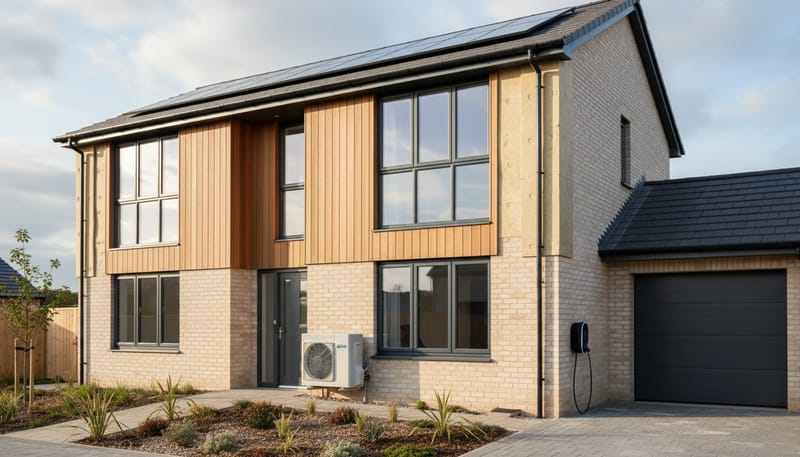
A common concern among prospective buyers is whether FHS-compliant homes will look or feel different from the homes they are used to. The reassuring answer is that from the outside and inside, FHS homes look very similar to current new builds. The heat pump outdoor unit is typically tucked away at the side or rear of the property, similar to an air conditioning unit. Triple-glazed windows look identical to double-glazed ones from both inside and out. The increased wall thickness required for improved insulation is accommodated within the wall structure without affecting room sizes or external appearance. MVHR units are typically installed in a utility room or loft space and are barely noticeable.
Where FHS homes do differ is in how they feel to live in. Occupants consistently report that FHS-compliant homes feel warmer, more even in temperature, quieter, and more comfortable than older homes or even recent new builds built to the previous standard. The improved airtightness eliminates draughts, the triple glazing reduces noise from outside, the MVHR provides a constant supply of fresh air without the need to open windows in winter, and the underfloor heating provides gentle, consistent warmth across the entire floor. Buyers of early FHS-ready homes have been overwhelmingly positive about the living experience, with many commenting that they would not want to go back to a conventionally heated home. The combination of comfort, low running costs, and environmental responsibility makes FHS homes an extremely attractive proposition for buyers at every stage of the property ladder.
The Future Homes Standard represents a genuine step-change in the quality and performance of new build homes in the UK. Far from being a burden on the industry, it is driving innovation, raising standards, and delivering homes that are better for buyers and better for the environment. The developers that are embracing the challenge most enthusiastically are the ones winning awards, attracting buyers, and building the homes of the future today. For buyers, purchasing a home that meets or exceeds the FHS is not just a sound environmental choice but a smart financial decision that will deliver lower running costs, greater comfort, and stronger long-term value.
For further reading, explore our guides on award-winning new build developments across the UK, modular and MMC construction, and developer commitments to biodiversity and green spaces.