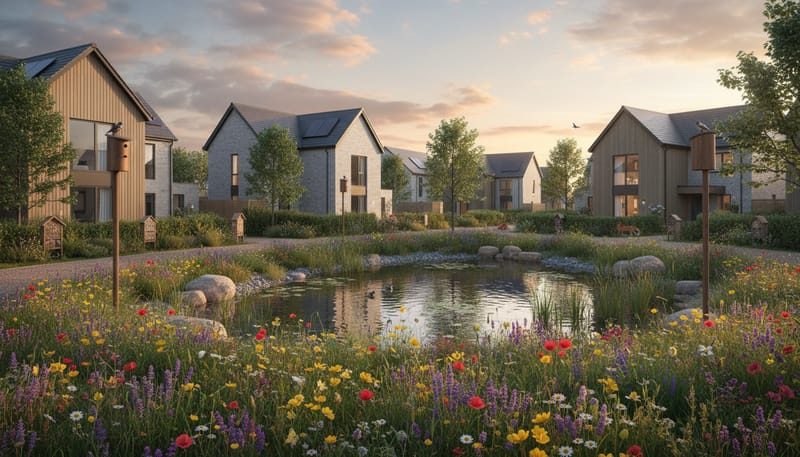
Developer Commitments to Biodiversity and Green Spaces
Published by New-Builds Team
The UK's new build housing sector is in the midst of an extraordinary green transformation. Driven by the landmark requirement for Biodiversity Net Gain (BNG), growing consumer demand for nature-rich living environments, and developers' own environmental ambitions, new build developments are increasingly being designed as ecological assets rather than simply places to live. From wildlife corridors that connect fragmented habitats to sustainable drainage systems that manage water naturally, from community orchards that bring neighbours together to green roofs that provide habitats for insects and birds, the landscape of new build housing is greener, wilder, and more ecologically valuable than ever before.
In this comprehensive guide, we explore the regulatory framework driving biodiversity improvements, examine how the UK's leading developers are responding with innovative green infrastructure solutions, and explain what these commitments mean for homebuyers seeking a home that connects them with nature while contributing to the health of the wider environment. The picture that emerges is one of an industry that is not merely complying with environmental requirements but actively embracing the opportunity to create developments that are genuinely better for people, wildlife, and the planet.
Green Infrastructure: Industry Commitments
Biodiversity Net Gain: The New Baseline
Biodiversity Net Gain became a mandatory requirement for most new developments in England from February 2024, representing a watershed moment in the relationship between housebuilding and the natural environment. Under the BNG requirement, all qualifying developments must deliver a minimum 10% net gain in biodiversity compared to the pre-development baseline. This means that when a development is completed, the site must support measurably more biodiversity than it did before construction began. The gain must be maintained for at least 30 years, ensuring that the ecological benefits are sustained over the long term rather than being a short-lived gesture.
The BNG requirement is measured using a standardised metric developed by Natural England that assesses the quantity, quality, and strategic significance of different habitat types. Developers must submit a biodiversity gain plan showing how they will achieve the required 10% net gain, which can be delivered through a combination of on-site habitat creation, off-site habitat improvements (such as purchasing biodiversity credits), or a mixture of both. The strong policy preference is for on-site delivery, which provides the greatest benefit to the development's residents and the local ecological network.
What makes BNG particularly significant is that it does not simply require developers to minimise their environmental impact; it requires them to leave the environment in a measurably better state than they found it. This is a fundamentally positive approach that recognises that well-designed developments can genuinely enhance biodiversity, creating new habitats, connecting fragmented ecosystems, and providing ecological stepping stones that benefit wildlife far beyond the development's boundaries. The mandatory nature of BNG has driven a step-change in how developers approach landscape and ecology, with biodiversity considerations now embedded at the earliest stages of masterplanning rather than being addressed as an afterthought.
Wildlife Corridors and Ecological Networks
One of the most impactful ways that developers are delivering biodiversity gains is through the creation and enhancement of wildlife corridors. These are continuous strips of natural habitat that connect different ecological areas, allowing wildlife to move freely across the landscape. In a country where habitat fragmentation is one of the primary threats to biodiversity, the creation of new wildlife corridors through development sites can make a genuinely significant contribution to ecological connectivity.
Barratt Developments has been a leader in integrating wildlife corridors into its masterplans, with its ecology team working with local wildlife trusts and Natural England to identify the most ecologically valuable corridor routes on each development. The company's approach typically involves retaining and enhancing existing hedgerows and tree lines as the backbone of the corridor network, and supplementing these with new native planting that widens and strengthens the corridors. Hedgehog highways — small gaps in garden fences that allow hedgehogs to move between gardens and into wider corridors — have become a standard feature across Barratt developments, reflecting the company's understanding that even small interventions can make a meaningful difference to wildlife.
Taylor Wimpey has invested in ecological assessments that go beyond the minimum requirements to understand the wider landscape context of each development. The company works with ecologists to map existing wildlife movement patterns and design its developments to maintain and enhance these routes. This sometimes means adjusting the layout of a development to accommodate a wildlife corridor, accepting a slightly lower housing density in exchange for a significant ecological benefit. Taylor Wimpey has also been a champion of 'living fences' — hedgerow boundaries between properties that provide habitat and food for wildlife while serving the same practical function as traditional fencing.
Berkeley Group has taken wildlife corridors to another level on its large-scale regeneration projects, creating substantial green corridors that serve as both wildlife habitats and recreational amenities for residents. At developments like Kidbrooke Village in Greenwich, Berkeley created extensive parkland and wetland habitats that provide continuous green connectivity across the development, linking into the wider green infrastructure network. These corridors serve a dual purpose, providing ecological benefits while offering residents attractive walking and cycling routes, play areas, and informal recreation spaces. This dual-function approach is a hallmark of the best green infrastructure design, delivering benefits for both people and wildlife.
Sustainable Drainage Systems (SuDS)
Sustainable Drainage Systems (SuDS) represent one of the most visible and ecologically valuable forms of green infrastructure on new build developments. Unlike traditional piped drainage systems that rush rainwater into sewers as quickly as possible, SuDS manage water naturally at the surface, mimicking the way that water moves through the natural landscape. The result is a network of swales, ponds, wetlands, rain gardens, and permeable surfaces that not only manage flood risk effectively but also create rich habitats for wildlife, improve water quality, and provide attractive landscape features for residents to enjoy.
SuDS have become standard practice across UK new build developments, driven by planning requirements, building regulation changes, and the adoption of the SuDS Manual by the Construction Industry Research and Information Association (CIRIA). The best SuDS schemes deliver a management train that progressively cleans and attenuates water as it moves through the system, with each element providing additional biodiversity and amenity benefits. A typical management train might include permeable paving in driveways and parking areas, rain gardens in front gardens, grassy swales along streets, and a naturalised detention pond at the lowest point of the development.
Bellway has been particularly innovative in its approach to SuDS, treating drainage features as central design elements rather than utilitarian infrastructure. On several developments, Bellway has created naturalised wetland areas that serve as focal points for the community, with seating areas, viewing platforms, and interpretive signage that help residents understand and appreciate the ecological value of their drainage system. These wetland features have become home to a wide range of wildlife, including amphibians, dragonflies, water birds, and aquatic plants, creating biodiversity hotspots that enhance the ecological value of the entire development.
Persimmon has invested in SuDS research and development to optimise the balance between drainage performance, ecological value, and maintenance cost. The company has developed standard SuDS details that can be adapted for different site conditions, ensuring consistent quality across its large portfolio of developments while allowing for local variation. Persimmon's approach to SuDS emphasises simplicity and robustness, creating systems that perform reliably over time with straightforward maintenance requirements — an important consideration given that SuDS features often become the responsibility of management companies or residents after the development is completed.
SuDS Performance: Key Metrics
Community Gardens and Allotments
An increasing number of developers are incorporating community gardens, allotments, and growing spaces into their developments, responding to strong demand from homebuyers for opportunities to grow their own food and connect with nature. These spaces provide multiple benefits: they promote physical and mental health, build social connections between neighbours, produce fresh local food, and create additional habitat for pollinators and other wildlife. The trend reflects a broader shift in how developers think about open space provision, moving away from purely ornamental landscaping toward productive, engaging spaces that residents actively use and value.
Redrow has been a notable advocate for community food-growing spaces, incorporating allotment plots and community orchards into many of its developments. The company's approach recognises that these features are not just amenities but important community-building tools that bring diverse groups of residents together around a shared activity. Redrow typically provides raised beds, communal tool stores, and compost facilities, along with establishing fruit trees and berry bushes that provide both food and habitat value. The community orchards, planted with traditional and local apple, pear, and plum varieties, serve as both productive landscapes and beautiful amenity spaces that change character with the seasons.
Crest Nicholson has integrated food growing into its masterplanning process, designing developments where growing spaces are located conveniently close to homes and connected by attractive walking routes. The company has also partnered with local food-growing organisations to provide guidance and support for residents who may be new to gardening, ensuring that the community gardens are well used and well maintained from the outset. On larger developments, Crest Nicholson has created dedicated community garden areas with covered seating, water supplies, and greenhouse facilities that enable year-round growing.
Green Roofs and Living Walls
Green roofs and living walls are becoming increasingly common features on new build developments, particularly on apartment buildings and community facilities. These vegetated surfaces provide habitat for insects and birds, absorb rainwater, improve thermal performance, reduce the urban heat island effect, and create visual interest. They also contribute to biodiversity net gain calculations, making them particularly attractive to developers seeking to deliver their BNG requirements on-site.
Berkeley Group has been a pioneer of green roofs in UK residential development, incorporating extensive green roof systems on many of its apartment blocks and podium levels. At developments like Woodberry Down in North London, Berkeley created extensive biodiverse roofs planted with a mix of native wildflowers, sedums, and grasses that provide habitat for pollinators and invertebrates. The company has monitored the ecological performance of its green roofs over time, demonstrating that they support a wider range of species than equivalent areas of hard roofing and contribute meaningfully to the development's overall biodiversity value.
Taylor Wimpey has incorporated green roofs on garage blocks, bin stores, and community buildings across its developments, demonstrating that green roof technology can be applied at all scales, not just on large apartment buildings. These smaller-scale green roofs cumulatively provide significant habitat area and, importantly, create ecological stepping stones that help wildlife move through the development. The company has also experimented with brown roofs — roofs covered with recycled substrate that is allowed to colonise naturally — which can provide even higher biodiversity value than planted green roofs because they create the kind of open, disturbed habitats that are becoming increasingly rare in the UK.
Developer Sustainability Strategies
Beyond the mandatory BNG requirement, many UK developers have adopted comprehensive sustainability strategies that embed biodiversity and green space commitments throughout their operations. These strategies go well beyond regulatory compliance, reflecting a genuine belief that environmentally responsible development is both the right thing to do and good business practice, as buyers increasingly value green features when choosing their homes.
Barratt Developments has been named Britain's Most Sustainable Housebuilder by the NextGeneration benchmark for multiple consecutive years, reflecting the breadth and depth of its environmental commitments. The company's biodiversity strategy includes targets for native species planting, hedgehog highway installation across all suitable developments, partnership with wildlife organisations including the RSPB and Wildlife Trusts, and investment in ecological monitoring to understand the long-term biodiversity outcomes of its developments. Barratt has also committed to achieving a minimum 10% BNG across all developments, matching the regulatory requirement but with an aspiration to significantly exceed it on many sites. For more on how Barratt leads the sector across multiple measures, see our article on award-winning new build developments across the UK.
Taylor Wimpey has set a target to deliver a minimum 10% BNG across its developments and has invested in training its planning and design teams to integrate biodiversity into development schemes from the earliest design stages. The company's Living Landscapes programme promotes the use of native planting, sustainable landscape management, and ecological monitoring across all developments. Taylor Wimpey has also partnered with local wildlife trusts to create bespoke biodiversity management plans for its developments, ensuring that the ecological features delivered through the planning process are properly maintained and managed for the required 30-year period.
Bellway has integrated biodiversity into its Group sustainability strategy, with commitments to protect and enhance ecological features on development sites, invest in native species planting, and create habitats for priority species. The company has been particularly proactive in installing bird and bat boxes on its developments, with many developments providing integrated boxes within the building fabric that are more durable and effective than surface-mounted alternatives. Bellway has also invested in staff training on ecology and biodiversity, recognising that environmental awareness across the business is essential for delivering meaningful green outcomes.
Persimmon has invested in ecology through its dedicated sustainability team, which works with regional divisions to deliver biodiversity gains across the company's large volume of developments. Persimmon's approach emphasises practical, scalable solutions that can be replicated across many sites, including standardised native planting schemes, hedgehog highway installations, and wildflower meadow creation. The company has also invested in post-completion ecological monitoring to verify that the biodiversity gains achieved during construction are maintained over time, providing evidence that its approach delivers lasting environmental benefits.
Developer Green Space Provision (% of development area)
The Health and Wellbeing Benefits
The green infrastructure on new build developments is not just about wildlife; it delivers profound benefits for human health and wellbeing too. A growing body of research demonstrates that access to nature and green spaces reduces stress, improves mental health, encourages physical activity, strengthens immune function, and builds social connections. For residents of new build developments, having high-quality green spaces on their doorstep means these benefits are available every day, not just on occasional visits to the countryside.
Developers are increasingly designing green spaces with health and wellbeing explicitly in mind. This means creating spaces that invite active use — trim trails, outdoor gym equipment, natural play areas for children, and circular walking routes that encourage daily exercise. It also means creating spaces for quiet contemplation — sensory gardens, woodland walks, and secluded seating areas where residents can decompress and connect with nature. The best developments offer a hierarchy of green spaces, from private gardens and shared courtyards to neighbourhood parks and wider landscape areas, ensuring that every resident has access to nature regardless of their home type.
The economic benefits of high-quality green infrastructure should not be underestimated either. Research by the Office for National Statistics and various academic institutions has consistently shown that proximity to green space increases property values, with homes bordering parks and nature areas commanding premiums of 5-15% compared to equivalent homes without green space access. For homebuyers, choosing a development with excellent green infrastructure is therefore not just a lifestyle choice but a sound financial investment. Developers that invest in quality green spaces are creating developments that will hold their value and appreciate well over time.
The Future: Regenerative Development
Looking ahead, the most forward-thinking developers are beginning to move beyond biodiversity net gain toward the concept of regenerative development — creating developments that actively restore and enhance ecological systems rather than simply mitigating harm. This represents a fundamental shift in philosophy, from development as an environmental liability to development as an ecological opportunity.
Regenerative development approaches include the restoration of degraded habitats, the creation of new habitats that address specific ecological deficits in the local area, the integration of development into wider landscape-scale conservation strategies, and the active engagement of residents in ecological stewardship. Some developers are already working with conservation organisations to identify how their developments can contribute to landscape-scale ecological recovery, creating habitats and corridors that connect into wider Nature Recovery Networks.
The mandatory BNG requirement has created a floor, but the ceiling is determined by the ambition and vision of individual developers. The developments that will be most valued by future generations are those that go beyond the minimum and create genuinely nature-rich communities where biodiversity thrives alongside human habitation. For homebuyers looking for a home that connects them with the natural world while contributing to its recovery, the UK's new build sector has never offered more exciting choices. Explore our related articles on how developers are meeting the Future Homes Standard and award-winning new build developments for further insight into the industry's evolving approach to sustainability and quality.