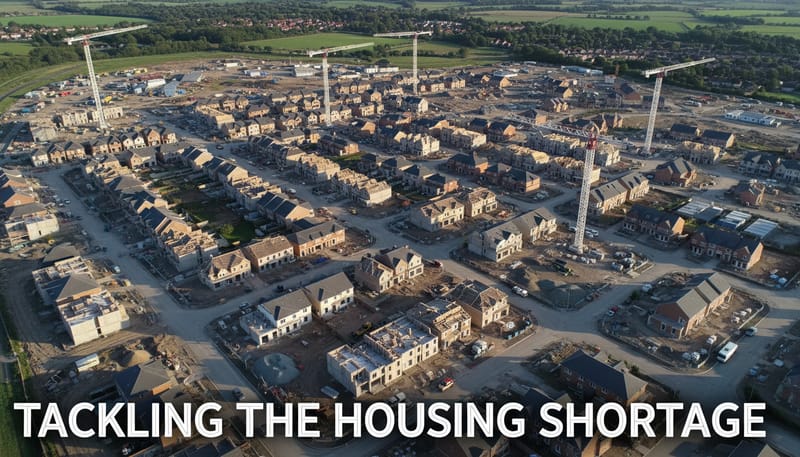
The UK's housing shortage is one of the defining domestic challenges of our era. For more than a generation, the country has consistently built fewer homes than are needed to meet demand, creating a cumulative undersupply that has pushed prices and rents upward, locked out aspiring homeowners and placed immense strain on social housing provision. The gap between housing need and housing delivery has been widely documented: England alone requires an estimated 300,000 or more new homes per year to address both current demand and the historic backlog, yet completions have consistently fallen short of this target, hovering around 200,000 to 240,000 per year in recent years. The challenge is enormous, but the response from the UK's housebuilding industry has been both ambitious and innovative.
Far from being passive observers of the crisis, developers large and small are investing billions of pounds in land acquisition, workforce development, construction technology and community engagement to increase the pace and quality of housing delivery. The largest builders — Barratt Developments, Persimmon, Taylor Wimpey, Bellway and Vistry Group — are maintaining robust pipelines of new developments and working constructively with Government to remove the planning and regulatory barriers that constrain supply. Meanwhile, a resurgent SME builder sector, supported by targeted Government programmes, is adding capacity in the places and at the scales that the largest companies cannot always reach. This article examines the scale of the housing challenge, the strategies developers are deploying to address it and the policy reforms that are enabling faster, better-quality housing delivery across the country.
The Scale of the Challenge: UK Housing Need in Numbers
Understanding the scale of the housing shortage requires looking at both annual need and the accumulated backlog. The Government's target of 300,000 new homes per year in England was established following the Letwin Review and the National Housing Federation's analysis of housing need. This figure accounts not only for projected household formation from population growth, immigration and the trend toward smaller household sizes, but also seeks to address the existing undersupply built up over decades of under-delivery.
The highest level of net additional dwellings in recent years was achieved in 2019/20, when approximately 243,000 new homes were delivered in England. However, the pandemic disrupted delivery in 2020/21, with completions falling to around 216,000. Recovery has been steady but constrained by planning delays, material cost inflation, labour shortages and higher interest rates affecting buyer demand. The Home Builders Federation (HBF) estimates that the sector needs to sustain a completions rate above 250,000 per year to begin making meaningful inroads into the backlog.
New Home Completions in England (thousands)
Planning Approvals: The Critical Bottleneck
The planning system is widely recognised as the single greatest constraint on housing delivery in England. Even developers with the capital, workforce and materials to build more homes cannot do so without planning permission, and securing consent has become an increasingly lengthy, uncertain and costly process. The average time from submitting a major planning application to receiving a decision has risen significantly over the past decade, with some applications taking two years or more to navigate the system.
Local planning authorities (LPAs) face severe resource constraints. Years of budget cuts have reduced planning department staffing to levels that are inadequate for processing the volume and complexity of applications received. A survey by the Royal Town Planning Institute found that 68% of LPAs consider themselves under-resourced, with experienced planners being lost to the private sector or leaving the profession entirely. The result is a system that creates delays even for well-designed, policy-compliant proposals.
The Government has taken several steps to address planning constraints. The Levelling Up and Regeneration Act introduced reforms to streamline the planning process, including a requirement for all local authorities to have an up-to-date Local Plan, a simplified environmental assessment process and new digital planning tools to improve transparency and efficiency. The presumption in favour of sustainable development, enshrined in the National Planning Policy Framework (NPPF), provides an important backstop that supports housing delivery where local plans are absent or out of date.
Developers are also investing in pre-application engagement and community consultation to improve the chances of securing planning permission and reduce the risk of delays and refusals. Many now hold extensive public consultations before submitting applications, using exhibitions, websites and door-to-door surveys to gather community feedback and address concerns proactively. This approach not only improves the quality of applications but also builds local support, making it harder for objectors to characterise developments as unwelcome or poorly considered.
The Land Banking Debate: Myth Versus Reality
One of the most persistent criticisms of volume housebuilders is the accusation of land banking — the claim that developers deliberately sit on large land holdings with planning permission, restricting supply to keep prices high. This narrative has gained political traction but is vigorously disputed by the industry, and the evidence paints a more nuanced picture.
The Letwin Review, commissioned by the Government specifically to investigate whether land banking was constraining housing delivery, found no evidence that major housebuilders were deliberately withholding land from development. Instead, the Review identified the principal constraint as market absorption rates — the speed at which new homes can be sold and occupied in any given location. Building faster than the local market can absorb does not increase delivery; it simply creates unsold stock and destroys value.
What the data shows is that the pipeline between receiving planning permission and completing homes is naturally lengthy, typically three to five years for a large site. This involves discharging planning conditions, completing Section 106 agreements, installing infrastructure (roads, utilities, drainage), preparing the site and then building the homes in phases. At any point, a developer's land bank will show sites at various stages of this pipeline, from newly consented to actively under construction.
Major developers have been transparent about their land positions, with annual reports providing detailed breakdowns of consented plots, plots under construction and plots in the strategic pipeline. The data consistently shows that land banks represent a working inventory necessary to maintain continuous production, not a speculative hoard. To increase delivery, the industry needs not fewer plots in the pipeline but faster passage through the planning system and stronger market conditions to support higher sales rates.
Completions Data: What the Numbers Tell Us
Annual housing completions data provides the clearest measure of the industry's contribution to tackling the housing shortage. While completions have not yet reached the 300,000 target, the trajectory over the past decade has been overwhelmingly positive. The industry has recovered strongly from the financial crisis of 2008-09, which saw completions collapse to below 120,000, and has more than doubled output since that low point.
The major housebuilders collectively deliver approximately 60% of all new homes in England, with the remainder coming from SME builders, housing associations, local authorities and self-build. Barratt Developments remains the largest single producer, consistently delivering over 17,000 homes per year. Persimmon, having refocused on build quality following well-publicised issues in 2018-19, has stabilised output at around 14,000 homes per year with significantly improved customer satisfaction scores. Bellway has been one of the strongest performers in recent years, growing completions from around 8,000 homes in 2015 to over 11,000, demonstrating consistent organic growth.
Vistry Group, formed from the merger of Bovis Homes and Galliford Try Partnerships, has become a major force through its partnerships model, delivering affordable housing through joint ventures with housing associations and local authorities. This model demonstrates that tackling the housing shortage is not solely about building homes for sale; partnership delivery of social, affordable and shared-ownership homes is essential to meeting the full spectrum of housing need.
SME Builders: The Missing Piece of the Puzzle
The decline of the SME housebuilder has been one of the most significant structural changes in the UK housing market over the past three decades. In the late 1980s, small and medium-sized builders — those producing fewer than 500 homes per year — were responsible for approximately 40% of all new home completions. By 2020, that figure had fallen to around 12%. The reasons are multiple: the financial crisis of 2008-09 eliminated many smaller firms, tighter bank lending criteria made it harder to secure development finance, planning costs and complexity disproportionately burden smaller operators, and the regulatory environment has become increasingly demanding.
The loss of SME capacity matters enormously for housing supply. Small builders operate on sites that are too small for the major developers, typically 5 to 50 homes, and they serve markets in smaller towns, villages and rural areas where large-scale development is neither appropriate nor viable. Their output is inherently more diverse, producing homes that are often more architecturally distinctive and responsive to local character. Rebuilding the SME sector is therefore critical to both increasing total housing supply and improving the variety and distribution of new homes across the country.
SME Builder Share of Housing Delivery Over Time
Government programmes to support SME builders have shown positive results. The Levelling Up Home Building Fund provides development finance to small and medium builders, and the Small Sites Fund allocates funding to bring smaller parcels of public land to market. The Federation of Master Builders (FMB) has campaigned effectively for proportionate planning requirements, reduced bureaucratic burden and better access to finance, and there are signs that the SME sector is beginning to recover, with the number of registered builder firms increasing for the first time in over a decade.
SME Impact: The HBF estimates that if SME builder output could be restored to its 1980s share of the market, this alone would add approximately 50,000-60,000 homes per year to England's housing supply — equivalent to roughly one-fifth of the annual target.
Modern Methods of Construction and Delivery Speed
Modern Methods of Construction (MMC) offer the potential to significantly accelerate housing delivery. By manufacturing building components in factory conditions and assembling them rapidly on site, MMC can reduce construction timescales by 30-60% compared to traditional brick-and-block methods. This is a critical advantage in the context of the housing shortage: building the same number of homes in less time effectively increases the industry's capacity without requiring proportionally more labour or land.
Persimmon's Space4 factory in the Midlands produces over 6,000 timber frame panels per year, which are transported to sites across the country for rapid erection. A typical Space4 house can be made weathertight in as little as three days from the arrival of the panels on site, compared to several weeks for a traditional masonry shell. This not only accelerates the programme but also reduces the weather-dependency that is one of the biggest sources of delay in UK housebuilding.
The Government has been a strong advocate for MMC, requiring its use in homes delivered through the Affordable Homes Programme and supporting the development of MMC capacity through grants and loans. Homes England, the Government's housing delivery agency, has invested in partnerships with MMC providers to demonstrate the viability of off-site construction at scale. While the sector has faced challenges — notably the financial difficulties of some early MMC providers — the long-term direction of travel toward greater off-site manufacturing is clear. For more on how MMC is improving quality and speed, see our article on how developers are reducing carbon footprints in new builds, which examines the environmental benefits of factory-built homes.
Affordable Housing Delivery
Affordable housing delivery is a critical component of tackling the housing shortage, and developers play a central role through the planning-led system of Section 106 contributions. Under this system, developments above a certain size are typically required to provide a proportion of homes as affordable housing, either on-site or through commuted sums that fund off-site provision. The proportion varies by local authority but commonly ranges from 20% to 40% of the total number of homes on a development.
Vistry Group has become a specialist in affordable housing delivery through its partnerships division, working with over 50 housing associations and local authorities across England to deliver social rent, affordable rent, shared ownership and First Homes tenure types. The company delivered over 8,000 affordable homes in its most recent financial year, making it one of the largest contributors to the Government's Affordable Homes Programme. This partnership model demonstrates that the private sector and public sector can collaborate effectively to meet the full range of housing needs.
The First Homes scheme, introduced by the Government, requires a proportion of affordable homes on new developments to be offered at a discount of at least 30% to local first-time buyers. This initiative has been welcomed by developers as a mechanism that supports young buyers while maintaining the commercial viability of developments. Taylor Wimpey, Barratt and Bellway have all actively promoted First Homes across their developments, helping first-time buyers onto the property ladder at a time when affordability pressures remain acute.
Workforce Development and Skills
Building 300,000 homes a year requires a skilled workforce large enough to sustain that level of output. The construction sector faces well-documented skills shortages, particularly in trades such as bricklaying, plastering, plumbing, electrical installation and carpentry. An ageing workforce, with a significant proportion of tradespeople expected to retire within the next decade, compounds the challenge.
Developers are investing heavily in training and apprenticeships to build the workforce of the future. Barratt Developments' apprenticeship programme supports over 400 apprentices at any one time across a range of construction trades and professional roles. Taylor Wimpey's training academy provides structured career pathways from apprentice to site manager. The CITB (Construction Industry Training Board) works with developers to fund and coordinate training programmes, with the housebuilding sector contributing over 100 million pounds annually through the Construction Skills Levy. For a detailed look at how developers are investing in skills, see our article on apprenticeships and developer support for local communities.
Strategic Infrastructure Investment
Large-scale housing delivery requires significant infrastructure investment, and developers are increasingly contributing to or directly delivering the roads, schools, healthcare facilities, utilities and public transport connections that new communities need. This infrastructure investment extends far beyond the legal requirements of planning obligations, with many developers adopting a proactive approach to community building that recognises good infrastructure as both a social responsibility and a commercial asset that supports sales and long-term property values.
Urban Extensions and Garden Villages represent the largest-scale infrastructure commitments. Developments such as Beaulieu in Chelmsford (Countryside Partnerships), Ebbsfleet Garden City (multiple developers) and Northstowe in Cambridgeshire (Homes England with various builders) involve thousands of homes alongside new schools, health centres, retail facilities, employment space and transport links. These developments demonstrate the industry's capacity to deliver complete communities when given the scale and certainty that large allocated sites provide.
Developers also fund infrastructure through Section 106 agreements and the Community Infrastructure Levy (CIL). These contributions total billions of pounds annually and fund everything from new primary schools to highway improvements, from GP surgeries to public parks. For a comprehensive analysis of these contributions, see our article on developer contributions to schools, parks and public services.
Regional Delivery and Levelling Up
Housing delivery patterns vary significantly across the country, and developers are playing a key role in the Government's levelling up agenda by investing in regions that have historically received less development activity. The Midlands, Northern England and the South West have seen notable increases in new build delivery, driven by relatively stronger affordability, available land and supportive local planning frameworks.
Looking Ahead: Reaching 300,000 Homes
Reaching the 300,000 homes per year target will require a concerted effort from developers, Government, planning authorities, infrastructure providers and the financial sector. The industry has demonstrated its capacity and willingness to build more homes; what it needs from the policy environment is a planning system that is faster and more predictable, a steady supply of development-ready land, a skilled and available workforce and market conditions that support continued buyer demand.
The signs are encouraging. Planning reform is underway, with a genuine commitment from Government to streamline the system while maintaining design and environmental standards. Investment in infrastructure through the Levelling Up Fund, the Housing Infrastructure Fund and other programmes is unlocking sites that were previously unviable. Skills investment through the CITB, developer-led apprenticeships and MMC adoption is addressing labour constraints. And the diversity of housing delivery — from large-scale urban extensions to SME-built rural developments, from partnership-led affordable housing to build-to-rent — means the industry has multiple routes to increasing output.
For prospective homebuyers, the commitment of the UK's developers to tackling the housing shortage is directly beneficial. Greater supply means more choice, more competitive pricing, better quality and homes in a wider range of locations and price points. Whether you are a first-time buyer seeking an affordable entry point, a growing family needing more space, or a downsizer looking for low-maintenance living, the industry's response to the housing challenge is working in your favour. For guidance on navigating the new build market, see our guide to the advantages of buying a new build home.