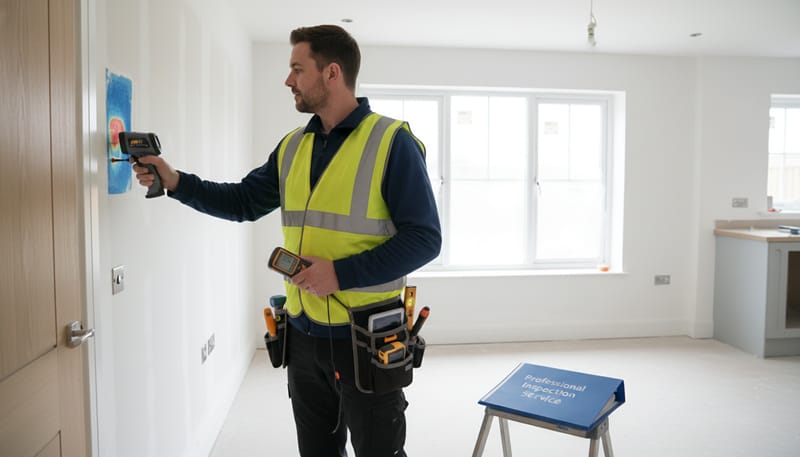
What Exactly Does a Professional Snagger Do?
A professional snagger (sometimes called a snagging inspector or new build inspector) conducts a systematic, room-by-room inspection of your new build property against the developer's specification, building regulations, and NHBC or warranty provider standards.
This is fundamentally different from a homebuyer survey or a building survey. Those assess the general condition and value of a property. A snagging inspection specifically checks whether the builder has finished the job properly — whether every element meets the standard it should.
What They Check
A thorough professional inspection covers:
- Internal finishes — walls, ceilings, paintwork, plastering quality, tile work, grouting, sealant lines, skirting boards, architraves, door hanging, ironmongery function
- Windows and doors — alignment, seals, locking mechanisms, drainage slots, trickle vents, scratch damage, condensation between panes
- Kitchen and bathrooms — worktop joints, unit alignment, soft-close mechanisms, tap flow rates, silicone application, waste drainage speed, extractor function
- Flooring — level checks with a spirit level, squeaks, hollow spots under tiles, threshold strips, underfloor heating responsiveness
- Electrical — socket and switch alignment, consumer unit labelling, smoke and CO detector placement, outdoor lighting, TV/data points
- Plumbing and heating — radiator balance, boiler pressure, hot water temperature, visible pipework, stop cock accessibility
- Loft space — insulation depth and coverage, ventilation, fire stopping at party walls, loft hatch seal
- External — brickwork quality, pointing, DPC visibility, render condition, roof tiles, guttering falls, drainage, driveway finish, fencing, boundary treatments
- Building regulation compliance — cavity tray positions, fire barriers, thermal bridging at lintels and window reveals, ventilation adequacy
The best snagging companies also use specialist equipment: moisture meters to detect damp behind walls, thermal imaging cameras to find insulation gaps, and borescopes to inspect cavities without opening them up.
What They Don't Check
To set expectations correctly, professional snaggers typically do not cover:
- Structural surveys or foundation assessments
- Full electrical testing (that requires a qualified electrician with certification)
- Gas safety checks (these need a Gas Safe registered engineer)
- Drainage CCTV surveys (some offer this as an add-on)
- Land or boundary disputes
- Planning permission compliance
How Much Does Professional Snagging Cost in 2026?
Professional snagging inspections in the UK are priced primarily by property size, with some regional variation. Here's what to expect:
Typical Price Ranges
| Property Type | Bedrooms | Typical Cost |
|---|---|---|
| Flat / apartment | 1-2 bed | £250-£350 |
| Terraced / semi-detached | 2-3 bed | £300-£450 |
| Detached house | 3-4 bed | £400-£550 |
| Large detached / executive | 4-5+ bed | £500-£700 |
| Luxury / bespoke build | 5+ bed | £700-£1,200+ |
What Affects the Price
- Property size — the primary factor; larger properties take longer to inspect
- Number of bathrooms — more wet rooms means more sealant, plumbing, and tiling to check
- Location — London and the South East are typically 10-20% more expensive
- Garage and outbuildings — detached garages or garden rooms may incur a supplement
- Thermal imaging — some companies include it as standard, others charge £50-£150 extra
- Re-inspection — a follow-up visit to check the developer has fixed the original snags typically costs £150-£250
- Urgency — same-week or next-day bookings may attract a premium
Is It Good Value?
Consider this: on a £350,000 new build, a £400 snagging inspection represents just 0.11% of the purchase price. If the inspection identifies a single thermal bridging issue, a missing cavity tray, or inadequate fire stopping — each of which could cost thousands to fix after the warranty period — it has paid for itself many times over.
Even if every defect found is cosmetic, you're getting 50-200 items fixed that the developer would otherwise have ignored. That's the paintwork, the sealant, the scuffed doors, the misaligned sockets — all corrected to the standard you're paying for.
When Should You Book a Snagging Inspection?
Timing is critical. There are three windows, each with distinct advantages and drawbacks.
Option 1: Before Legal Completion (Pre-Completion Inspection)
This is the ideal scenario. You (or your inspector) visit the property after the developer has finished building but before you legally complete the purchase.
- Advantages: Maximum leverage — the developer wants your completion money. Major issues can be addressed as a condition of completion. You can negotiate a retention (a sum held back by your solicitor until defects are fixed).
- Disadvantages: Developers can refuse access. They're not legally obliged to let you or your inspector in before completion. Some developers actively resist pre-completion inspections.
- How to arrange it: Ask your sales advisor and site manager as early as possible — ideally when your completion date is first discussed. Put the request in writing via your solicitor. Frame it as a "pre-completion inspection" rather than a "snagging survey" — developers respond better to the former.
Option 2: On Completion Day
Some buyers book their snagger for the morning of completion day, before picking up the keys.
- Advantages: You own the property (or are about to), so access is guaranteed. You can still flag issues on day one.
- Disadvantages: Tight timing. You've already committed financially, so your leverage is reduced. The developer may not have the site team available to review findings immediately.
Option 3: After Completion (Post-Completion Inspection)
The most common timing in practice. You move in, then book a snagger within the first few weeks or months.
- Advantages: No access issues. You can also identify snags that only appear with use — slow drains, squeaky floors, doors that stick as the house dries out.
- Disadvantages: Reduced leverage. The developer has your money. Repairs are at their convenience, not yours. Some developers drag their feet on post-completion snags.
- Important deadline: Your developer is obligated to fix defects reported within the first two years under NHBC Buildmark (or equivalent warranty). Report everything promptly — don't wait until month 23.
The Best Approach
If the developer allows access, book a pre-completion inspection. If not, book within the first 2-4 weeks of moving in. This gives you time to notice usage-related issues while keeping the urgency high with the developer's aftercare team.
Some buyers book two inspections: one at completion and a follow-up at 6-9 months to catch drying-out defects (shrinkage cracks, sticking doors, nail pops) that wouldn't have been visible on day one.
How to Choose a Professional Snagging Company
The snagging inspection industry is unregulated. Anyone can set up a snagging company, buy a spirit level, and start charging £400 a visit. The quality difference between a good snagger and a poor one is enormous. Here's how to choose well.
1. Check Their Background
The best snagging inspectors have a background in construction — former site managers, building surveyors, construction managers, or building control officers. They understand building regulations, NHBC standards, and what constitutes acceptable workmanship because they've spent years on the other side of the fence.
Ask directly: "What is your inspector's construction background?" If the answer is vague or focused on customer service rather than technical expertise, look elsewhere.
2. Ask About Their Process
A good snagging company should be able to explain exactly how they conduct an inspection. Key questions:
- How long will the inspection take? (For a 3-bed house, expect 2-4 hours. Under 90 minutes is a red flag.)
- Do you inspect the loft space? (Some don't — this is where serious issues often hide.)
- Do you check external areas? (Gutters, drainage, brickwork, fencing, drives.)
- Do you use moisture meters or thermal imaging? (Not essential but a good sign.)
- Do you check against NHBC Standards or just cosmetic finish? (You want both.)
- What happens if I need a re-inspection?
3. Look at Sample Reports
Ask to see a sample report before booking. A quality report should include:
- Individual photographs of every defect (not just a written list)
- Room-by-room organisation
- Clear descriptions that the developer's trades can understand and act on
- Severity ratings or categorisation (cosmetic vs functional vs safety)
- Reference to NHBC standards or building regulations where relevant
- A summary or executive overview for the homeowner
If the sample report is a single-page list of bullet points with no photos, the inspection probably matches.
4. Verify Reviews and Reputation
- Check Google Reviews, Trustpilot, and Checkatrade — look for volume and consistency, not just a perfect score
- Search for the company name plus "review" or "experience" on forums like MumsNet, Reddit, and new build buyer groups on Facebook
- Ask in local new build community groups — homeowners on your development may have already used a snagger and can recommend (or warn against) specific companies
5. Confirm Insurance
Reputable snagging companies carry professional indemnity insurance and public liability insurance. This protects you if the inspector causes damage during the inspection (unlikely but possible) or if they miss a critical defect that later causes you loss.
6. Beware of Developer-Recommended Snaggers
If a developer offers to "arrange" a snagging inspection for you, or recommends a specific company, treat this with extreme caution. A snagger paid for or recommended by the developer has a conflict of interest. Always choose and pay for your own independent inspector.
Red Flags to Watch For
- Inspections completed in under 90 minutes for a house
- No photographs in the report
- Reports delivered more than 48 hours after the inspection
- Inspector cannot explain NHBC tolerances when asked
- No professional indemnity insurance
- Significantly cheaper than competitors (below £200 for a house)
- Unable to provide sample reports
What Does a Snagging Report Look Like?
A professional snagging report is a detailed, photographic record of every defect found during the inspection. Here's what a good one contains:
Report Structure
Most professional reports follow this format:
- Cover page — property address, inspection date, inspector details, weather conditions
- Executive summary — total number of defects, breakdown by severity, key concerns
- Room-by-room defect schedule — each defect numbered, photographed, described, and categorised
- External defect schedule — front, rear, sides, roof (as visible), garden, driveway
- Loft and service areas — insulation, ventilation, fire stopping, tank rooms
- Summary of critical items — issues requiring urgent attention or potential building regulation non-compliance
Example Defect Entry
A typical defect entry in a professional report reads something like:
Item 47 — Master Bedroom, Window Reveal (Left)
Category: Defect — Plasterwork
Severity: Medium
Plaster cracking visible at window reveal junction, left side. Crack measures approximately 3mm wide, extending 200mm vertically. Exceeds NHBC tolerance of 1mm for visible plaster cracking. Likely caused by differential movement at the lintel/reveal junction. Requires cutting out and re-plastering. [Photo attached]
What You Receive
Most companies deliver the report as a PDF document within 24-48 hours of the inspection. Some also provide:
- An online portal where you can track which defects have been reported to the developer and which have been resolved
- A condensed version formatted specifically for sending to the developer's aftercare team
- Recommendations for items to monitor over the coming months (drying-out related issues)
What Happens After the Inspection?
Having the report is only half the job. Here's the process for getting defects fixed:
Step 1: Review the Report
Go through the report with the inspector's findings. Understand which items are cosmetic (paint touch-ups, minor scratches), which are functional (stiff mechanisms, slow drains), and which are serious (structural cracks, missing fire stopping, damp).
Step 2: Submit to the Developer
Send the full report to the developer's aftercare or customer care department. Most developers prefer email with the PDF attached. Some have their own online reporting portals — use both if available. Keep proof of submission.
Include a cover letter stating:
- Your name and plot/address
- The date of inspection
- The total number of defects found
- A request for a response within 14 days with a proposed repair schedule
- A note that you expect all items to be rectified within the 2-year builder defect period
Step 3: Chase and Document
Developers vary hugely in their responsiveness. Some excellent aftercare teams will schedule repairs within 2-4 weeks. Others will delay, dispute, and require multiple follow-ups.
Keep a log of every communication. If the developer fails to respond within 14 days, escalate to the site manager and then the regional managing director. If the developer continues to ignore you, contact your warranty provider (NHBC, LABC, etc.) to initiate a complaint or resolution process.
For a detailed guide on escalation, see our complete snagging guide.
Step 4: Re-Inspection
Once the developer claims to have completed repairs, consider booking a re-inspection. This costs £150-£250 and verifies that defects have actually been fixed properly — not just patched over. Some snagging companies offer discounted re-inspections if you used them for the initial survey.
DIY Snagging vs Professional: The Honest Comparison
Can you snag your own home? Absolutely. Should you rely solely on DIY snagging? That depends on your situation.
What DIY Snagging Can Catch
- Cosmetic defects — scratches, paint runs, scuffed skirting boards, poor grouting
- Obvious functional issues — stiff door handles, squeaky floors, slow-draining sinks
- Visible finish problems — misaligned sockets, uneven tile spacing, poor sealant lines
- Operational issues — extractor fans not working, heating not responding, windows not locking
What DIY Snagging Typically Misses
- Loft defects — most buyers don't climb into the loft or know what to look for. Missing fire stopping, insufficient insulation depth, blocked ventilation — these are common and invisible from below.
- External issues at height — roof tile alignment, flashing condition, gutter falls, mortar quality on upper floors
- Hidden damp — moisture behind walls that hasn't yet caused visible damage; needs a moisture meter to detect
- Thermal defects — cold bridging at lintels, window reveals, and wall ties that cause condensation problems in winter; needs thermal imaging
- NHBC tolerance failures — a 3mm floor deviation might look level to your eye but fails the NHBC 5mm-in-2m tolerance; a professional uses a 2-metre straight edge
- Plumbing issues — inadequate pipe support, missing isolation valves, incorrect waste connections that won't be apparent until something leaks
- Building regulation non-compliance — cavity tray positions, fire barriers, ventilation rates, electrical regulations — you'd need construction knowledge to spot these
Head-to-Head Comparison
| Factor | DIY Snagging | Professional Snagging |
|---|---|---|
| Cost | Free | £300-£600 |
| Time required | 4-8 hours (learning + inspection) | 2-4 hours (they handle everything) |
| Defects typically found | 20-50 (mostly cosmetic) | 50-200+ (cosmetic, functional, structural) |
| Hidden defects (loft, damp, thermal) | Usually missed | Included as standard |
| Knowledge of NHBC tolerances | Requires research | Professional expertise |
| Photographic evidence | Your phone photos | Professional report with numbered photos |
| Developer takes seriously | Sometimes disputed | Harder to dismiss a professional report |
| Building reg compliance checks | Not possible without training | Standard for good inspectors |
| Equipment (moisture meter, thermal camera) | Not usually available | Professional-grade tools |
| Re-inspection service | You do it again yourself | Discounted follow-up visits |
The Practical Recommendation
The best approach for most buyers is both. Use a professional snagger for the comprehensive technical inspection, and then continue doing your own DIY snagging over the first few months as you live in the property. You'll notice different things through daily use — the door that swells when it rains, the extractor that's too weak, the radiator that never gets warm — that even a professional can't catch in a single visit.
If budget is tight, prioritise a professional inspection for detached or semi-detached houses (more external areas, more to go wrong) and higher-value properties. For a small apartment where you can see every surface yourself, DIY snagging with a thorough room-by-room checklist may be sufficient — but you'll still miss loft and hidden issues.
When Is a Professional Snagger Definitely Worth It?
Some situations make professional snagging a no-brainer:
- Detached houses — more external area, more roof to inspect, more things to go wrong
- Properties over £300,000 — the inspection cost is negligible relative to the purchase price
- Off-plan purchases — you haven't seen the property being built, so you don't know the quality of workmanship
- Developer with poor aftercare reputation — check the HBF star rating. A 3-star developer needs more scrutiny than a 5-star one
- First-time buyers — without experience of previous home purchases, you're less likely to spot issues
- Properties bought with Help to Buy or shared ownership — you own a stake and you're responsible for maintenance; undetected defects become your problem
- Complex builds — timber frame, steel frame, basements, flat roofs, or properties with integrated garages have more potential failure points
- If the developer refused a pre-completion inspection — if they didn't want you looking before completion, you definitely want someone looking after completion
When You Might Skip Professional Snagging
There are a few situations where DIY might be sufficient:
- A small 1-2 bed apartment from a developer with an excellent aftercare track record
- You have genuine construction experience yourself (not just DIY enthusiasm — actual trade or surveying background)
- You're buying a show home where the finish has already been scrutinised extensively
- The developer proactively offers a comprehensive accompanied snagging walkthrough with the site manager and agrees to fix everything identified in writing
Even in these cases, if the property is over £250,000, the £300-£400 inspection cost is hard to argue against.
Questions to Ask Before Booking
Use these questions when comparing snagging companies:
- What is your inspector's construction background? (Former site manager, building surveyor, or building control officer are ideal.)
- How long will the inspection take for my property size?
- Do you inspect the loft space and external areas?
- Do you use moisture meters and/or thermal imaging?
- Can I see a sample report?
- How soon will I receive the report after the inspection?
- Is the report photographically evidenced with defect-by-defect images?
- Do you categorise defects by severity?
- Do you reference NHBC standards in the report?
- What does a re-inspection cost if I need one?
- Do you carry professional indemnity insurance?
- Are you independent of any developers? (The answer must be yes.)
Any company that can't confidently answer all twelve of these questions isn't worth your money.
How to Prepare for the Inspection
On inspection day, a few simple preparations help the snagger do a thorough job:
- Ensure all utilities are on — heating, hot water, electrics. The inspector needs to test these.
- Turn on the heating for at least an hour beforehand — this allows the inspector to check radiator performance and thermostat response
- Clear access to the loft hatch — don't stack boxes underneath it
- Make sure all rooms are accessible — unlock any secondary locks, especially on garages and garden rooms
- Run all taps for a few minutes beforehand — this primes the system and highlights any air locks
- Share your specification — if you have the developer's original specification or brochure, give a copy to the inspector so they can check what was promised versus what was delivered
- Note your own concerns — write down anything you've already noticed so the inspector can give a professional opinion on whether it's a genuine defect or within tolerance
The Developer's Response: What to Expect
Developers' responses to professional snagging reports range from excellent to obstructive. Here's a realistic picture:
Best Case
A developer with a strong aftercare team will acknowledge the report within a week, schedule a walkthrough to review the findings, and arrange trades to complete repairs within 4-8 weeks. The best developers fix items in batches — painters for cosmetic work, plumbers for plumbing items, electricians for electrical issues — to minimise disruption.
Common Reality
Many developers will dispute some items, classifying them as "within tolerance" or "not a defect." This is where a professional report with NHBC tolerance references becomes invaluable — it's harder to dismiss a defect when the report cites the exact standard it fails.
Expect 2-3 rounds of communication. The developer fixes the obvious items first, then you push back on the disputed ones. A professional snagging company can advise on which items are genuinely within tolerance and which the developer is trying to avoid fixing.
Worst Case
Some developers ignore reports entirely or make token repairs. If this happens:
- Escalate in writing to the regional managing director (name them specifically)
- Contact the NHBC (or your warranty provider) to open a complaint under the builder warranty
- Report the developer to the New Homes Quality Board (NHQB) if they are a registered developer
- Leave factual reviews on Trustpilot, Google, and the HBF annual survey
- Consider your warranty claims process for defects the developer refuses to fix
Key Takeaways
- Professional snagging inspections cost £300-£600 and typically find 50-200+ defects — most of which you'd never spot yourself
- Book pre-completion if the developer allows access; otherwise within the first 2-4 weeks of moving in
- Choose an inspector with a construction background, check sample reports, and verify they carry professional indemnity insurance
- Never use a developer-recommended snagger — independence is non-negotiable
- The best approach is professional inspection plus ongoing DIY snagging as you live in the property
- A professional report carries significantly more weight with developers than a handwritten list
- For a comprehensive list of what to look for, see our 50 most common snagging issues guide
- If you prefer to inspect yourself, use our room-by-room DIY snagging checklist