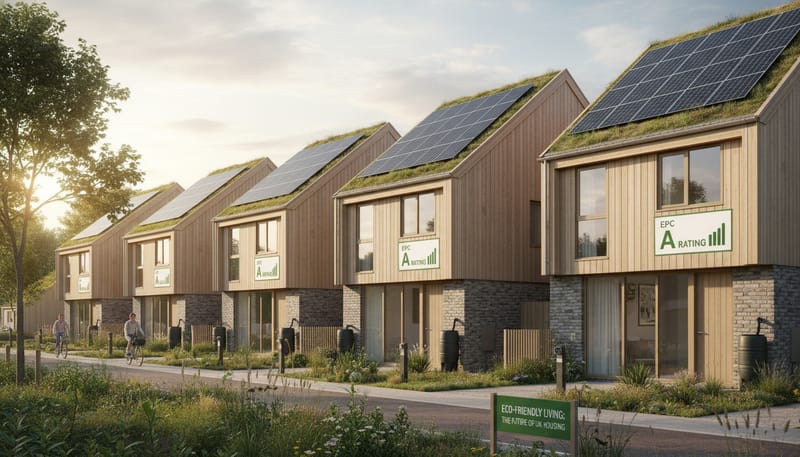
The UK new build housing market is undergoing its most significant transformation in a generation. Driven by the impending Future Homes Standard, net-zero carbon commitments, and a seismic shift in buyer expectations, sustainability has moved from a niche marketing feature to the central pillar of how new homes are designed, built, and sold. In 2026, every major housebuilder in the country has a published sustainability strategy, EPC ratings have become a genuine differentiator in the sales process, and the regulatory framework is tightening at a pace that would have seemed unimaginable just five years ago. The homes being built today look fundamentally different from those constructed even in 2020 — not just in their energy performance, but in the materials used, the technologies installed, and the way entire developments are planned around ecological and environmental considerations.
For buyers, this transformation presents both opportunities and challenges. On one hand, new build homes are more energy-efficient, cheaper to run, and better for the environment than at any point in history. On the other, these improvements come at a cost — and that cost is ultimately reflected in purchase prices. Understanding how sustainability trends are shaping the new build market is essential for anyone considering buying a new home in 2025-2026, whether you are a first-time buyer looking for low running costs, an investor assessing long-term value, or an environmentally conscious homeowner who wants to minimise your carbon footprint. This comprehensive guide examines every major sustainability trend affecting the UK new build sector, from regulatory changes and building materials to buyer behaviour and the green premium debate.
The Future Homes Standard: What It Means for New Builds
The Future Homes Standard (FHS) is the single most consequential piece of regulation affecting the new build housing market in the UK. Announced by the government in 2019 and confirmed through subsequent consultations, the FHS mandates that all new homes built from 2025 onwards must produce at least 75-80% fewer carbon emissions than those built under the previous Part L (2013) regulations. In practical terms, this means new homes must be built with exceptionally high levels of insulation, airtightness, and energy efficiency, and must be heated using low-carbon technologies rather than traditional gas boilers.
The interim uplift to Part L of the Building Regulations, which came into effect in June 2022, required a 31% reduction in carbon emissions compared to the 2013 standard. The full Future Homes Standard, which took effect for all new planning applications from late 2025, goes dramatically further. The key technical requirements include:
The implications for developers are profound. The FHS effectively bans gas boilers in new homes, requiring instead the use of air source heat pumps (ASHPs), ground source heat pumps (GSHPs), or heat networks. It mandates significantly improved fabric performance — thicker walls, better insulation, reduced thermal bridging, and much higher levels of airtightness. And it requires consideration of overheating risk, with mechanical ventilation with heat recovery (MVHR) systems becoming increasingly standard.
For buyers, the FHS means that any new build home purchased from 2026 onwards will be built to a dramatically higher energy efficiency standard than homes built even three or four years ago. This translates into lower energy bills, greater comfort, and a home that is more resilient to future energy price shocks. However, it also means higher construction costs, which are inevitably passed through to purchase prices. We examine this cost impact in detail later in this article, and in our companion piece on construction costs and how they affect new build prices.
Zero-Carbon Homes: Where Are We Now?
The concept of zero-carbon homes has been discussed in UK housing policy for over two decades. The original Code for Sustainable Homes, introduced in 2006, set a pathway to zero-carbon new homes by 2016 — a target that was ultimately abandoned by the government in 2015. A decade later, the aspiration has returned with renewed urgency, driven by the UK's legally binding commitment under the Climate Change Act to achieve net-zero greenhouse gas emissions by 2050.
In 2026, there is an important distinction between operationally zero-carbon homes (homes that produce zero carbon emissions in day-to-day operation through highly efficient fabric and renewable energy generation) and whole-life zero-carbon homes (which also account for the carbon embodied in construction materials, the building process, and eventual demolition). The Future Homes Standard focuses primarily on operational carbon, but the industry is increasingly engaging with whole-life carbon considerations.
Key Fact: Operational vs Embodied Carbon
For a typical new build home, approximately 60-70% of its total lifetime carbon footprint comes from operational energy use (heating, hot water, lighting, appliances), while 30-40% comes from embodied carbon — the emissions associated with manufacturing and transporting building materials, on-site construction, maintenance, and end-of-life demolition. As operational emissions are driven down by the FHS, embodied carbon becomes a proportionally larger share and is receiving increasing regulatory and industry attention.
Several developments are pushing the industry towards genuinely zero-carbon new builds:
| Initiative | Status (2026) | Impact |
|---|---|---|
| Future Homes Standard | In force for new applications | 75-80% operational carbon reduction |
| Part Z (Embodied Carbon) | Under consultation | Would mandate whole-life carbon assessments |
| UKGBC Net Zero Carbon Buildings Framework | Voluntary, widely adopted | Provides definitions and verification pathways |
| LETI Climate Emergency Design Guide | Influential industry guidance | Sets targets for operational and embodied carbon |
| Passivhaus certification | Growing adoption by niche builders | Ultra-low energy demand (<15 kWh/m²/yr) |
Notable pioneer projects include the Springfield Meadows development in Oxfordshire (often cited as the UK's first net-zero carbon housing development), Etopia Homes' modular zero-carbon houses, and large-scale urban developments like the Stirling Prize-nominated Goldsmith Street in Norwich (Passivhaus standard social housing). However, it is important to acknowledge that truly zero-carbon new builds remain a small fraction of total output. The vast majority of new homes built in 2025-2026 will be compliant with the FHS — a massive improvement on previous standards — but will not achieve full operational or whole-life zero-carbon status.
Green Building Materials: What Is Changing
The materials used to build new homes are changing rapidly, driven by a combination of regulatory pressure, supply chain considerations, cost dynamics, and growing awareness of embodied carbon. While traditional masonry construction (brick and block) remains dominant in the UK — accounting for approximately 70-75% of new homes by volume — alternative materials and construction methods are gaining significant ground.
Key Material Trends in 2026
Timber Frame Construction
Timber frame now accounts for approximately 28% of new homes in England and over 80% in Scotland. Timber is a natural carbon store — a typical timber frame house sequesters around 20-25 tonnes of CO2, compared to the 40-50 tonnes of CO2 emitted in manufacturing the equivalent amount of concrete and steel. Cross-laminated timber (CLT) is increasingly used for mid-rise apartment buildings, with several UK projects now reaching 8-10 storeys.
Low-Carbon Concrete
Concrete production accounts for approximately 8% of global CO2 emissions. The UK construction industry is actively transitioning to lower-carbon alternatives, including ground granulated blast-furnace slag (GGBS) blends, fly ash substitution, and emerging technologies like CarbonCure (which injects CO2 into concrete during mixing). Several major developers now specify a minimum 30-50% cement replacement in their standard concrete mixes.
Modern Methods of Construction (MMC)
Factory-built modular and panelised homes produce up to 67% less waste on site compared to traditional construction, according to WRAP data. MMC also enables tighter quality control on insulation and airtightness, supporting compliance with the FHS. While still accounting for under 10% of new builds, MMC is growing rapidly, supported by government procurement mandates for affordable housing.
Recycled and Bio-Based Insulation
Traditional mineral wool and rigid foam insulation is increasingly being supplemented or replaced by materials with lower embodied carbon: sheep's wool, hemp, wood fibre, cellulose (recycled newspaper), and recycled plastic insulation products. While these materials often cost 15-30% more than conventional alternatives, their carbon credentials and performance characteristics are driving adoption, particularly among premium and sustainability-focused developers.
Embodied Carbon Comparison: Construction Systems
| Construction System | Embodied Carbon (kgCO2e/m²) | Relative Rating |
|---|---|---|
| Traditional brick and block | 500-700 | Moderate-High |
| Steel frame with cladding | 600-800 | High |
| Timber frame | 300-450 | Low-Moderate |
| Cross-laminated timber (CLT) | 250-400 | Low |
| Structural Insulated Panels (SIPs) | 280-420 | Low |
| Passivhaus-certified timber | 200-350 | Very Low |
These figures are indicative and vary based on specific design choices, but the trend is clear: timber-based and off-site manufactured systems offer significantly lower embodied carbon than traditional masonry or steel construction. As whole-life carbon assessments become more common (and potentially mandatory under a future Part Z regulation), this advantage will become increasingly commercially relevant.
EPC Ratings: The New Build Advantage
Energy Performance Certificates (EPCs) have moved from a bureaucratic formality to a genuine factor in buying decisions and property valuations. New build homes overwhelmingly achieve EPC ratings of A or B, placing them in a fundamentally different category from the existing housing stock, where the average rating is D.
EPC Distribution: New Builds vs Existing Stock
New Build Homes (2025)
Existing Housing Stock
The data is stark. While 94% of new build homes achieve an EPC rating of A or B, only 5% of existing homes reach the same standard. This gap is widening as new build standards improve, and it has significant financial implications.
The EPC Price Premium
Research by the Department for Energy Security and Net Zero (DESNZ), building on earlier DECC studies, indicates that homes with an EPC rating of A or B command a price premium of approximately 5-8% over equivalent homes rated D. For a home valued at £350,000, this translates to a premium of £17,500-£28,000. Crucially, this premium appears to be growing over time as energy costs rise and buyer awareness of EPCs increases. A 2025 RICS survey found that 73% of buyers now consider EPC ratings "important" or "very important" in their purchase decision, up from 54% in 2021.
Energy Cost Savings: The Running Cost Advantage
The practical benefit of a high EPC rating is most tangible in energy bills. Based on typical energy consumption data from the Standard Assessment Procedure (SAP) and current energy prices (as of the January 2026 Ofgem price cap), the annual energy cost differences are significant:
| EPC Rating | Typical Annual Energy Cost (3-bed semi) | Annual Saving vs EPC D |
|---|---|---|
| EPC A (SAP 92+) | £620-£780 | £1,120-£1,480 |
| EPC B (SAP 81-91) | £820-£1,050 | £850-£1,080 |
| EPC C (SAP 69-80) | £1,250-£1,500 | £400-£600 |
| EPC D (SAP 55-68) | £1,800-£2,100 | Baseline |
A new build home rated EPC A can save its occupants over £1,000 per year in energy costs compared to a typical EPC D older home. Over a 25-year mortgage term, that represents cumulative savings of £25,000-£37,000 — a figure that goes a significant way towards justifying the new build price premium. For a more detailed analysis of running costs, see our guide to new build energy efficiency and how much you can save.
Heat Pumps: The Centrepiece of Low-Carbon Heating
The transition from gas boilers to heat pumps is the single most visible change in new build home technology under the Future Homes Standard. Air source heat pumps (ASHPs) have become the default heating system for new builds in 2026, with ground source heat pumps (GSHPs) and communal heat networks used in specific applications.
For new build buyers, the heat pump transition is largely seamless — homes are designed from the outset with appropriately sized radiators (or underfloor heating), good insulation, and hot water cylinders suited to heat pump operation. The key considerations for buyers include:
What New Build Buyers Should Know About Heat Pumps
- Running costs are comparable to or lower than gas — at current energy prices and typical ASHP efficiencies, heating a well-insulated new build with a heat pump costs roughly the same as gas, and often less. As electricity prices are expected to fall relative to gas over time (driven by renewable energy growth), the economics will improve further.
- Heat pumps work differently to boilers — they operate most efficiently at lower flow temperatures, heating the home gradually rather than providing rapid blasts of heat. New builds are designed for this, with larger radiators and excellent insulation ensuring comfort.
- External units are compact and quiet — modern ASHPs are significantly quieter than older models, typically generating around 40-45 dB at 1 metre (comparable to a refrigerator). They require an external unit, usually positioned at the side or rear of the property.
- Smart controls are standard — most new build heat pump installations come with smart thermostats and zoning capabilities, allowing precise control of temperatures in different rooms and time-based scheduling.
- Maintenance costs are low — heat pumps have fewer moving parts than gas boilers and typically require only an annual service. Expected lifespan is 20-25 years, compared to 12-15 years for a gas boiler.
Solar Panels and Battery Storage: The Energy Independence Trend
Solar photovoltaic (PV) panels are becoming an increasingly common feature on new build homes, driven by both the Future Homes Standard (which favours renewable generation to meet carbon reduction targets) and buyer demand for lower energy bills and greater energy independence.
Data from the Microgeneration Certification Scheme (MCS) and NHBC shows that approximately 45% of new build homes completed in 2025 included solar PV panels as standard, up from around 20% in 2022. Under the FHS, this proportion is expected to rise to 60-70% for homes completed from 2026 onwards, as developers use solar generation to offset residual carbon emissions and meet the tighter performance targets.
| Typical Specification | 3-Bed Semi | 4-Bed Detached |
|---|---|---|
| Solar PV system size | 3.0-4.0 kWp | 4.0-6.0 kWp |
| Annual generation | 2,700-3,600 kWh | 3,600-5,400 kWh |
| Annual bill savings (without battery) | £350-£500 | £500-£750 |
| Annual bill savings (with battery) | £550-£750 | £750-£1,100 |
| Smart Export Guarantee income | £80-£150/yr | £120-£250/yr |
Battery storage is the natural companion to solar PV, enabling homeowners to store excess generation for use in the evening when electricity prices are highest. While battery storage is not yet standard on most new build developments, it is increasingly offered as an optional upgrade — typically at a cost of £3,000-£5,000 for a 5-10 kWh system. Several forward-thinking developers, including Barratt and Berkeley, now offer battery storage packages on selected developments.
Buyer Willingness to Pay a Green Premium
One of the most critical questions for the new build market is whether buyers are willing to pay more for sustainable homes. The evidence increasingly suggests that they are — but the picture is nuanced.
Survey Evidence on Green Willingness to Pay
| Source | Finding | Year |
|---|---|---|
| NHBC Foundation | 68% of buyers willing to pay extra for energy-efficient features; average willingness: £5,000-£10,000 | 2025 |
| RICS Residential Market Survey | 73% consider EPC ratings important or very important in purchase decision | 2025 |
| Savills Buyer Sentiment Survey | 54% willing to pay a 5%+ premium for a zero-carbon home; 22% willing to pay 10%+ | 2025 |
| Halifax Green Homes Index | EPC A-B homes sell for 6.3% more on average than equivalent EPC D homes | 2025 |
| Knight Frank Sustainability Report | 81% of under-35 buyers rate sustainability as "important" vs 58% of over-55s | 2025 |
The data reveals a generational divide: younger buyers (particularly millennials and Gen Z) place significantly higher value on sustainability features than older cohorts. This is both a values-driven trend and a practical one — younger buyers are more likely to be first-time buyers who will live in the home for many years, making running cost savings more relevant. They are also more likely to have grown up with climate change awareness as a background fact of life, rather than a recently acquired concern.
The Affordability Tension
While willingness to pay for sustainability is growing, it exists in tension with affordability constraints. Many buyers, particularly first-time buyers, are already stretched to their maximum budget. Research by the Home Builders Federation (HBF) suggests that sustainability-related costs add approximately £10,000-£20,000 to the cost of building a typical new home under the FHS compared to the previous Part L standard. Whether the market can absorb these costs — through higher prices, compressed developer margins, or a combination — is one of the key structural questions facing the industry. For more on how construction costs flow through to prices, see our analysis of construction costs and new build prices.
Water Efficiency and Sustainable Drainage
Water efficiency is an increasingly important but often overlooked dimension of new build sustainability. The UK faces growing water stress, particularly in the South East and East of England, where demand is projected to exceed supply by the 2040s without intervention. New build homes are subject to increasingly stringent water efficiency standards.
Under current Building Regulations, new homes must meet a maximum water consumption target of 125 litres per person per day. However, many local planning authorities in water-stressed areas impose tighter targets of 110 litres per person per day through planning conditions, and the government has consulted on making this the national standard. To meet these targets, new builds typically incorporate:
- Low-flow taps and showers — aerated shower heads delivering 8 litres/minute vs 12-15 litres/minute for standard fittings
- Dual-flush toilets — 4/2.6 litre flush volumes vs 6+ litres for older models
- Flow restrictors — fitted to basin taps to reduce flow to 5-6 litres/minute
- Water-efficient appliances — specifications requiring dishwashers and washing machines meeting minimum efficiency standards
- Rainwater harvesting — increasingly common on larger developments, using collected rainwater for garden irrigation and toilet flushing
Sustainable Drainage Systems (SuDS) are another critical element of new build sustainability that goes beyond individual homes. SuDS are designed to manage surface water runoff from developments in a way that mimics natural drainage patterns, reducing flood risk, filtering pollutants, and enhancing biodiversity. Under Schedule 3 of the Flood and Water Management Act 2010 (now being implemented), SuDS are becoming mandatory for most new developments. Common SuDS features on new build estates include permeable paving, swales, detention basins, rain gardens, and constructed wetlands.
Biodiversity Net Gain: The 10% Requirement
Since February 2024, all major planning applications in England have been required to deliver a minimum 10% biodiversity net gain (BNG) — meaning that developments must leave biodiversity in a measurably better state than before construction. This requirement, introduced under the Environment Act 2021, has significant implications for new build developments.
In practice, BNG is changing the way developments are designed and landscaped. Common measures include:
Native Planting
Developments are specifying native wildflower meadows, hedgerows, and tree planting instead of ornamental landscaping, supporting local wildlife and pollinators.
Integrated Wildlife Features
Bird boxes, bat boxes, hedgehog highways (small gaps in fences allowing hedgehog passage), and insect hotels are being built into the fabric of developments.
Off-Site BNG Credits
Where 10% cannot be achieved on site, developers can purchase biodiversity credits to fund habitat creation elsewhere. The statutory credit price is £42,000 per biodiversity unit — creating a financial incentive to maximise on-site provision.
Green Infrastructure
Open spaces, community orchards, pocket parks, and ecological corridors are being integrated into masterplans, creating more attractive and liveable developments while meeting BNG obligations.
For buyers, BNG means that new build developments built from 2024 onwards should offer noticeably greener, more biodiverse environments than older estates. This is a genuine quality-of-life benefit that is not captured in EPC ratings or SAP calculations, but which research consistently shows contributes to mental health, wellbeing, and community satisfaction.
Electric Vehicle Charging: Future-Proofing New Builds
Since June 2022, Building Regulations have required all new homes with associated parking to have an electric vehicle (EV) charge point installed. This regulation reflects the UK government's ban on the sale of new petrol and diesel cars from 2035 (with all new cars required to be fully zero emission by 2035 under the ZEV mandate) and the rapidly growing adoption of EVs.
For new build buyers, having an EV charger pre-installed is a significant convenience and cost saving. Retrofitting a charge point to an existing home typically costs £800-£1,500, and may require electrical upgrades to the consumer unit. Having this infrastructure already in place future-proofs the property and adds to its resale value. With EV adoption accelerating rapidly — pure battery EVs accounted for 22.1% of new car registrations in 2025, up from 16.5% in 2023 — an EV charger is increasingly seen as essential infrastructure rather than a luxury feature.
Developer Sustainability Strategies: How the Big Builders Are Responding
Every major UK housebuilder has published a sustainability strategy, but the ambition, scope, and credibility of these strategies vary considerably. Here is a summary of how the largest developers are positioning themselves:
| Developer | Key Sustainability Commitments | Notable Initiatives |
|---|---|---|
| Barratt Redrow | Net zero operational carbon by 2030; Science Based Targets initiative member | Z House prototype; 50% timber frame target; extensive BNG programme |
| Taylor Wimpey | Science Based Targets; 36% scope 1&2 reduction by 2030 | Project 2025 for FHS-compliant design; supply chain carbon reduction programme |
| Persimmon | Carbon reduction roadmap; 100% FHS compliance ahead of schedule | Futureproofed house type range; expanded timber frame programme |
| Berkeley Group | Net zero by 2030; most ambitious embodied carbon targets | Whole-life carbon assessments on all developments; circular economy strategy; urban ecology focus |
| Bellway | 50% Scope 1&2 reduction by 2030; TCFD reporting | Green procurement strategy; 100% responsibly sourced timber |
| Vistry Group | Net zero by 2035; partnership-focused model emphasising affordable housing | MMC investment; community energy schemes; social value framework |
Berkeley Group stands out as the most ambitious on embodied carbon, already conducting whole-life carbon assessments on all developments and setting targets to reduce embodied carbon by 40% by 2030. Barratt Redrow's Z House prototype — a concept home designed to be net zero in operation — has attracted widespread attention as a demonstration of what the near future of housebuilding could look like, featuring an ASHP, solar PV, battery storage, MVHR, triple glazing, and a timber frame structure.
Green Mortgages: Financial Incentives for Sustainable Homes
A growing number of lenders are offering "green mortgages" — products that provide preferential terms (typically a lower interest rate or cashback) for properties that meet certain energy efficiency criteria. The rationale is that energy-efficient homes carry lower default risk (because occupants have lower running costs and therefore more disposable income for mortgage payments) and that lenders want to support the transition to net zero.
| Lender | Green Mortgage Offer | Eligibility |
|---|---|---|
| Nationwide | 0.10% rate discount on Green Additional Borrowing | EPC A or B properties |
| Barclays | Up to £2,000 cashback on Green Home Mortgage | EPC A or B; new build or energy-improved homes |
| NatWest | Discounted fixed rates for energy-efficient homes | EPC A-C properties |
| Halifax/Lloyds | £500 cashback on energy-efficient properties | EPC A or B |
| Ecology Building Society | Discounted rates for Passivhaus and zero-carbon homes | Verified sustainable construction |
While the financial benefits of green mortgages are currently modest (typically saving £500-£2,000 over the term), the market is expected to develop significantly as regulatory pressure on lenders to reduce the carbon intensity of their loan books increases. The Bank of England's climate stress testing and the Task Force on Climate-related Financial Disclosures (TCFD) requirements are pushing all major lenders to consider climate risk in their mortgage portfolios. For a broader look at mortgage options, see our guide to the best mortgage rates for new build homes.
The Cost of Sustainability: Impact on New Build Prices
The sustainability improvements described in this article do not come free. The additional costs of building to the Future Homes Standard, installing heat pumps, fitting solar panels, achieving high airtightness, and meeting BNG requirements all contribute to higher construction costs, which are ultimately reflected in purchase prices.
Additional Cost per Home (FHS vs Old Part L)
The HBF estimates that the total additional construction cost of FHS compliance is approximately £15,000-£25,000 per home, depending on the type and size of property. This represents a 5-8% increase in build costs for a typical home. How much of this cost is passed through to buyers (as opposed to absorbed through lower land values or reduced developer margins) varies by market conditions, but industry analysis suggests that the majority is ultimately reflected in higher selling prices.
However, it is essential to view these costs alongside the benefits. Over a 25-year period, the energy cost savings alone (typically £800-£1,200 per year) substantially offset the additional purchase price. When lower maintenance costs, the EPC price premium on resale, and potential green mortgage benefits are also factored in, the total cost of ownership of a sustainable new build is increasingly competitive with — and in many cases lower than — that of an equivalent older property. For a full analysis of how construction costs flow through to prices, see our dedicated article on construction costs and new build prices.
Frequently Asked Questions
Are all new build homes now built without gas boilers?
Under the Future Homes Standard, which applies to new planning applications from late 2025, homes must use low-carbon heating — typically air source heat pumps. However, homes that received planning permission before this date may still be built with gas boilers, so some new builds completing in 2026-2027 may still have gas heating. Always check the specification before purchasing.
Will a more sustainable new build cost me more to buy?
Yes, sustainability features do add to the purchase price — typically £15,000-£25,000 compared to a home built under previous standards. However, this is offset by significantly lower energy bills (saving £800-£1,200/year), a higher resale value (EPC A/B homes sell for 5-8% more), and potential green mortgage benefits.
How noisy are heat pumps? Will they disturb my neighbours?
Modern air source heat pumps operate at approximately 40-45 dB at one metre — comparable to a domestic refrigerator. They are designed to meet strict noise regulations, and developers position them carefully to minimise impact. Most homeowners report that they are barely noticeable during normal operation.
What EPC rating should I expect from a new build in 2026?
The vast majority of new builds completed in 2026 will achieve an EPC rating of A or B. Homes built under the full Future Homes Standard should comfortably achieve EPC A in most cases. If a new build is rated C or below, this would be unusual and worth questioning.
Do I need to buy an electric car to use the EV charger?
No. The EV charger is installed as standard infrastructure and can be used whenever you are ready. If you do not currently drive an EV, the charger simply sits unused at no ongoing cost. It future-proofs your home and adds value when you come to sell.
What is biodiversity net gain and how does it affect me as a buyer?
Biodiversity net gain (BNG) requires developments to leave biodiversity in a better state than before construction — a minimum 10% improvement. For buyers, this means new developments should feature more native planting, wildlife habitats, and green spaces than older estates. It creates more attractive, nature-rich environments to live in.
Conclusion: Sustainability Is No Longer Optional
The sustainability transformation of the UK new build housing market is now irreversible. The Future Homes Standard, biodiversity net gain, EV charging mandates, water efficiency requirements, and growing buyer expectations have collectively moved sustainability from a marketing differentiator to a fundamental requirement. For buyers, this is overwhelmingly positive news — the homes being built in 2026 are dramatically better in energy performance, environmental impact, and long-term running costs than anything built even five years ago.
The challenge lies in cost. Sustainability improvements add £15,000-£25,000 to the construction cost of a typical home, and these costs are largely passed through to buyers in the form of higher prices. In a market where affordability is already stretched for many, this creates a tension that policymakers, developers, and lenders are all grappling with. Green mortgages, targeted incentives, and innovation in construction methods (particularly MMC) offer potential pathways to managing this tension, but there is no avoiding the fundamental reality that better homes cost more to build.
For anyone buying a new build in 2025-2026, we recommend prioritising energy efficiency and sustainability features not just for environmental reasons, but as a sound financial decision. The combination of lower running costs, higher resale values, and increasing regulatory pressure on the existing housing stock means that a new build home with a high EPC rating, a heat pump, and solar panels is an investment in long-term value. Explore our wider library of new build guides for more on every aspect of the buying process, including our detailed look at how inflation is affecting new build prices in 2026 and our analysis of first-time buyer activity in the new build market.