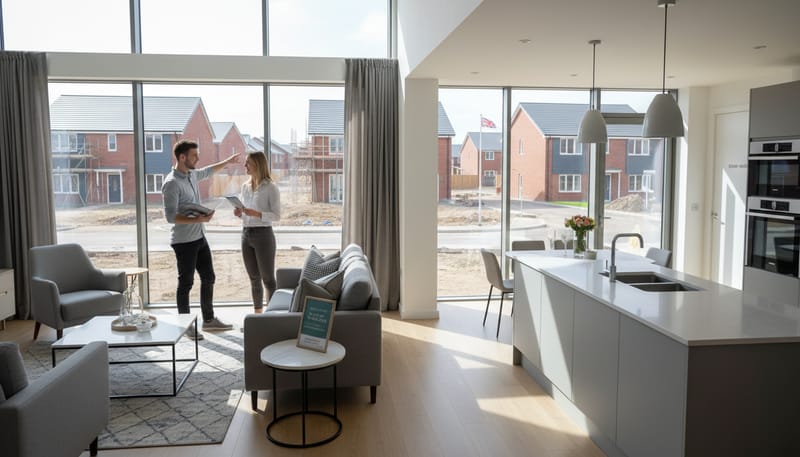
First-time buyers are the lifeblood of the UK housing market, and their relationship with the new build sector is uniquely important. New build homes have traditionally been a natural fit for first-time buyers: they offer chain-free purchases, modern specifications, NHBC warranty protection, energy efficiency that keeps running costs low, and — critically — they have been the primary vehicle for government homeownership schemes from Help to Buy to the current First Homes programme. In 2025-2026, first-time buyers account for a larger share of new build purchases than at any point in the last decade, even as they face ongoing challenges around deposit accumulation, mortgage affordability, and a market where prices have outpaced wages over the longer term. Understanding the dynamics of first-time buyer activity in the new build market is essential both for those aspiring to get on the property ladder and for anyone seeking to understand the broader health of the UK housing market.
This article provides a data-driven examination of first-time buyer activity in the UK new build sector. We analyse the share of new build sales going to first-time buyers, examine how government schemes and developer incentives are supporting access, break down the deposit and income requirements in different regions, explore the evolving age profile of first-time buyers, and assess the outlook for 2026 and beyond. Drawing on data from UK Finance, the Bank of England, HMRC, NHBC, and the English Housing Survey, this guide offers the most comprehensive picture available of the first-time buyer experience in the new build market.
First-Time Buyers: The Scale of the Market
First-time buyers are the single largest buyer group in the UK housing market. According to UK Finance data, first-time buyers accounted for approximately 53% of all mortgaged home purchases in 2025 — a historic high that reflects both the growing difficulty of moving up the ladder (which suppresses activity among existing homeowners) and targeted support for first-time buyers through government policy and lender products.
Within the new build sector specifically, first-time buyers account for approximately 33% of all new build home purchases — a proportion that has grown steadily from around 25% in 2018, when Help to Buy equity loans were at their peak and attracting a broader mix of buyer types. The shift towards a higher FTB share reflects several factors: the end of the Help to Buy equity loan scheme (which also attracted second-time buyers and investors), developer pricing and marketing strategies increasingly targeting the entry-level market, and the availability of 5% and 10% deposit mortgage products that make new builds accessible to those with smaller savings.
FTB Share of New Build Sales: Timeline
| Year | FTB Share of New Build Sales | FTB New Build Purchases (est.) | Key Context |
|---|---|---|---|
| 2018 | 25% | ~48,000 | Help to Buy at peak; strong investor demand |
| 2019 | 26% | ~46,500 | Brexit uncertainty dampening overall market |
| 2020 | 27% | ~40,200 | Pandemic disruption; stamp duty holiday boosts existing stock |
| 2021 | 28% | ~49,800 | Help to Buy equity loan restricted to FTBs from April 2021 |
| 2022 | 29% | ~47,600 | Help to Buy final year; mortgage rate shock in Q4 |
| 2023 | 31% | ~42,800 | Post-Help to Buy era; affordability squeeze |
| 2024 | 32% | ~48,200 | Improving mortgage rates; FTB stamp duty relief |
| 2025 (est.) | 33% | ~54,500 | Continued recovery; FTB-focused developer strategies |
Government Schemes Supporting First-Time Buyers
The closure of the Help to Buy equity loan scheme in March 2023 left a significant gap in government support for first-time buyers purchasing new builds. The scheme had facilitated approximately 387,000 property purchases since its launch in 2013, with the vast majority being new build homes. Its absence has been felt keenly, particularly at the more affordable end of the market. However, several alternative schemes and programmes continue to provide support:
First Homes Scheme
First Homes is the government's flagship affordable homeownership programme for new builds. Eligible first-time buyers receive a minimum 30% discount on the market price (with some local authorities offering 40-50% discounts). The discount is applied in perpetuity — when the home is sold, the same percentage discount must be passed to the next buyer, ensuring long-term affordability.
| Discount | Minimum 30% off market value |
| Price cap (after discount) | £250,000 nationally (£420,000 in London) |
| Income cap | £80,000 (£90,000 in London) |
| Eligibility | First-time buyers only; local connection may apply |
Shared Ownership
Shared ownership allows buyers to purchase a share (typically 25-75%) of a new build home and pay rent on the remaining share. This significantly reduces both the deposit and mortgage required. The reformed model introduced in 2021 includes a 10-year initial repair period (where the housing association covers major structural repairs), a right to staircase in 1% increments, and a fairer staircasing valuation process.
| Initial share | 25-75% (some providers offer 10%) |
| Deposit | 5-10% of your share (not full value) |
| Income cap | £80,000 (£90,000 in London) |
| Rent on retained share | Capped at 2.75% of share value annually |
Lifetime ISA (LISA)
The Lifetime ISA allows first-time buyers aged 18-39 to save up to £4,000 per year and receive a 25% government bonus (up to £1,000/year). Funds can be used towards a first home priced up to £450,000. While not new build-specific, LISAs are a critical savings tool for those building a deposit.
| Annual contribution limit | £4,000 |
| Government bonus | 25% (up to £1,000/year) |
| Property price cap | £450,000 |
| Maximum bonus over time | £33,000 (saving from age 18 to 50) |
FTB Stamp Duty Relief
First-time buyers in England and Northern Ireland pay no stamp duty on the first £300,000 of the purchase price (for properties up to £500,000). This represents a saving of up to £8,750 compared to standard rates. This relief is particularly beneficial for new build purchases, which tend to have higher average prices than resale equivalents.
Deposit Requirements: The Biggest Barrier
Saving for a deposit remains the single largest obstacle for aspiring first-time buyers. While 95% LTV mortgages are available (meaning a 5% deposit), most advisors recommend saving 10-15% to access better rates and reduce monthly payments. The challenge is that even a 5% deposit on an average new build represents a substantial sum.
Deposit Requirements by Region: New Build Homes
| Region | Avg New Build Price | 5% Deposit | 10% Deposit | Years to Save (10%, median wage) |
|---|---|---|---|---|
| London | £548,200 | £27,410 | £54,820 | 9.5 years |
| South East | £438,700 | £21,935 | £43,870 | 8.1 years |
| South West | £385,400 | £19,270 | £38,540 | 7.9 years |
| East Midlands | £298,600 | £14,930 | £29,860 | 6.2 years |
| North West | £278,500 | £13,925 | £27,850 | 5.7 years |
| Yorkshire & Humber | £264,800 | £13,240 | £26,480 | 5.6 years |
| North East | £228,400 | £11,420 | £22,840 | 4.9 years |
| Scotland | £254,200 | £12,710 | £25,420 | 5.1 years |
| Wales | £262,800 | £13,140 | £26,280 | 5.6 years |
The "years to save" column assumes a savings rate of 15% of gross median regional income, which is already an ambitious target for most households. The reality is starker still when living costs are factored in — research by the Resolution Foundation suggests that the typical FTB takes 8-12 years to save a 10% deposit nationally, and considerably longer in the South. The Bank of Mum and Dad remains a critical factor: approximately 34% of first-time buyers receive financial help from family, according to the 2025 English Housing Survey, with an average gift of approximately £25,000.
Developer Deposit Contributions: A Key FTB Tool
Many new build developers offer deposit contribution schemes — typically contributing 3-5% towards the buyer's deposit. On a £280,000 home, a 5% contribution is worth £14,000. When combined with a 95% LTV mortgage, this can mean the buyer needs as little as zero personal savings for the deposit (though they will still need funds for legal fees, moving costs, and other expenses). These schemes are particularly prevalent among volume housebuilders targeting the first-time buyer market. Always check whether the contribution affects mortgage eligibility, as some lenders treat developer contributions differently in their affordability assessments.
The Age Profile of First-Time Buyers
One of the most significant long-term trends in the UK housing market is the rising age at which people first buy a home. Data from the English Housing Survey and UK Finance reveals a steady upward drift that shows no sign of reversing.
The average first-time buyer in 2025 is 34 years old — eight years older than in 1990. In London, the average age is even higher at 36. This trend reflects the compounding effects of rising house prices relative to incomes, the time required to save deposits, student debt, high rents reducing saving capacity, and the general increase in the cost of living. For new build purchases specifically, FTBs tend to be slightly younger than the overall average (around 32-33), reflecting the role of developer incentives, 95% LTV mortgages, and the absence of chains in making new builds more accessible to younger buyers.
FTB Age Distribution for New Build Purchases (2025)
The largest cohort of new build first-time buyers is aged 30-34, accounting for 32% of purchases. The 25-29 age group represents 28%, while a notable 13% are aged 40 or over — reflecting the increasing number of people who, for various reasons, reach their late thirties or forties before being able to buy.
What First-Time Buyers Are Purchasing
The type of new build home that first-time buyers can afford varies significantly by region and budget. Nationally, the most common new build purchase for a first-time buyer is a 2-3 bedroom house or apartment, with the average FTB new build purchase price sitting at approximately £268,400 in 2025.
| Property Type | Share of FTB New Build Purchases | Avg FTB Purchase Price | Typical Deposit (10%) |
|---|---|---|---|
| 1-2 bed apartment | 28% | £228,500 | £22,850 |
| 2 bed terraced/semi | 26% | £256,800 | £25,680 |
| 3 bed terraced/semi | 32% | £298,400 | £29,840 |
| 3-4 bed detached | 14% | £368,200 | £36,820 |
The 3-bedroom terraced or semi-detached house is the most popular new build property type for first-time buyers, accounting for 32% of purchases. This reflects a preference for houses over flats (particularly post-pandemic, when the value placed on private outdoor space increased) and the focus of volume housebuilders on the 2-3 bedroom house market as their core FTB product.
Why New Builds Appeal to First-Time Buyers
New build homes have several specific advantages that make them particularly attractive to first-time buyers, beyond the general appeal of a brand-new property:
Chain-Free Purchase
New builds eliminate the chain — you are not dependent on another buyer completing their purchase before you can move in. This reduces the risk of the transaction falling through (approximately 30% of chained transactions collapse before completion) and allows more predictable move-in dates.
Low Running Costs
New build homes rated EPC A or B cost approximately £1,000-£1,400 per year less to heat and power than a typical EPC D older home. For first-time buyers on tight budgets, this running cost advantage can be the difference between comfortable and stretched monthly finances.
NHBC Warranty
Most new builds come with a 10-year NHBC Buildmark warranty covering defects in the first 2 years and structural issues for up to 10 years. This provides peace of mind that an unexpected repair bill will not derail your finances in the critical early years of homeownership.
Developer Incentives
Developers actively target first-time buyers with generous incentive packages: deposit contributions (3-5%), stamp duty paid, furniture packages (£5,000-£15,000), white goods included, flooring and turfing packages, and mortgage rate subsidies. These can collectively save £15,000-£30,000.
No Immediate Maintenance
Unlike older properties, new builds should not require any significant maintenance or repair for many years. There is no need to budget for a new boiler, rewiring, replastering, or roofing work — costs that can easily run to £10,000-£30,000 on an older property in the first few years of ownership.
Modern Specification
New builds come with a complete modern kitchen, bathrooms, integrated appliances, EV charger, high-speed broadband connectivity, and USB charging points as standard. Achieving the same specification in an older property through renovation typically costs £20,000-£50,000. For more on what sustainability features to expect, see our guide to sustainability trends in new builds.
Mortgage Products for First-Time Buyers in 2026
The mortgage market in 2026 offers a wider range of products for first-time buyers than at any point since 2007. Competition among lenders for FTB business is intense, and product innovation is ongoing.
| Product Type | Key Features | Typical Rate (Feb 2026) | Suitability |
|---|---|---|---|
| 95% LTV Fixed | 5% deposit; 2 or 5-year fix | 5.0-5.4% | Buyers with minimal savings |
| 90% LTV Fixed | 10% deposit; better rates than 95% | 4.4-4.8% | Standard FTB choice; best value |
| Family Springboard | Family member deposits 10% as security; returned after 5 years | 4.2-4.6% | Buyers with family support |
| Guarantor Mortgage | Parent guarantees; potentially 100% LTV | 4.5-5.2% | Buyers with guarantor; no deposit saved |
| Professional Mortgage | Up to 5.5x income; 90-95% LTV; for specific professions | 4.3-4.9% | Doctors, lawyers, accountants, etc. |
| Green Mortgage | Rate discount or cashback for EPC A/B homes | 4.1-4.5% (75% LTV) | New build buyers (almost all EPC A/B) |
| Shared Ownership Mortgage | Mortgage on your share only; rent on remainder | 4.8-5.4% | Buyers priced out of full ownership |
Green Mortgages: A Hidden FTB Benefit
Because almost all new build homes achieve EPC A or B ratings, first-time buyers purchasing new builds are automatically eligible for green mortgage products from lenders including Barclays, NatWest, Nationwide, and Halifax. These products typically offer rate discounts of 0.05-0.10% or cashback of £500-£2,000 — a benefit that is specific to energy-efficient homes and therefore strongly favours new build purchasers. See our guide to the best mortgage rates for new builds for current deals.
Regional Accessibility: Where Can FTBs Afford New Builds?
Affordability for first-time buyers varies enormously by region. Using a standard affordability model (4.5x joint income for a couple on median wages in each region, with a 10% deposit), we can estimate the maximum new build price accessible to a typical FTB couple:
| Region | Median Couple Income | Max Affordable (4.5x + 10%) | Avg New Build Price | Affordable? |
|---|---|---|---|---|
| London | £62,400 | £312,000 | £548,200 | No (£236k gap) |
| South East | £58,400 | £292,000 | £438,700 | No (£147k gap) |
| South West | £52,800 | £264,000 | £385,400 | No (£121k gap) |
| East Midlands | £52,200 | £261,000 | £298,600 | Stretch (£38k gap) |
| West Midlands | £53,400 | £267,000 | £312,400 | Stretch (£45k gap) |
| North West | £52,800 | £264,000 | £278,500 | Just about (£15k gap) |
| Yorkshire & Humber | £51,600 | £258,000 | £264,800 | Just about (£7k gap) |
| North East | £50,400 | £252,000 | £228,400 | Yes (£24k headroom) |
| Scotland | £54,200 | £271,000 | £254,200 | Yes (£17k headroom) |
| Wales | £51,200 | £256,000 | £262,800 | Just about (£7k gap) |
The analysis reveals a stark geographical divide. An average new build home is genuinely affordable for a median-income FTB couple only in the North East and Scotland. In Yorkshire, North West, and Wales, it is a stretch but achievable with modest developer incentives. In London, the South East, and South West, a median-income couple is priced out of the average new build by £100,000-£236,000 — requiring either significantly above-average incomes, substantial family financial support, or alternative routes such as shared ownership.
Frequently Asked Questions
Is now a good time for first-time buyers to purchase a new build?
Conditions in early 2026 are the most favourable they have been since 2021 for first-time buyers. Mortgage rates are falling, developer incentives are generous, stamp duty relief saves up to £8,750, and the quality of new builds (EPC A ratings, heat pumps, solar panels) is at an all-time high. Prices are growing modestly but not running away. However, affordability remains challenging in southern regions.
What deposit do I actually need for a new build?
The minimum is 5% (with a 95% LTV mortgage). On a £280,000 new build, that is £14,000. However, if the developer offers a 5% deposit contribution, your personal deposit could be significantly less. You will still need approximately £3,000-£5,000 for legal fees, surveys, and moving costs.
Are there still government schemes to help first-time buyers?
Yes. While Help to Buy equity loans have ended, First Homes (30%+ discount), Shared Ownership, Lifetime ISAs (25% government bonus on savings), and first-time buyer stamp duty relief all remain active. Developer-specific incentives (deposit contributions, mortgage rate buy-downs) are also widely available.
Should I buy a new build flat or house as a first-time buyer?
This depends on your budget, location, and priorities. Flats are cheaper (averaging £228,500 for FTBs vs £298,400 for a 3-bed house) but come with service charges and leasehold complexities. Houses offer more space, private gardens, and typically better resale values. In southern regions, a flat may be the only affordable option; in northern regions, houses are often within reach.
How do I find new build developments in my price range?
You can search our new build homes directory by location and price range to find developments that match your budget. We also recommend speaking to a mortgage broker early in the process to understand exactly what you can afford, and visiting multiple developments to compare value before committing.
Conclusion: A Challenging but Navigable Path
First-time buyer activity in the new build market is stronger in 2025-2026 than it has been for several years, driven by falling mortgage rates, generous developer incentives, high-quality specifications, and the enduring appeal of chain-free purchases with NHBC warranty protection. FTBs now account for approximately one-third of all new build sales, and this share is growing.
However, significant challenges remain. The average age of a first-time buyer continues to rise (now 34 nationally), reflecting the time required to save deposits in an environment where house prices have consistently outpaced wages over the long term. Regional affordability disparities are stark: while a new build is genuinely within reach for a median-income couple in the North East or Scotland, it remains out of range in much of the South without family financial support or alternative routes like shared ownership.
For aspiring first-time buyers, the key is to be proactive, informed, and strategic. Maximise your savings using a Lifetime ISA, explore all available government schemes, negotiate aggressively on developer incentives, and consider green mortgage products that favour new builds. The path to homeownership may be longer and more complex than it was a generation ago, but with the right approach, a new build home remains an achievable and rewarding first step on the property ladder. For broader market context, see our winter 2026 market report, and for guidance on inflation's impact on your budget, read our analysis of how inflation is affecting new build prices.