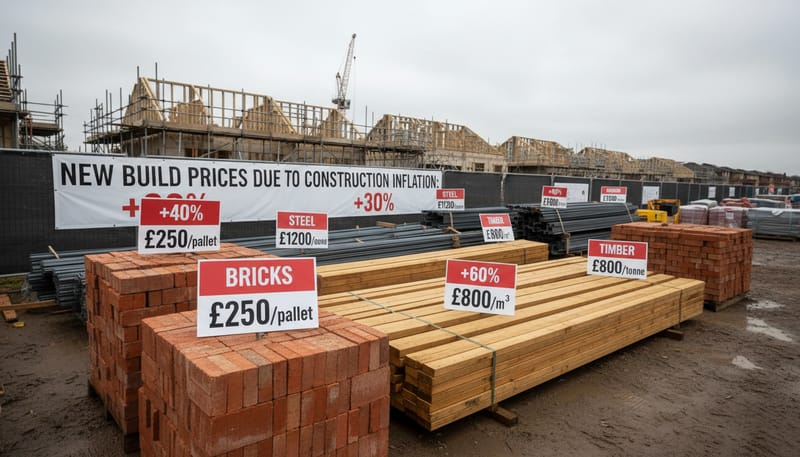
The price of a new build home is determined by far more than just land value and developer profit. Behind every price tag is a complex web of construction costs — from the bricks, timber, and steel that form the structure to the skilled tradespeople who assemble them, the regulations that dictate how they must be built, and the supply chains that deliver materials to site. In 2025-2026, the UK housebuilding industry is navigating a construction cost environment that has been reshaped by pandemic-era disruption, persistent material price inflation, a deepening skilled labour shortage, and the significant additional costs of building to the Future Homes Standard. Understanding these cost dynamics is essential for anyone buying a new build home, because they directly determine what you pay and why.
This article provides a detailed, data-driven analysis of UK construction costs and their relationship to new build house prices. We break down the cost structure of a typical new build home, examine trends in material costs and labour availability, explore the impact of regulatory changes and supply chain pressures, and explain how developers pass these costs through to buyers. Whether you are a prospective buyer trying to understand why new builds cost what they do, an investor assessing the fundamentals of the housebuilding sector, or simply curious about the economics of building a home in modern Britain, this guide will give you the comprehensive picture you need.
The Cost Structure of a New Build Home
To understand how construction costs affect new build prices, it helps to start with the fundamental economics of housebuilding. The selling price of a new build home is made up of several key components, each of which is subject to different cost pressures and market dynamics.
Typical Cost Breakdown: 3-Bedroom Semi-Detached Home (England Average)
Based on a selling price of approximately £320,000 (broadly representative of a 3-bed semi outside London), the construction cost element — which includes all materials, labour, plant, and site-specific costs — typically accounts for 30-35% of the total price. This might seem like a relatively modest proportion, but in absolute terms it represents £96,000-£112,000 per home, and even small percentage changes in construction costs translate into significant price impacts when multiplied across thousands of units.
Important: The Land Cost Variable
Land cost is the single largest component and the most variable by region. In London and the South East, land can account for 50-60% of the final selling price, while in parts of the North East and Wales it may be as low as 15-25%. This is why construction cost inflation has a proportionally larger impact on prices in northern regions (where construction is a bigger share of total cost) than in the South East (where land dominates). For more on regional price dynamics, see our regional housing starts analysis for 2026.
Material Costs: The Inflation Story
Building materials represent approximately 40-45% of total construction costs (i.e., 12-16% of the final selling price). The cost trajectory of key materials has been one of the defining stories of UK housebuilding since 2020, characterised by unprecedented inflation followed by a partial but incomplete correction.
Material Price Index: Key Categories (2020 = 100)
| Material | 2020 | 2022 (Peak) | 2024 | 2025 Q4 | Change Since 2020 |
|---|---|---|---|---|---|
| Structural timber | 100 | 178 | 132 | 128 | +28% |
| Concrete blocks | 100 | 148 | 142 | 138 | +38% |
| Bricks | 100 | 142 | 136 | 133 | +33% |
| Ready-mixed concrete | 100 | 138 | 140 | 141 | +41% |
| Structural steel | 100 | 165 | 124 | 121 | +21% |
| Insulation materials | 100 | 156 | 148 | 145 | +45% |
| Copper and wiring | 100 | 162 | 152 | 148 | +48% |
| Plasterboard | 100 | 145 | 134 | 131 | +31% |
| BEIS All-Work Material Price Index | 100 | 152 | 139 | 136 | +36% |
The data tells a clear story. Material prices surged dramatically between 2020 and 2022, driven by a combination of pandemic supply chain disruption, the energy crisis (which affected energy-intensive materials like bricks, concrete, and glass), post-Brexit import friction, and global demand surges. While prices have retreated from their 2022 peaks, they have not returned to pre-pandemic levels and show little sign of doing so. The BEIS All-Work Material Price Index stands approximately 36% above its 2020 level — meaning that the material cost of building a home is more than a third higher than it was five years ago.
Material-by-Material Analysis
Concrete and Cement
Ready-mixed concrete has been one of the most persistently inflationary materials, up 41% since 2020 with minimal price correction. Concrete is highly energy-intensive to produce (cement manufacturing alone accounts for around 1.5% of UK CO2 emissions), and energy costs remain elevated compared to pre-2021 levels. Additionally, the UK Emissions Trading Scheme (UK ETS) is adding carbon costs to cement production, which are expected to increase further as free allowances are phased out. The transition to lower-carbon concrete alternatives (GGBS, fly ash blends) may offer modest cost relief in the medium term but will not reverse the structural shift in pricing.
Timber
Structural timber experienced the most dramatic price spike (up 78% by mid-2022) but has also seen the most significant correction, now sitting approximately 28% above 2020 levels. The initial spike was driven by extraordinary global demand (particularly from the US housing market) and supply chain disruption. The correction reflects normalising supply chains and reduced demand. However, timber prices remain structurally elevated relative to pre-pandemic levels, and the increasing use of timber frame construction (driven by sustainability considerations and the Future Homes Standard) is maintaining strong demand from the UK housebuilding sector.
Insulation
Insulation materials have risen by 45% since 2020 and have remained stubbornly elevated. This reflects both energy-related manufacturing costs and a structural increase in demand — the Future Homes Standard requires significantly thicker and higher-performance insulation than previous regulations. PIR (polyisocyanurate) boards, mineral wool, and phenolic foam have all seen sustained price increases. Bio-based alternatives (wood fibre, hemp, sheep's wool) remain 15-30% more expensive than conventional products, though the gap is narrowing. This is a cost pressure that is here to stay: tighter energy standards mean more insulation per home, at higher unit costs. For more on how these sustainability-driven costs are shaping the market, see our analysis of sustainability trends in new build housing.
Labour Costs: The Skills Shortage Crisis
Labour accounts for approximately 35-40% of total construction costs, and the availability and cost of skilled workers is one of the most critical challenges facing the UK housebuilding industry. The Construction Industry Training Board (CITB) has consistently identified skills shortages as the sector's number one constraint on output, and the problem has intensified in recent years.
The Scale of the Labour Shortage
The labour shortage has multiple causes that are compounding simultaneously. An ageing workforce is the most fundamental: approximately one-third of UK construction workers are aged 50 or over, and the industry is not attracting enough young people to replace those retiring. The post-Brexit reduction in EU migrant workers — who at their peak accounted for around 10% of the UK construction workforce, and much higher proportions in London and the South East — has further tightened the labour market. And the growing complexity of building to higher sustainability standards requires new skills (heat pump installation, MVHR fitting, airtightness testing) that are in particularly short supply.
Trade-by-Trade Wage Analysis
| Trade | Average Day Rate (2025) | 3-Year Change | Shortage Severity |
|---|---|---|---|
| Bricklayer | £240-£300 | +28% | Severe |
| Electrician | £220-£280 | +22% | Severe |
| Plumber / Heating Engineer | £230-£290 | +25% | Severe |
| Heat Pump Installer (MCS certified) | £260-£340 | +35% | Critical |
| Carpenter / Joiner | £210-£260 | +20% | Moderate |
| Plasterer | £200-£260 | +24% | Moderate-High |
| Groundworker | £190-£240 | +18% | Moderate |
| MVHR Installer | £250-£320 | +40% | Critical |
The most acute shortages — and therefore the most aggressive wage growth — are in trades related to the new sustainability requirements: heat pump installers (MCS-certified), MVHR system installers, and airtightness testers. These are relatively new specialisms with a small existing workforce and rapidly growing demand, creating classic supply-demand price pressure. The CITB estimates that the UK needs to train approximately 18,000 additional heat pump installers by 2028 to meet demand from the FHS and the government's heat pump deployment targets.
Supply Chain Impacts and Resilience
The period from 2020 to 2023 exposed the fragility of UK construction supply chains. Pandemic lockdowns, shipping disruptions, the Suez Canal blockage, the Ukraine-Russia war, and post-Brexit border friction combined to create the most severe supply chain crisis the UK construction industry had experienced in decades. While the acute phase of disruption has passed, the experience has permanently changed how the industry manages its supply chains — and the costs of that change are embedded in current prices.
Supply Chain Cost Factors in 2026
Increased Stockholding
Developers and merchants now maintain larger material stocks as a buffer against disruption. This ties up working capital and adds warehousing costs, estimated at 2-4% of material cost.
Transport and Logistics
Diesel fuel costs remain elevated (approximately 30% above 2019 levels), HGV driver shortages persist (though less severe than in 2021), and post-Brexit customs procedures add friction to imported materials. Delivery costs now represent approximately 8-12% of landed material cost.
Import Dependency
The UK imports approximately 60-65% of its construction timber, significant quantities of steel, and many specialist products (heat pumps, solar panels, MVHR units). Currency fluctuations and international shipping costs directly affect UK construction costs, with a weaker pound increasing import prices.
Supplier Consolidation
The UK brick industry is dominated by three major producers (Ibstock, Forterra, and Wienerberger) who collectively control approximately 80% of the market. Similar concentration exists in concrete products, plasterboard, and roof tiles. Limited competition gives suppliers pricing power that they have used to maintain elevated price levels.
Regulatory Compliance Costs
The cost of meeting regulatory requirements has increased substantially in recent years, driven by three principal factors: the Future Homes Standard, the Building Safety Act, and biodiversity net gain. These are not optional extras — they are mandatory costs that every developer must bear.
| Regulation | Additional Cost Per Home | Key Components |
|---|---|---|
| Future Homes Standard | £15,000-£25,000 | Heat pump, enhanced insulation, solar PV, MVHR, triple glazing, airtightness |
| Building Safety Act | £3,000-£8,000 | Gateway process, building control, fire safety, principal designer/contractor requirements |
| Biodiversity Net Gain (10%) | £1,500-£5,000 | Habitat assessment, on-site provision, off-site credits, 30-year management plans |
| EV Charge Point Mandate | £800-£1,200 | 7kW charger installation, electrical infrastructure upgrade |
| Water efficiency (110 l/p/d) | £300-£600 | Low-flow fittings, dual-flush, water-efficient appliances |
| Total Regulatory Cost Increase | £20,000-£40,000 | Cumulative additional cost vs 2020 regulatory baseline |
The Building Safety Act, introduced in response to the Grenfell Tower tragedy, imposes new requirements on the design, construction, and management of all new buildings (with more stringent requirements for buildings over 18 metres). The gateway approval process, enhanced building control oversight, mandatory golden thread of information, and principal designer/contractor obligations all add cost and time to the development process. While these requirements are critical for safety and quality, their financial impact is real and ultimately borne by buyers.
Build Cost Per Square Metre: Regional Comparison
Construction costs vary significantly by region, reflecting differences in land conditions, labour availability, transport costs, and local market dynamics. The Building Cost Information Service (BCIS) publishes quarterly data on construction costs by region, using a location factor that adjusts national average costs for regional variations.
| Region | Build Cost (£/m²) | Location Factor | Cost for 95m² 3-bed |
|---|---|---|---|
| Inner London | £2,180-£2,620 | 1.18 | £207,000-£249,000 |
| Outer London | £1,920-£2,350 | 1.06 | £182,000-£223,000 |
| South East | £1,780-£2,140 | 1.02 | £169,000-£203,000 |
| South West | £1,620-£1,950 | 0.97 | £154,000-£185,000 |
| East of England | £1,680-£2,020 | 0.99 | £160,000-£192,000 |
| West Midlands | £1,540-£1,860 | 0.94 | £146,000-£177,000 |
| East Midlands | £1,480-£1,780 | 0.93 | £141,000-£169,000 |
| North West | £1,460-£1,760 | 0.92 | £139,000-£167,000 |
| Yorkshire & Humber | £1,420-£1,720 | 0.91 | £135,000-£163,000 |
| North East | £1,380-£1,680 | 0.89 | £131,000-£160,000 |
| Wales | £1,400-£1,700 | 0.90 | £133,000-£162,000 |
| Scotland | £1,440-£1,740 | 0.91 | £137,000-£165,000 |
The regional variation is significant — building the same home in Inner London costs approximately 55-60% more than in the North East. This reflects higher labour rates in London (driven by competition from commercial construction and the high cost of living), more complex site conditions (brownfield sites, constrained access), and higher transport and logistics costs.
How Developers Pass Costs Through to Buyers
The critical question for buyers is: when construction costs rise, who absorbs the increase — the developer, the landowner, or the buyer? The answer is that all three share the burden, but the proportions vary depending on market conditions.
The Residual Land Value Model
Housebuilders use a residual land valuation model to determine what they can afford to pay for land. The calculation is: Residual Land Value = Expected Revenue - Construction Costs - Developer Margin - Section 106/Infrastructure - Finance Costs - Sales/Marketing. When construction costs rise, the residual land value falls — meaning developers bid less for land. In theory, this means the landowner absorbs a significant portion of cost increases through lower land values. In practice, this adjustment is slow (land transactions agreed years ago at higher values are still working through the system) and imperfect (landowners may hold out for higher prices rather than sell at reduced values, constraining supply).
In the current market, the evidence from developer financial results suggests that cost increases are being shared roughly as follows:
Passed to Buyers: ~50-60%
The majority of cost increases are ultimately reflected in higher selling prices. However, this is constrained by affordability and competition — developers cannot raise prices beyond what the market will bear. In areas where affordability is already stretched, price pass-through is lower.
Absorbed by Landowners: ~20-30%
Lower residual land values mean developers pay less for new land acquisitions. This adjustment is visible in DLUHC land value estimates, which show residential land values approximately 15-20% below their 2022 peak in most regions.
Absorbed by Developers: ~15-25%
Developer gross margins have compressed from the 22-25% range typical in 2019-2021 to approximately 18-22% in 2025. This compression reflects the inability to fully pass through all cost increases to buyers in an affordability-constrained market.
Section 106 and Infrastructure Costs
Section 106 (s106) agreements and the Community Infrastructure Levy (CIL) represent a significant and often underappreciated component of new build costs. These are contributions that developers are required to make towards affordable housing, local infrastructure, schools, healthcare facilities, transport improvements, and public open space as a condition of planning permission.
The scale of s106/CIL contributions has increased substantially in recent years as local authorities seek to capture more developer value to fund infrastructure. According to DLUHC data, total s106/CIL contributions in England reached approximately £7.2 billion in 2023-2024, equivalent to roughly £30,000-£45,000 per open-market home on a typical mixed-tenure development (though this varies enormously by location and scheme size).
Example: S106 Obligations on a Typical 200-Home Development
- Affordable housing (30% of units): equivalent cost of ~£3.5-5.0 million
- Education contribution: ~£600,000-£1,200,000
- Healthcare contribution: ~£150,000-£300,000
- Transport/highways improvements: ~£400,000-£800,000
- Public open space/play areas: ~£200,000-£500,000
- Community Infrastructure Levy: ~£500,000-£1,500,000
- Total s106/CIL: approximately £5.5-9.5 million (£28,000-£48,000 per open-market home)
These contributions are a legitimate cost of development — they fund the infrastructure that new residents will use — but they are a cost that is ultimately borne by a combination of buyers (through higher prices) and landowners (through lower land values). The government's proposed Infrastructure Levy, which would replace CIL and much of the s106 system, aims to streamline this process but is not expected to significantly reduce the overall quantum of developer contributions.
The BCIS Construction Cost Index: Historical Trend
The Building Cost Information Service (BCIS), maintained by RICS, is the industry's benchmark measure of construction cost inflation. The BCIS General Building Cost Index captures changes in the cost of labour, materials, and plant used in construction.
| Year | BCIS Index (2015 = 100) | Annual Change | Cumulative Change Since 2019 |
|---|---|---|---|
| 2019 | 116.2 | +3.4% | - |
| 2020 | 118.8 | +2.2% | +2.2% |
| 2021 | 128.4 | +8.1% | +10.5% |
| 2022 | 142.6 | +11.1% | +22.7% |
| 2023 | 149.8 | +5.1% | +28.9% |
| 2024 | 155.2 | +3.6% | +33.6% |
| 2025 (est.) | 160.1 | +3.2% | +37.8% |
The cumulative picture is striking: construction costs have risen by approximately 38% since 2019 — significantly outpacing both general inflation (CPI has risen approximately 25% over the same period) and house price growth (approximately 20-25% nationally). This means that construction costs are consuming a growing share of the final selling price, squeezing both developer margins and the residual amount available for land acquisition. For a broader perspective on the inflationary environment, see our analysis of how inflation is affecting new build prices in 2026.
What This Means for Buyers
Understanding construction costs gives you a more informed perspective when evaluating new build prices. Here are the key practical takeaways:
1. New build prices are not arbitrary
The price of a new build home reflects genuine underlying costs that have increased dramatically. While the new build premium over resale properties can seem high, much of it is accounted for by genuinely higher construction standards, energy performance, and regulatory compliance costs. This does not mean you should not negotiate — always negotiate — but it provides context for why new builds cost what they do.
2. Significant price falls are unlikely
With construction costs continuing to rise (even if more moderately), developers cannot significantly reduce prices without either making losses or abandoning developments. This places a floor under new build prices and makes the dramatic price crashes that some buyers hope for extremely unlikely. For detailed forecasts, see our winter 2026 market report.
3. Developer incentives are the real negotiation lever
In a market where headline prices are supported by genuine costs, the most effective negotiation strategy focuses on incentives rather than price reductions. Stamp duty contributions, furniture packages, mortgage rate buy-downs, and upgrade packages can collectively be worth £10,000-£30,000 without the developer formally reducing the published price. See our guide to negotiating the best deal on a new build for strategies.
4. Higher build quality justifies part of the premium
Homes built to 2025-2026 standards are genuinely superior in energy performance, safety, and sustainability to those built even five years ago. The additional construction costs that drive higher prices also deliver tangible benefits: lower energy bills, higher comfort, better safety standards, and stronger resale values. Factor these into your value assessment.
Frequently Asked Questions
How much does it actually cost to build a new home in the UK?
Construction costs (excluding land) for a typical 3-bedroom semi-detached house range from approximately £131,000 in the North East to £249,000 in Inner London, with a national average of around £150,000-£180,000. These figures include all materials, labour, plant, prelims, and site-specific costs but exclude land acquisition, s106 contributions, finance costs, and developer profit.
Why have new build prices risen so much since 2020?
The main drivers are: construction material inflation (+36% since 2020), labour cost increases (+20-35% depending on trade), new regulatory requirements (Future Homes Standard, Building Safety Act, BNG adding £20,000-£40,000 per home), higher finance costs (reflecting elevated interest rates), and increased s106/infrastructure contributions.
Will construction costs come down?
The rate of increase is moderating (3-4% annually vs 8-11% in 2021-2022), but absolute costs are unlikely to fall materially. Labour shortages are structural and deepening, regulatory requirements continue to add costs, and energy-intensive materials face ongoing pressure from carbon pricing. The industry consensus forecasts annual construction cost inflation of 3-5% for 2026-2028.
What percentage of the new build price is developer profit?
Developer gross margins (before tax and central overheads) typically range from 18-22% of revenue for the major listed housebuilders. Net margins (after all costs) are typically 10-14%. These margins have compressed from the 22-25% gross margin range seen in 2019-2021, reflecting the inability to fully pass through cost increases to buyers.
How much does the Future Homes Standard add to the cost of a new build?
The FHS adds approximately £15,000-£25,000 to construction costs per home compared to the previous Part L 2013 standard. This covers the cost of heat pumps, enhanced insulation, solar PV, MVHR, triple glazing, improved airtightness, and associated design and testing costs.
Conclusion: Costs Are Not Coming Down — But Value Is Going Up
The construction cost environment facing UK housebuilders in 2025-2026 is characterised by elevated but stabilising material costs, persistent and deepening labour shortages, increasing regulatory compliance costs, and supply chain resilience measures that add structural cost. The cumulative effect is that it costs approximately 38% more to build a home today than it did in 2019 — a figure that has outpaced both general inflation and house price growth.
For buyers, the key message is nuanced. New build homes cost more than they did five years ago, and this reflects genuine cost increases rather than profiteering. The homes you are paying more for are also genuinely better — more energy-efficient, safer, more sustainable, and cheaper to run. The new build premium over resale properties, while significant, is at least partly justified by tangible differences in specification and performance. And the cost floor created by high construction costs makes significant price declines unlikely, providing a degree of confidence for those committing to a purchase.
The challenge is affordability. When construction costs rise faster than wages, fewer households can afford to buy — even at prices that represent fair value relative to underlying costs. This is the fundamental tension at the heart of UK housing policy, and it explains why the government's ambition to deliver 300,000 homes per year remains so far from reality. For a first-time buyer's perspective on navigating this market, see our guide to first-time buyer activity in the new build market.