New Build Storage Solutions and Organisation Tips
One of the most common frustrations new build homeowners encounter is a perceived lack of storage space. Modern new build homes are designed to maximise living area within increasingly efficient footprints, which can sometimes mean that storage feels like an afterthought. Wardrobes may be smaller than expected, hallways narrower, and those generous lofts found in older properties are often replaced by compact roof spaces or inaccessible voids. Yet with the right approach, clever products, and a bit of organisational thinking, you can transform your new build into a beautifully organised home where everything has its place.
This comprehensive guide covers storage solutions for every room in a typical new build home, from hallway hacks and kitchen organisation to bedroom wardrobes and garage systems. We include specific UK product recommendations with real price ranges, practical DIY tips that won’t void your NHBC warranty, and design principles that work specifically with the layouts and construction methods used by major UK housebuilders like Barratt, Taylor Wimpey, Persimmon, and Bellway.
Understanding New Build Storage Challenges
Before diving into solutions, it helps to understand why new builds present unique storage challenges. Modern building regulations, land economics, and construction practices all play a role in shaping the storage landscape of your home.
Firstly, new build homes are typically built to tighter footprints than their older counterparts. A new build three-bedroom semi-detached house might offer 80–90 square metres of floor area, compared with 95–110 square metres for a similar Victorian or Edwardian terrace. Developers maximise the number of homes per site, which means every square metre must work hard. Hallways are narrower, landings are smaller, and rooms are configured primarily for furniture placement rather than storage.
Secondly, roof construction has changed dramatically. Many new builds use trussed rafter roofs rather than traditional cut timber roofs. This means the loft space is criss-crossed with structural timbers, making it difficult to board out and use for storage without professional adaptation. The days of simply throwing suitcases and Christmas decorations into a cavernous loft are largely gone for new build owners.
Thirdly, new builds rarely come with built-in storage furniture. Unlike some older homes that might include alcove shelving, under-stairs cupboards with fitted shelves, or built-in wardrobes, new builds typically offer empty spaces with perhaps a basic shelf rail in the wardrobe area and a few hooks on the back of doors. The blank canvas can feel overwhelming, but it also offers an opportunity to create storage that is perfectly tailored to your needs.
New Build Storage Advantages
- ✓ Clean, regular wall surfaces for mounting systems
- ✓ Consistent room dimensions for fitted furniture
- ✓ Modern garages with smooth floors and walls
- ✓ Standard door and window sizes for off-the-shelf solutions
- ✓ Blank canvas allows personalised organisation
New Build Storage Challenges
- ✗ Smaller overall footprint than older homes
- ✗ Trussed roofs limit loft storage potential
- ✗ Narrow hallways and landings
- ✗ Minimal built-in storage provided
- ✗ Plasterboard walls need proper fixings
Hallway and Entrance Storage
The hallway is the first area you encounter when entering your home, and in a new build it often doubles as a dumping ground for shoes, coats, bags, and post. New build hallways are typically narrow — often just 900mm to 1,200mm wide — which rules out bulky furniture but still leaves room for clever solutions.
Wall-Mounted Coat and Shoe Solutions
In a narrow hallway, the floor is precious real estate. Wall-mounted solutions keep things tidy without encroaching on the walkway. A simple row of coat hooks at adult height plus a lower row at child height can accommodate a family’s outerwear without a bulky coat stand. Look for hook boards with shelves above for hats and gloves — IKEA’s PINNIG range (£35–£65) offers several wall-mounted options that combine hooks with a shelf and are specifically designed for narrow spaces.
For shoes, wall-mounted shoe racks are far more space-efficient than floor-standing alternatives. The IKEA TRONES shoe storage cabinet (£25 for a pack of three) mounts flat against the wall and is just 18cm deep, making it ideal for new build hallways. Each unit holds two pairs of shoes and can be stacked vertically or arranged side by side. Alternatively, the Habitat Roscoe wall-mounted shoe rack (£40–£60) offers a more design-led option in oak or walnut finishes.
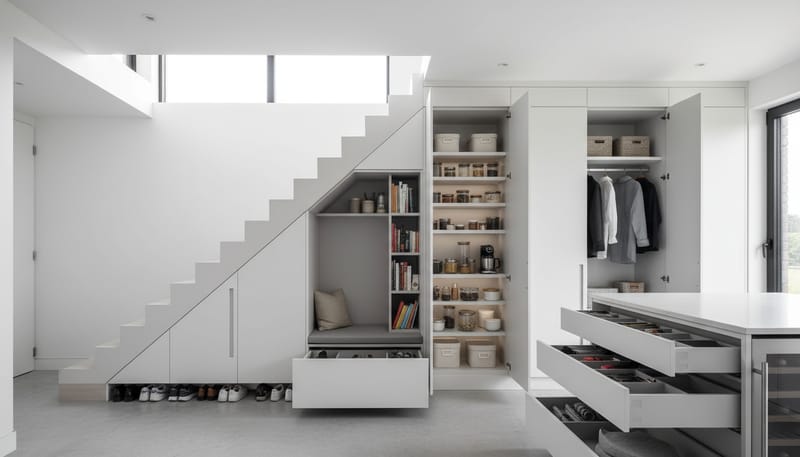
Under-Stairs Storage
Most two-storey new builds include an under-stairs cupboard, but it is often a single void with no internal organisation. The typical under-stairs space in a new build measures roughly 2.5m deep, 1.8m high at the tallest point, and tapers to virtually nothing at the back. Without a plan, this space quickly becomes a black hole of forgotten items.
The most effective approach is to zone the space. Use the tall section near the door for frequently accessed items like the vacuum cleaner, ironing board, and mop. The mid-height zone is ideal for shelving units or stacking storage boxes — the IKEA SAMLA boxes (£3–£8 depending on size) are transparent and stackable, perfect for this purpose. The low, tapered section at the back is best reserved for rarely used items like seasonal decorations, suitcases, or archived paperwork stored in labelled boxes.
For a more polished solution, consider pull-out drawers on runners that make use of the full depth of the space. Companies like Clever Closet and Bespoke Under Stairs offer made-to-measure pull-out systems starting from around £800 for a basic configuration up to £3,000+ for a fully fitted solution with soft-close drawers and integrated lighting. This is a significant investment but transforms an awkward void into highly usable, accessible storage.
Kitchen Storage and Organisation
New build kitchens come with a standard range of base and wall units, but the internal organisation of these units is often basic — typically a single shelf in wall cupboards and empty cavities in base units. With some targeted additions, you can dramatically increase the usable storage capacity of your kitchen without replacing a single unit.
Inside-Cabinet Organisers
The single most impactful kitchen storage upgrade is adding internal organisers to existing units. Drawer dividers for cutlery and utensils are a basic starting point — the Joseph Joseph DrawerStore range (£10–£30) offers expandable options that fit most standard new build kitchen drawers (typically 450mm or 500mm wide). For deeper drawers, the expandable bamboo organisers from Lakeland (£15–£25) offer a natural-look alternative.
Inside wall cupboards, under-shelf baskets create an instant extra level of storage. These wire baskets hook over an existing shelf and hang beneath it, effectively doubling the usable space. Available from Amazon, Lakeland, or Dunelm for £5–£12 each, they are perfect for storing lighter items like cling film, foil, sandwich bags, and small packets. A cupboard shelf riser achieves a similar effect — place one on a shelf to create a raised platform, then store items both on and underneath it.
For base units, particularly the deep cupboards either side of the cooker, pull-out wire baskets on runners are transformative. Rather than losing items at the back of a deep, dark cupboard, pull-out baskets bring everything to hand. Retrofit pull-out systems are available from kitchen suppliers like Howdens, B&Q, and specialist websites like kitchendoorworkshop.co.uk, with prices ranging from £25 for a basic single basket to £80 for a two-tier pull-out system. Installation typically requires a drill and about 30 minutes per unit.
Maximising Corner Cupboard Space
Corner cupboards are the most wasted space in most new build kitchens. The deep L-shaped void is notoriously hard to reach, and items placed at the back often remain there for years. A retrofit carousel or Lazy Susan is the classic solution — full-circle carousels from B&Q or Wickes cost £40–£80 and turn the entire interior into accessible rotating shelves. For a more premium option, the LeMans II pull-out system (available through Howdens and independent kitchen fitters at £150–£300 installed) provides kidney-shaped trays that swing out from the corner, bringing the full depth of the cupboard within easy reach.
Pantry and Food Storage
Few new builds include a dedicated pantry or larder, but you can create one from a tall cupboard or even a section of a utility room. The key to an effective pantry is visibility — being able to see everything at a glance prevents duplicate purchasing and food waste. Use clear containers for dry goods (pasta, rice, cereals, flour) and label everything. The IKEA 365+ range (£3–£12 per container) offers a comprehensive selection of airtight containers in various sizes. For a more premium look, the ProCook Malvern glass storage jars (£8–£18 each) offer an attractive option in clear glass with bamboo lids.
Door-mounted spice racks make excellent use of the inside of cupboard doors. Over-door wire racks from Amazon or Lakeland (£8–£15) can hold 20+ spice jars without taking up any shelf space. For a more substantial door organiser, the Elfa door rack system (available from The Container Store UK, £30–£50) offers adjustable wire baskets that mount on the inside of a cupboard door and can hold everything from spices to cling film to cleaning products.
Living Room Storage
New build living rooms are designed primarily as open, flexible spaces, and most come without any built-in storage beyond perhaps a single alcove or recess for the television. The challenge is to add storage that enhances the room rather than cluttering it. The key principle here is to choose furniture that works double duty — every piece should offer storage as well as its primary function.
Multi-Functional Furniture
An ottoman coffee table is perhaps the single best storage investment for a new build living room. The IKEA KIVIK footstool with storage (£200–£280) provides a large internal cavity for blankets, board games, and remote controls while functioning as additional seating or a footrest. For a more premium option, the Loaf Bumper ottoman (£445–£695) offers a generous storage compartment in a range of fabrics with a gas-lift lid mechanism.
Side tables with built-in storage are another clever choice. The IKEA LIATORP side table (£95) includes a shelf and drawer, while the Dunelm Arlo side table (£50–£75) offers a lower shelf for books and magazines. For families with young children, a storage bench beneath the window or along a wall provides toy storage that can be quickly tidied away — the Great Little Trading Company (GLTC) offers purpose-built toy storage benches from £180–£350.
Wall-Mounted Shelving and Media Units
Floating shelves are a popular choice for new build living rooms, creating display and storage space without taking up floor area. However, correct installation is critical in new builds. Most new build internal walls are either plasterboard on metal or timber framing, or lightweight blockwork with a plaster skim. For plasterboard walls, always use appropriate fixings such as spring toggles (for loads up to 25kg per fixing) or specialised plasterboard anchors. For heavier items like books or media equipment, locate the studs or battens behind the plasterboard and fix into those.
The IKEA LACK floating shelf range (£10–£25 depending on length) is a budget-friendly option that comes in various colours and lengths. For a more premium look, the MADE.com Esme floating shelves (£59–£99) offer a sleek design in brass and walnut finishes. TV media units that combine open and closed storage keep cables and devices hidden while maintaining a clean aesthetic — the IKEA BESTÅ system (£100–£600 depending on configuration) is endlessly configurable and designed to be wall-mounted, which is particularly effective in new builds where the floor space may be limited.
Bedroom Storage Solutions
Bedrooms in new builds typically feature a single wardrobe recess — an alcove or section of wall designated for a wardrobe — rather than a full built-in wardrobe. The master bedroom wardrobe recess is usually around 1.8m–2.4m wide and 600mm deep, while secondary bedrooms may have an even smaller provision. Making the most of this space requires careful wardrobe selection and internal organisation.
Wardrobe Systems Compared
Wardrobe Internal Organisation
Regardless of which wardrobe system you choose, the internal layout is where the real storage gains are made. The standard single hanging rail that comes with most wardrobes (or that developers install in wardrobe recesses) is hugely inefficient. Most clothing items — shirts, blouses, jackets, skirts — hang to less than half the height of a standard wardrobe, leaving the bottom half empty. By installing a double-tier hanging system (two rails, one at chest height and one at knee height), you effectively double your hanging capacity for shorter items.
Hanging organisers are another simple but effective upgrade. Fabric hanging shelves (£8–£15 from Dunelm, B&M, or Amazon) suspend from the wardrobe rail and provide 5–6 shelving sections for folded items like jumpers, t-shirts, and jeans. This is particularly useful in children’s bedrooms where shelving space is often limited. Velvet hangers (£10–£20 for packs of 50) are a worthwhile investment — their slim profile takes up 40% less rail space than standard plastic hangers, and the non-slip surface prevents clothes from sliding off.
Under-Bed Storage
The space beneath the bed is one of the most underused storage areas in any home, and in a new build bedroom it can make a significant difference. Beds with built-in drawers are the most convenient option — the IKEA MALM bed frame with storage drawers (£350–£500 depending on size) includes four large drawers beneath the mattress platform. For existing beds, flat storage containers on castors slide easily under most divan or frame beds. The Really Useful Box 50-litre under-bed storage box (£12–£18) is a UK favourite — transparent, stackable, and robust, it fits under beds with at least 18cm of clearance.
Vacuum storage bags are particularly effective for seasonal items like duvets, pillows, and winter coats. By removing the air, these bags compress bulky items to a fraction of their original volume. Lakeland’s vacuum bags (£8–£20 per pack) come in various sizes and can be sealed with a standard vacuum cleaner, making them ideal for storing under-bed or at the top of wardrobes.
Bathroom Storage
New build bathrooms and en-suites are notoriously compact. A typical new build family bathroom might measure just 2.4m x 1.8m, with an en-suite even smaller at 1.5m x 1.8m. The vanity unit provided by the developer usually offers the only built-in storage, and it is often surprisingly shallow. Every centimetre of wall and vertical space needs to work hard in these rooms.
Over-Toilet and Wall Storage
The wall space above the toilet is often completely unused and offers room for shelving or a cabinet. A slim bathroom cabinet mounted above the WC can store toiletries, medicines, and cleaning supplies out of sight. The IKEA LILLÅNGEN wall cabinet (£35–£60) is specifically designed for compact bathrooms at just 21cm deep. Alternatively, a floating shelf with a raised edge or lip can hold attractively displayed toiletries and adds decorative interest — the Habitat Bamboo Bathroom Shelf (£20–£35) is a popular choice.
Shower caddies and corner shelves make use of otherwise wasted wall space inside the shower enclosure. Rust-resistant options in stainless steel or plastic are essential given the wet environment. The Simplehuman adjustable shower caddy (£30–£50) uses tension against the shower walls rather than requiring drilling, making it ideal for a new build where you might be reluctant to drill into tiled walls during the warranty period.
Vanity Unit Maximisation
The standard vanity unit in a new build bathroom can be organised far more efficiently with a few simple additions. Stackable under-sink organisers (£10–£20 from Dunelm or TK Maxx) create multiple levels within the unit, preventing the common problem of everything being piled in a single layer. A pull-out organiser bin specifically designed for under-sink use (£15–£25) keeps cleaning supplies accessible. If space allows, a tension rod fitted across the inside of the cabinet creates an instant hanging point for spray bottles, freeing up shelf space below.
✓ Mirror cabinet (replaces basic mirror)
✓ Shower caddy or corner shelves
✓ Vanity unit internal organisers
✓ Door-mounted hooks for towels and robes
✓ Heated towel rail (functional and space-saving)
✓ Tall slim cabinet for linens (if floor space allows)
Loft Storage in New Builds
As mentioned earlier, new build lofts present unique challenges due to trussed rafter construction. However, this does not mean loft storage is impossible — it simply requires a more considered approach than in older properties with open roof voids.
Loft Boarding Options
The most important rule for loft storage in a new build is never to compress the insulation. New builds have thick layers of loft insulation (typically 270mm) that are essential for meeting building regulations and keeping your energy bills low. Placing boards directly on the ceiling joists compresses this insulation, reducing its effectiveness and potentially causing damp problems.
The solution is a raised boarding system that sits above the insulation level. Companies like LoftZone offer specifically designed systems where a framework of legs and cross-members creates a raised platform above the insulation, which is then boarded over. The LoftZone StoreFloor system costs approximately £35–£45 per square metre for the framework and boards (excluding fitting). A typical boarding area of 5–8 square metres around the loft hatch will cost £200–£400 in materials, or £400–£800 professionally installed.
Professional loft boarding specialists such as Instaloft, The Loft Boys, and local companies across the UK offer complete packages that typically include boarding, a proper loft ladder, and lighting. Expect to pay £400–£900 for a standard new build loft conversion including ladder and lighting, depending on the area boarded and your location. Always ensure the company uses raised systems that do not compress insulation — ask specifically about this, as some less scrupulous companies still board directly onto joists.
Garage Storage Systems
If your new build includes a garage, it represents a significant storage opportunity — but only if you approach it systematically. The typical new build single garage measures approximately 5.5m x 2.7m, which is too narrow for most modern cars plus meaningful side storage. Many new build homeowners quickly decide to use the garage primarily for storage rather than parking, and this can work extremely well with the right systems in place.
Wall-Mounted Racking and Shelving
The most efficient garage storage uses the walls rather than the floor. Wall-mounted systems keep the floor clear for parking (if needed) or for workshop activities. The most popular system in the UK is the GaragePride wall panel system (£150–£400 for a starter kit), which uses slotted wall panels that accept a wide range of hooks, baskets, tool holders, and shelves. Similar systems include the Gladiator GarageWorks range (£200–£600) and the Sealey wall-mounted tool storage system (£80–£200).
For general bulk storage, heavy-duty shelving is hard to beat. The Racking Solutions or Storalex brands offer boltless shelving units that are quick to assemble and can hold 175–265kg per shelf. A standard five-shelf unit measuring 1.8m x 0.9m x 0.45m costs £35–£60 from Amazon or Costco. Three or four of these units along the back wall of a garage create a substantial amount of organised storage for tools, garden supplies, paint, and household items.
Overhead and Ceiling Storage
The ceiling of a new build garage is often completely unused storage space. Overhead storage racks that mount to the ceiling joists can hold large, lightweight items such as camping equipment, seasonal decorations, and sports gear. Products like the Monkey Bar overhead storage system (£100–£250) create a raised platform that items can be placed on, while pulley-based systems (£30–£80) allow individual items like bikes or surfboards to be hoisted up and out of the way. A bike pulley system from Halfords (£25–£40) is a particularly practical solution for families who want to store bicycles vertically without taking up floor or wall space.
Utility Room and Laundry Organisation
Many new builds include a small utility room or a combined utility/WC area, which provides an excellent opportunity for dedicated laundry and cleaning storage. Even if your utility room is tiny (some are barely larger than a cupboard), it can be made to work extremely hard with the right approach.
The most effective utility room layout places the washing machine and tumble dryer (or a combined washer-dryer) with shelving or a worktop above them. If the appliances are placed side by side, a worktop across the top creates an instant folding and sorting station. If space only allows them to be stacked, a purpose-built stacking kit (£30–£60, available from appliance manufacturers or Screwfix) ensures the dryer sits safely on top of the washing machine, freeing up the adjacent wall for shelving or a slim shelving tower.
Slim pull-out towers that fit between or beside appliances are a brilliant space-saving solution. At just 15–20cm wide, these tower units sit in gaps that would otherwise be wasted and provide multiple tray levels for laundry products, cleaning supplies, and cloths. Available from Amazon and specialist kitchen/utility suppliers for £25–£60, they are one of the most satisfying small-space storage investments you can make.
Wall-mounted airers are essential in a utility room, particularly during the drying-out period of a new build when you should be ventilating heavily. A ceiling-mounted Sheila Maid traditional clothes airer (£40–£80 from John Lewis, Dunelm, or Lakeland) uses a pulley system to raise and lower a drying rack, keeping wet clothes out of the way while benefiting from rising warm air. For smaller spaces, a wall-mounted fold-down airer from Brabantia (£35–£55) folds flat against the wall when not in use.
Children’s Room Organisation
Keeping children’s rooms tidy in a new build is a particular challenge, as these bedrooms are often the smallest in the house. The key principles are accessibility (children need to be able to reach and return items themselves), visibility (open storage encourages tidying), and flexibility (storage needs change rapidly as children grow).
Toy Storage Systems
The IKEA TROFAST storage system (£40–£120 depending on configuration) is arguably the gold standard for children’s storage. Its modular frames accept a range of coloured bins in different sizes, making it easy for children to see what is in each container and return items to the right place. The bins are lightweight enough for toddlers to pull out and are available in shallow and deep sizes to accommodate everything from Lego to dressing-up clothes.
For a slightly older child, the Great Little Trading Company (GLTC) offers the Abbeville range of children’s storage furniture (£80–£350) in white, grey, and natural wood finishes. These include cube storage units, toy chests, and bookshelves that are designed to grow with the child and can be repurposed as display or study storage as the child gets older. Vertbaudet (available online in the UK) also offers an extensive range of children’s storage furniture in design-led finishes, though prices tend to be at the upper end (£100–£400).
Book Storage
Front-facing book display shelves are far more effective than traditional spine-out shelving for younger children. Being able to see the cover of a book encourages reading and makes it easy for little hands to choose and replace books. The IKEA FLISAT wall-mounted book display (£12 each) is a slim, affordable option that mounts flat against the wall and holds 5–8 books face-forward. The Tidy Books Original bookcase (£130–£165, a UK-designed product) offers a freestanding option with front-facing display in various colours.
3–5 years: Colour-coded bins, picture labels, front-facing book displays. Child-height hanging rails for coats and costumes.
6–9 years: Cube storage with mix of open and lidded bins. Bookshelf for chapter books. Desk with drawers for school supplies.
10+ years: Wardrobe with double rail. Shelving for hobbies and collections. Desk with proper filing or drawer storage for homework.
Garden and Outdoor Storage
New build gardens vary enormously in size, from the compact courtyard gardens of city terraces to the generous plots of semi-rural four-bedroom detached homes. Regardless of size, outdoor storage is essential for tools, garden furniture cushions, toys, and bikes.
Shed vs. Storage Box vs. Lean-To
Before investing in outdoor storage, check your new build development’s planning conditions and any covenants in your lease or transfer deed. Some new build estates have restrictive covenants that govern the size, position, and appearance of sheds and outbuildings. It is not uncommon for estates managed by a management company to require approval before erecting a shed. Always check before purchasing.
For smaller gardens, a Keter Store-It-Out storage box (£80–£140) provides lockable, weatherproof storage for garden tools and furniture cushions without the footprint of a full shed. These resin boxes sit against a fence or wall and are maintenance-free, which is an advantage over timber sheds that require annual treatment. The Keter Factor and Artisan ranges of plastic sheds (£300–£700) offer a full shed experience with minimal maintenance requirements and are available from B&Q, Wickes, and online retailers.
Home Office Storage
With hybrid working now the norm for many UK professionals, a dedicated home office or workspace is increasingly important. In a new build, the home office is most commonly set up in a second or third bedroom, in an alcove on the landing, or in a corner of the living room. Storage for paperwork, tech equipment, stationery, and files needs to be efficient without dominating the space.
A desk with built-in drawers is the foundation of good home office storage. The IKEA ALEX/LINNMON desk combination (£100–£180) offers a large work surface with generous drawer storage at a competitive price. For a more premium option, the John Lewis Branch desk (£299–£499) includes cable management and integrated storage in a range of finishes. Wall-mounted shelving above the desk keeps reference materials within arm’s reach without taking up floor space — the IKEA EKET wall-mounted cube system (£15–£25 per cube) can be configured into various arrangements to suit your needs.
For filing and paperwork, the shift towards digital storage has reduced the volume of physical files most people need to keep, but some documents still need paper copies (mortgage documents, insurance policies, warranties). A compact filing cabinet or document box keeps these organised. The Really Useful Box A4 filing box (£8–£12) with hanging file inserts offers a budget-friendly filing solution that can sit on a shelf or in a cupboard. For those with more extensive filing needs, the Bisley A4 two-drawer filing cabinet (£80–£120) is a British-made classic that fits under most desks.
The Organisation Mindset: Decluttering and Maintaining Order
No amount of clever storage products will help if you have more possessions than your home can reasonably accommodate. Moving into a new build is actually the perfect time to declutter, as everything needs to be packed, transported, and unpacked anyway. Use the opportunity to assess every item you own and ask whether it deserves a place in your new home.
The Four-Box Decluttering Method
When unpacking in your new home, have four boxes or bags ready for each room: Keep, Donate, Sell, and Bin. Be ruthless — if you have not used an item in the past 12 months and it has no sentimental value, it probably does not need to come into your new home. Charity shops such as British Heart Foundation, Sue Ryder, and local hospice shops welcome good-quality household items and furniture. For items with resale value, Facebook Marketplace, eBay, and Gumtree can turn your clutter into cash.
The One-In-One-Out Rule
Once your new home is organised, the simplest way to maintain order is to adopt the one-in-one-out rule: for every new item that enters the house, one item must leave. This prevents the gradual accumulation that leads to overcrowded storage and cluttered rooms. It is a particularly effective discipline for children’s toys and clothing, which can multiply at astonishing rates.
Seasonal Storage Rotation
Rotating seasonal items is a key strategy for maximising limited new build storage. In spring, pack away heavy winter coats, boots, scarves, and gloves into vacuum bags or storage boxes and move them to the loft or back of the wardrobe. In autumn, do the reverse with summer clothes, garden furniture cushions, and outdoor toys. This approach ensures that your most accessible storage is always being used for items you actually need right now.
Room-by-Room Storage Budget Guide
To help you plan your storage investment, here is a realistic budget guide for equipping a typical three-bedroom new build home with effective storage solutions. We have included budget, mid-range, and premium options for each area.
Smart Storage: Technology Solutions
Technology can play a surprising role in home storage and organisation. Digital solutions can reduce the volume of physical items you need to store, while smart labelling and inventory systems help you keep track of what you have and where it is located.
A document scanner (such as the Fujitsu ScanSnap iX1600 at £350–£400, or the budget Brother ADS-1200 at £180–£220) allows you to digitise important paperwork and then shred the originals (where legally permissible). This can dramatically reduce the volume of paper files you need to store. Cloud storage services like Google Drive, iCloud, or OneDrive provide secure backup for digital documents at minimal cost.
For loft and garage storage, a simple labelling system prevents the common frustration of not being able to find specific items among dozens of identical boxes. A label maker such as the Brother P-Touch PT-H110 (£20–£30) creates clear, durable labels that are far more readable than handwritten notes. More tech-savvy organisers might appreciate the Sortly app (free basic version, premium from £4/month), which lets you photograph, label, and categorise stored items with their location, creating a searchable inventory of everything in your home.
Frequently Asked Questions
Final Thoughts
Storage in a new build home is not about having the biggest house or the most expensive furniture — it is about being intentional with the space you have. Start by understanding the specific storage challenges of your home, declutter ruthlessly before moving in, and then invest strategically in solutions that address your particular pain points. The hallway, kitchen, and bedroom are typically the areas that benefit most from early attention, while loft boarding and garage organisation are excellent projects for the first few months of ownership.
Remember that new build homes have advantages too — clean, regular walls make mounting shelving and systems easier, standard dimensions mean off-the-shelf solutions fit well, and the blank canvas allows you to create storage that is truly tailored to your lifestyle. With a considered approach and the right products, your new build can be not just beautifully designed but beautifully organised too.
For more practical advice on making the most of your new build home, explore our guides to managing the drying out period, seasonal maintenance for new build owners, and insurance for your new build home.