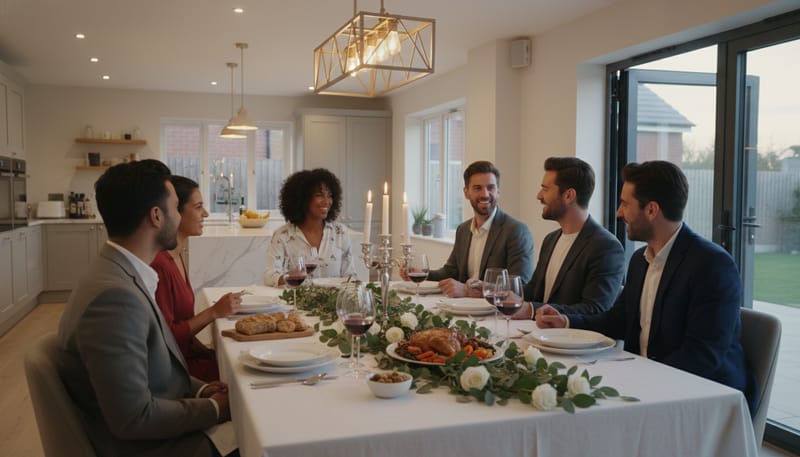
The Open-Plan Advantage
The vast majority of new build homes now feature open-plan or broken-plan living, and this is genuinely wonderful for entertaining. Unlike older homes where the kitchen was a separate room at the back of the house, modern new builds combine the kitchen, dining area, and living space into one flowing area. The cook is never isolated from the conversation, guests gather around the kitchen island, and the transition from pre-dinner drinks to the meal itself is seamless.
Open-plan layouts fundamentally change the dynamics of hosting. In a traditional layout, the host disappears into the kitchen and emerges stressed with plates of food. In an open-plan new build, cooking becomes part of the entertainment. Guests perch on bar stools at the island, someone helps chop vegetables, another pours drinks, and the whole evening has a relaxed, communal feel. However, open-plan living requires some thought when entertaining — noise carries, cooking odours spread, and the mess from food preparation is visible to everyone.
Open-Plan Advantages
- ● Cook stays part of the conversation
- ● Kitchen island doubles as bar or serving station
- ● Natural flow between cooking, dining, and relaxing
- ● Easy to supervise children while hosting adults
Open-Plan Challenges
- ● Cooking smells spread to the living area
- ● Kitchen mess is visible from all angles
- ● Noise levels build with no walls to absorb sound
- ● Limited storage means clutter shows easily
Equipping Your Kitchen for Entertaining
New build kitchens come with the basics — an oven, hob, fridge-freezer, and dishwasher. While adequate for everyday cooking, regular entertaining may require supplementing what the developer provided. One of the most common frustrations is limited worktop space. The solution is to think creatively: a large chopping board over the sink creates instant workspace, and a kitchen trolley on wheels (£30–£80 from IKEA or Dunelm) can be rolled out for preparation and tucked away afterwards.
Managing Cooking Smells in Open-Plan Spaces
One of the biggest complaints about open-plan new builds is that cooking smells permeate the entire ground floor, clinging to soft furnishings and cushions. Your cooker hood is the first line of defence — most new builds come with a recirculating hood that filters air through a carbon filter. Make sure this carbon filter is replaced every three to six months, turn the hood on before you start cooking, and leave it running for 15 to 20 minutes afterwards.
If your home has an MVHR ventilation system, use the boost setting while cooking. Between the cooker hood and MVHR boost, most cooking smells are managed effectively. For additional freshness, simmer a small pan of water with lemon slices, cinnamon sticks, and cloves after cooking — this natural freshener creates a lovely welcoming aroma for guests. Choose slow-cooked or oven-baked dishes over high-heat frying to minimise strong odours in the first place.
- ✓ Replace cooker hood carbon filter every 3–6 months (£8–£20)
- ✓ Switch hood on 5 minutes before cooking begins
- ✓ Leave hood running 15–20 minutes after cooking finishes
- ✓ Use MVHR boost setting during and after cooking
- ✓ Prefer slow-cooked dishes over high-heat frying
- ✓ Simmer citrus and spices as a natural freshener
Seating and Dining Solutions
Seating is often the biggest practical challenge. Dining areas in new builds are typically sized for a four to six-seater table, which can feel cramped for larger gatherings. An extendable dining table is arguably the single best investment — companies like IKEA, Made.com, and John Lewis offer tables that seat four to six normally and extend to eight, ten, or twelve. Look for tables that store the extension leaf internally, as storage space is at a premium.
For casual entertaining, consider a mix of seating. Bar stools at the kitchen island, a bench along one side of the dining table, and stackable chairs kept in a cupboard can easily accommodate extra guests. Benches take up less visual space than individual chairs and can squeeze in an extra person when needed.
Setting the Atmosphere: Lighting and Music
Atmosphere makes or breaks an evening, and lighting is the most important element. New build downlighters are practical but can feel clinical. Smart bulbs from Philips Hue, IKEA Tradfri, or TP-Link Tapo allow you to dim lights, change colour temperature to a warm amber, and set scenes. A “dinner party” scene that dims downlighters to 30% and warms the colour creates an instantly inviting mood. Smart bulbs start from around £8 each for basic dimmable options, or £15–£25 for colour-changing versions.
Candles remain one of the most effective ways to create warmth. Place them on the dining table, along the island, and on windowsills. Battery-operated LED candles are sensible with children or pets, and modern versions are remarkably realistic. A smart speaker like the Amazon Echo or Google Nest is perfect for background music — set it to a low volume so it creates ambiance without competing with conversation.
Menu Planning for Stress-Free Hosting
The secret to stress-free entertaining is choosing the right menu. The best dinner party dishes can be mostly prepared in advance, do not require last-minute fussing, and look impressive without being technically difficult. For a new build kitchen with a single oven, this approach is essential. Think in terms of timing: a cold starter fully prepared before guests arrive, a main course already in the oven or slow cooker, and a dessert made the day before. When your guests ring the doorbell, you should be relaxed and ready to enjoy the evening.
Main: Slow-cooked beef bourguignon with creamy mash and seasonal greens (bourguignon improves when made the day before)
Dessert: Individual chocolate pots with whipped cream and raspberries (made morning of, chilled)
Main: Slow-roasted lamb shoulder with tzatziki, couscous, and roasted vegetable salad (lamb in oven 4 hours, couscous prepared ahead)
Dessert: Eton mess with fresh strawberries (meringues bought or made ahead, assembled at the table)
Main: Chicken tikka masala and vegetable dhansak with pilau rice and naan (curries made day before, rice fresh)
Dessert: Mango sorbet with fresh passion fruit (shop-bought, no cooking required)
Drinks and Bar Setup
A self-serve drinks station takes the pressure off you as host. In a new build, the kitchen island is the natural location, or a trolley can double as a bar cart. Have everything prepared before the first guest arrives. New build fridge-freezers often lack capacity for party drinks, so fill a large washing-up bowl or storage box with ice to chill white wine, beer, and soft drinks. Bags of ice cost £1–£2 from any supermarket — buy at least two for a party of eight.
Always have good non-alcoholic options. The UK’s low-and-no alcohol market has grown enormously. Products like Seedlip (non-alcoholic spirits), Lucky Saint (alcohol-free lager), and Nosecco are widely available and taste significantly better than options from a decade ago. Having these available shows consideration and ensures every guest enjoys a special drink.
Outdoor Entertaining
New build gardens offer tremendous potential for outdoor entertaining. With a few strategic investments, your garden can become a brilliant extension of your hosting space from late spring through early autumn. Create distinct zones: a dining area, a socialising area with comfortable seating, and a cooking area for the barbecue. Even compact gardens can accommodate this with overlapping zones. Patio furniture from Argos, B&Q, or IKEA offers excellent outdoor dining sets from £150–£400 that comfortably seat six to eight.
Essential Outdoor Kit
- ● Barbecue (charcoal or gas) — £50–£300
- ● Outdoor dining set — £150–£400
- ● Festoon or fairy lights — £10–£40
- ● Citronella candles — £5–£15
- ● Outdoor Bluetooth speaker — £20–£60
- ● Large coolbox for drinks — £15–£40
Barbecue Comparison
Entertaining with Children
Entertaining when children are involved requires a different approach but can be just as enjoyable. New build homes are well suited to child-friendly hosting because the open-plan layout lets you keep an eye on children from the kitchen, and gardens are typically fenced and secure. The key strategy is feeding children first and separately — plan a simple children’s meal (pasta, fish fingers, pizza) served an hour before the adult dinner. Once fed, they can play in the living area or a bedroom while adults sit down for a relaxed meal.
For daytime family gatherings — birthday parties, Sunday lunches, bank holiday get-togethers — the garden is your greatest asset. Even a small garden can accommodate a bouncy castle hire (£50–£80 for a day), garden games, and a paddling pool in summer. A children’s birthday party at home costs around £5–£10 per child (food, decorations, party bags) compared to £15–£25 per child at a venue. For 10–15 children, expect to spend £80–£150 total.
The Housewarming Party
Your housewarming is likely the first major social event in your new home. The best format for a new build housewarming is a drinks and nibbles party, typically 2pm to 6pm on a Saturday or Sunday. This avoids the expense of a full meal, allows guests to arrive and leave at their convenience, and means you can invite far more people than you could seat for dinner. The open-plan layout works brilliantly, with drinks on the island, food on the dining table, and people circulating freely between kitchen, living area, and garden.
- ✓ Send invitations 3–4 weeks ahead (WhatsApp group or Paperless Post)
- ✓ Prepare finger food that needs no plates or cutlery
- ✓ Set up a self-serve drinks station with clear labelling
- ✓ Clear coat hooks and hall space for jackets
- ✓ Fresh hand towel and soap in the downstairs WC
- ✓ Share parking information with guests
- ✓ Budget £5–£10 per guest for food and drinks
Noise and Neighbourly Relations
New build estates are built at higher density than older neighbourhoods, which means your neighbours are closer. Party walls can still transmit noise, particularly bass from music. The golden rule: tell your immediate neighbours beforehand. A quick message saying “We are having friends over on Saturday, we will keep noise down after 11pm” goes a very long way. Most neighbours appreciate the courtesy. On new build estates where everyone has moved in around the same time, this kind of communication builds the community spirit that makes developments feel like real neighbourhoods.
Do: Good Neighbour Practices
- ● Inform neighbours 24–48 hours before a party
- ● Keep music at conversational volume indoors
- ● Bring outdoor parties inside by 10pm
- ● Ensure guests do not block driveways
Don’t: Common Mistakes
- ● Playing loud music past 11pm weeknights
- ● Using outdoor speakers at high volume
- ● Hosting loud garden parties every weekend
- ● Ignoring complaints or becoming defensive
Seasonal Entertaining Ideas
Each season offers different entertaining opportunities, and varying your approach keeps things fresh throughout the year.
Spring
Garden Opening: Invite neighbours for afternoon tea as the weather improves. Open patio doors to blend indoor and outdoor space.
Summer
Sports Events: TV near patio doors for Wimbledon or football. Festoon lights create magical evening atmosphere.
Autumn
Halloween: New build estates are brilliant for trick-or-treating. Host a pumpkin carving party beforehand.
Winter
New Year’s Eve: An intimate dinner for 6–8 is often more enjoyable (and cheaper) than going out.
Christmas Dinner: The Single-Oven Strategy
Hosting Christmas dinner is a rite of passage for new homeowners and the most complex entertaining event of the year. With a single oven, you cannot roast a turkey, cook roast potatoes, and heat everything simultaneously. The solution is staggering your cooking: turkey first (rested for an hour while wrapped in foil and tea towels, it stays hot), then potatoes and parsnips at high heat in the freed oven, with vegetables cooked on the hob and Christmas pudding steamed alongside.
Christmas Day Timeline (Serving at 2pm)
Parking and Guest Access
Parking is one of the most contentious issues on new build estates and becomes particularly relevant when hosting. New builds typically provide one or two dedicated spaces per home with limited visitor parking. When you invite six couples for dinner, that is six extra cars on an estate not designed for overflow. Include clear parking information in your invitation — where to park, any restrictions, and whether the management company enforces rules. Many estates fine vehicles parked on grass verges or in turning areas.
Encourage car sharing, suggest taxis for those who plan to drink, and include a Google Maps pin or What3Words location in your invitation. New build estates can be confusing to navigate, especially at night when all the houses look similar.
Buffet and Sharing-Style Entertaining
If hosting a sit-down dinner for more than eight feels daunting, buffet or sharing-style entertaining is an excellent alternative. It is inherently more relaxed, accommodates larger numbers, and removes the pressure of precise timing. Guests serve themselves and eat where they are comfortable. The key is variety and simplicity: a mix of hot and cold dishes, with the majority prepared in advance.
What Does Entertaining Actually Cost?
Hosting at home is significantly cheaper than eating out. A dinner party for six that costs £100–£150 at home (including drinks) would easily cost £300–£500 at a restaurant. Here is a realistic breakdown of different types of entertaining.
Quick Cleanup Strategies
Your dishwasher is your greatest ally. Load it as you go rather than letting dishes pile up in the visible open-plan kitchen. Have a large washing-up bowl ready in the utility room or under the island — as dishes are cleared, scrape and stack them out of sight. The serious washing up can wait until the next morning.
- ✓ Run the dishwasher between courses
- ✓ Line baking trays with foil to eliminate scrubbing
- ✓ Use one large bin bag instead of the small kitchen bin
- ✓ Wipe worktops as you go
- ✓ Accept help when guests offer — clearing plates together is part of the experience
Building Community Through Hosting
One of the unique aspects of a new build estate is that everyone is new. There are no established cliques or hierarchies, creating a wonderful opportunity to build genuine community. Start small by inviting your immediate neighbours for a cup of tea or glass of wine on a weekend afternoon. Many new build residents are keen to meet their neighbours but feel awkward making the first move. Being the one to extend the invitation is almost always appreciated.
As the community develops, you might organise larger events: a street barbecue where everyone brings a dish, a Halloween gathering for children, or Christmas drinks. These events strengthen the community, improve security (neighbours who know each other look out for each other), and make the estate a genuinely pleasant place to live. New build estates with strong community bonds consistently report higher satisfaction rates and better property values.
Your new build home is not just a building — it is a canvas for creating memories with the people you care about. Whether it is a midweek supper, a chaotic children’s birthday, a sophisticated dinner party, or a raucous New Year’s Eve, every gathering makes your house feel more like home. The open-plan layouts, modern kitchens, and blank-canvas gardens of new builds are well suited to entertaining. So send that invitation, fire up the oven, put on a playlist, light a candle, and open your door. Your new build is ready to host.