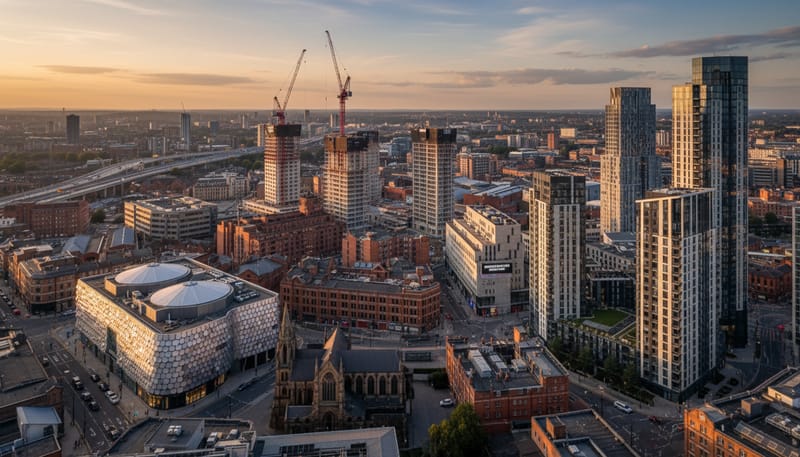
Birmingham New Build Market Overview
- Average new build price: approximately £250,000 across Birmingham (city centre apartments from ~£190,000; suburban houses from ~£260,000)
- Price growth: 22-28% over 5 years, driven by regeneration and population growth
- Rental yield: 5-6.5% gross, with student areas reaching 7%+
- Key employers: HSBC UK (headquarters), PwC, Deutsche Bank, Jaguar Land Rover (nearby), NHS (multiple major hospitals), 5 universities (80,000+ students)
- Transport: Birmingham New Street (UK's busiest interchange), HS2 Curzon Street (under construction), extensive Midland Metro tram, Birmingham Airport, M6/M42 motorway network
- Population: 1.15 million (city), 4 million (metro area) — the youngest major city in Europe with 40% of residents under 25
New Build Prices by Area
| Area | New Build Apartment | New Build House | Rental Yield | Best For |
|---|---|---|---|---|
| City Centre (Colmore Row, Broad Street) | £250,000 - £400,000 | N/A | 5-6% | Professionals, corporate lets |
| Digbeth | £190,000 - £300,000 | Limited | 5.5-7% | Creatives, investors, first-time buyers |
| Jewellery Quarter | £220,000 - £340,000 | N/A | 5-6% | Young professionals, premium renters |
| Eastside / HS2 corridor | £200,000 - £320,000 | N/A | 5.5-6.5% | Growth investors, first-time buyers |
| Edgbaston | £230,000 - £350,000 | £350,000 - £550,000 | 4.5-5.5% | Families, professionals |
| Selly Oak / Bournville | £180,000 - £260,000 | £280,000 - £420,000 | 5.5-7% | Student investors, families (Bournville) |
| Sutton Coldfield | £220,000 - £300,000 | £350,000 - £550,000 | 4-5% | Families, commuters |
| Solihull | £250,000 - £350,000 | £380,000 - £600,000 | 4-5% | Families, JLR/NEC commuters |
| Erdington / Perry Barr | £150,000 - £220,000 | £220,000 - £320,000 | 6-7.5% | Budget buyers, yield investors |
The HS2 Effect: Curzon Street and the Eastern Corridor
HS2's Birmingham Curzon Street station — currently under construction east of the city centre — is expected to be transformative. When operational, it will connect Birmingham to London Euston in approximately 38 minutes, fundamentally changing the city's relationship with the capital.
What HS2 means for property
- Direct price impact: areas within walking distance of Curzon Street (Eastside, Digbeth, Bordesley) are expected to see the strongest growth — estimates suggest 10-20% additional premium when the station opens
- Employment impact: the station area is planned to accommodate 36,000 new jobs and 4,000 new homes in the wider Curzon masterplan
- Ripple effect: improved Birmingham-London connectivity makes the entire city more attractive to London-based companies and workers seeking lower costs
Where to buy near HS2
- Eastside (directly adjacent): the closest new build area to Curzon Street. Prices from £200,000 for apartments. Multiple developments launching or in planning. This is the most direct HS2 play but prices already reflect some of the expected uplift
- Digbeth (5-10 minute walk): still lower prices than Eastside with strong regeneration momentum of its own. The creative quarter angle gives it appeal beyond pure HS2 speculation
- Bordesley / Small Heath (emerging): further east along the HS2 corridor, with the lowest prices and highest risk/reward profile. Less established but significant council investment planned
HS2 timing caveat
HS2 has faced cost overruns and delays. The Birmingham leg is proceeding but the final operational date has shifted multiple times. Buy near HS2 if you believe in the area's fundamentals beyond the train line — the station is a catalyst, not the only reason to invest. If HS2 is your sole reason for buying, you're exposed to further delay risk.
Digbeth: The Creative Quarter
Digbeth is Birmingham's most exciting regeneration story. Once an industrial area known primarily for the Custard Factory and Irish Centre, it's now emerging as the city's creative and cultural heart — drawing comparisons with Manchester's Ancoats a decade ago.
- Price range: £190,000 - £300,000 (apartments); very limited houses
- Character: Street art, independent venues, converted industrial spaces, the Custard Factory creative hub, Digbeth Dining Club (street food market), nightlife venues. Gritty but rapidly gentrifying
- Key developments: Smithfield (massive 17-hectare mixed-use development replacing the former wholesale markets), Connaught Square, Upper Trinity Street, multiple warehouse conversions
- Transport: Walking distance to New Street and Moor Street stations, HS2 Curzon Street adjacent, Midland Metro extension (planned through Digbeth)
- Growth potential: Smithfield alone will transform the area with 3,000 new homes, retail, leisure, and a new public square. Combined with HS2 and the tram extension, Digbeth could see the strongest growth of any Birmingham area over the next decade
- Best for: Buyers who want to get in early on a regeneration story, creatives who want walkable urban living, investors targeting areas with multiple growth catalysts
- Watch out for: The area is noisy at weekends (live music, nightclubs). Construction disruption will be significant for years. Some existing housing stock is poor quality — focus on new build or quality conversions
Jewellery Quarter: Established Character
The Jewellery Quarter is Birmingham's most established urban village — a designated conservation area with a mix of historic workshops, contemporary apartments, independent restaurants, and galleries.
- Price range: £220,000 - £340,000 (apartments)
- Character: Historic Georgian and Victorian architecture alongside modern conversions and new builds. Strong restaurant and bar scene (St Paul's Square). Genuine neighbourhood feel within walking distance of the city centre
- Transport: Jewellery Quarter rail and tram station, 10-minute walk to New Street
- New build availability: Limited by conservation area constraints — mostly conversions and smaller infill schemes. What's available tends to sell quickly
- Best for: Professionals wanting established urban living with character, buyers who prefer a finished neighbourhood over an emerging one
Smithfield: The City Centre's New Heart
The Birmingham Smithfield development occupies the 17-hectare site of the former Birmingham Wholesale Markets, immediately south of the Bullring. It's one of the largest city centre regeneration projects in the UK.
- Planned homes: 3,000+ across multiple phases
- Facilities: new public market, leisure attractions, cultural venues, public square, green spaces, retail, and commercial space
- Price expectations: early phases expected from ~£220,000 (apartments), rising as the development matures
- Timeline: phased delivery over 15+ years. Early residential phases launching from 2025-2027
- Investment case: buying in early phases typically offers the best prices, as with any large masterplan. But early buyers also live on a construction site — weigh the price advantage against years of disruption
Edgbaston: The Leafy Suburb
Edgbaston is Birmingham's most prestigious residential area — wide tree-lined streets, large houses, proximity to the Botanical Gardens and Edgbaston cricket ground, and easy access to the city centre.
- Price range: £230,000 - £350,000 (apartments); £350,000 - £550,000 (houses)
- Character: Leafy, established, professional. Five Ways area has a strong restaurant and bar scene. Reservoir provides waterside green space
- Transport: Short bus or cycle ride to city centre, Five Ways rail station, good road links
- Schools: Some of Birmingham's best schools, both state and independent (King Edward's schools)
- Key developments: Edgbaston Village (mixed-use), developments along Hagley Road, Lee Bank/Attwood Green area (affordable new builds closer to city centre)
- Best for: Families wanting inner-city green living, professionals working at the QE Hospital or university, buyers wanting a premium address
Selly Oak and Bournville
These adjacent areas serve very different markets despite their proximity:
Selly Oak
- Price range: £180,000 - £260,000 (apartments); £280,000 - £380,000 (houses)
- Character: University of Birmingham campus area. Dominant student population means strong rental demand but a transient feel in term time
- Rental yield: 5.5-7%+, driven by student demand. HMO (House in Multiple Occupation) lets to students can achieve higher yields but require licensing
- Best for: Buy-to-let investors targeting the student market
Bournville
- Price range: £300,000 - £420,000 (houses); limited apartments
- Character: The original Cadbury garden village — tree-lined streets, large gardens, strong community. Bournville Village Trust manages the estate with strict design standards (no pubs, limited modifications). One of Birmingham's most desirable family areas
- New build availability: Very limited due to trust controls. When new builds appear, they sell quickly at premium prices
- Best for: Families wanting an exceptional neighbourhood environment with village character
Perry Barr and Erdington: Commonwealth Games Legacy
Perry Barr hosted the 2022 Commonwealth Games athletes' village, which has been converted into 1,400 homes. This is one of Birmingham's most affordable areas with genuine regeneration momentum.
- Price range: £150,000 - £220,000 (apartments); £220,000 - £320,000 (houses)
- Character: Mixed — the athletes' village area is modern and well-designed, while surrounding streets are more traditional North Birmingham. Perry Barr station has been rebuilt and the A34 corridor upgraded
- Transport: Perry Barr station (direct to New Street in 8 mins), A34 Sprint rapid bus, good road links
- Growth drivers: Commonwealth Games infrastructure legacy, Aston University expansion nearby, council investment in public realm, significant housing allocation in local plan
- Rental yield: 6-7.5%, among the highest in Birmingham
- Best for: Budget-conscious first-time buyers wanting to be close to the city centre, and yield-focused investors
- Watch out for: Beyond the athletes' village, the area is still transitioning. Check the immediate surroundings carefully — quality varies block by block
Sutton Coldfield and Solihull: Premium Commuter Towns
Sutton Coldfield
- Price range: £220,000 - £300,000 (apartments); £350,000 - £550,000 (houses)
- Character: Affluent town within Birmingham's boundaries. Sutton Park (one of the largest urban parks in Europe) provides exceptional green space. Strong high street with independent shops
- Transport: Direct trains to New Street (20 mins), good road links (A38, M6 Toll nearby)
- Schools: Excellent state and grammar schools (Sutton Coldfield Grammar School for Girls, Bishop Vesey's Grammar School)
- Best for: Families wanting premium suburban living with excellent schools and green space, within easy commuting distance of the city centre
Solihull
- Price range: £250,000 - £350,000 (apartments); £380,000 - £600,000 (houses)
- Character: Prosperous town adjacent to Birmingham. Touchwood shopping centre, Tudor-style high street, proximity to Jaguar Land Rover, NEC, and Birmingham Airport. The UK Central/HS2 Interchange station area is a major future development zone
- Transport: Solihull station (direct to New Street and London), future HS2 Interchange station at NEC, M42 corridor
- Key development: UK Central Hub — the area around the planned HS2 Interchange station is earmarked for major mixed-use development including thousands of new homes. This is a long-term play with significant growth potential
- Best for: JLR and NEC workers, families wanting excellent facilities, buyers who want HS2 connectivity (Interchange station) in a premium setting
Transport: Midland Metro and Connectivity
Birmingham's transport network is expanding significantly:
- Midland Metro tram: currently runs from Wolverhampton through the city centre to Edgbaston. Extensions to Digbeth, Eastside, and East Birmingham are planned — the Digbeth/Eastside extension aligns with the HS2 corridor and would boost property values along the route
- Sprint rapid bus: A34 and A45 Sprint routes provide bus rapid transit connecting Perry Barr and Solihull to the city centre with dedicated bus lanes
- Rail: Birmingham New Street is the UK's busiest interchange. Cross City Line connects Lichfield, Sutton Coldfield, city centre, Selly Oak, and Longbridge. Snow Hill and Moor Street serve the north and east
- HS2: Curzon Street (city centre) and Interchange (Solihull/NEC) stations will transform long-distance connectivity
For new build buyers, proximity to current or planned transport is the single strongest predictor of value growth. The Midland Metro extension through Digbeth, when confirmed and built, will likely replicate the value uplift seen along Manchester's Metrolink corridors.
Birmingham for Buy-to-Let Investors
Birmingham offers a compelling investment case: lower entry prices than Manchester, strong yield potential, and arguably the strongest growth fundamentals of any UK city based on committed infrastructure investment.
Best areas by investment strategy
| Strategy | Best Area | Expected Yield | Growth Outlook |
|---|---|---|---|
| Capital growth | Digbeth, Eastside (HS2) | 5.5-6.5% | Strong (HS2, Smithfield, tram) |
| Maximum yield | Perry Barr, Erdington, Selly Oak | 6-7.5% | Moderate (regeneration-dependent) |
| Balanced | Jewellery Quarter, city centre | 5-6% | Steady (established demand) |
| Student lettings | Selly Oak, Edgbaston (south) | 6-8% (HMO) | Stable (5 universities) |
Key advantages
- Entry price: lower than Manchester and significantly lower than London — your investment budget goes further
- Student demand: 80,000+ students across 5 universities create persistent rental demand
- HS2 catalyst: no other UK city has a comparable infrastructure investment driving growth
- Population growth: youngest major city in Europe with strong net migration
Birmingham New Build Buying Tips
1. Check the construction type
Birmingham's rapid development includes modern methods of construction (modular, timber frame, steel frame) alongside traditional brick-and-block. Some mortgage lenders restrict lending on non-traditional construction — confirm your chosen lender accepts the construction type before reserving.
2. Understand the leasehold position
City centre apartments are leasehold. Check ground rent (should be peppercorn on new leases post-June 2022), service charges, and management company. Birmingham has seen some high-profile disputes over service charge increases — research the management company.
3. Book a snagging inspection
Birmingham's building pace means quality varies between developers and even between plots on the same development. A professional snagging inspection is essential — use our snagging checklist to know what to look for.
4. Research the neighbourhood on foot
Birmingham's neighbourhoods can change character within a few streets. A development in 'Edgbaston' might technically be in Lee Bank; one in 'Digbeth' might be on a busy dual carriageway. Visit on foot, at different times of day, and check the exact location — not just the marketing name.
5. Factor in parking and transport
Birmingham's Clean Air Zone charges non-compliant vehicles in the city centre. If you drive, check whether the development is within or outside the zone, and whether parking is included or additional cost.
6. Consider timing around HS2
Buying before HS2 opens captures the pre-completion discount. Buying after it opens means paying the established premium but with certainty of the infrastructure. Both strategies have merit — your risk appetite determines which is right.
Summary: Where to Buy in Birmingham
| Buyer Type | Best Areas | Budget |
|---|---|---|
| First-time buyer (apartment) | Digbeth, Perry Barr, Eastside | £150,000 - £250,000 |
| First-time buyer (house) | Perry Barr, Erdington, outer suburbs | £220,000 - £320,000 |
| Family | Edgbaston, Sutton Coldfield, Solihull, Bournville | £350,000 - £600,000 |
| Growth investor | Digbeth, Eastside, Smithfield | £190,000 - £300,000 |
| Yield investor | Perry Barr, Selly Oak, Erdington | £150,000 - £260,000 |
| Premium buyer | Jewellery Quarter, Edgbaston, Solihull | £350,000+ |
Further Reading
- Best Cities in the UK to Buy a New Build Home — how Birmingham compares to London, Manchester, Leeds, and 8 other cities
- Mortgage Affordability Guide — how much you can borrow for your Birmingham new build
- Mortgage Types Explained — every mortgage type available for new build buyers
- Complete Snagging Guide — your rights and how to report defects