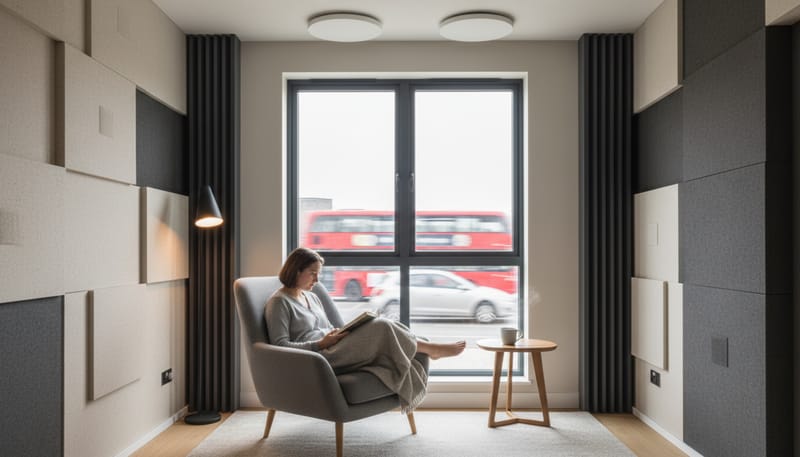
Noise is one of the most common complaints among new build homeowners in the UK. Whether it is the sound of your neighbour’s television through the party wall, footsteps on the floor above in an apartment block, the hum of a nearby road, or the drone of a heat pump outside your bedroom window, unwanted noise can significantly impact your quality of life and even your mental health. While new build homes are required to meet specific acoustic standards under Building Regulations, many homeowners find that the reality of living in their new home falls short of their expectations when it comes to sound insulation. This comprehensive guide explains the acoustic standards that new builds must meet, identifies the most common noise problems, and provides practical advice on how to improve the soundproofing of your home — whether you are dealing with airborne noise, impact noise, or external noise from traffic and neighbours.
The acoustic performance of a home is determined by a combination of the building’s design, the materials used in construction, the quality of workmanship, and the standard of fixtures and fittings. In new build homes, all of these factors are controlled by the developer, and the standards they must meet are set out in Part E of the Building Regulations (England and Wales). While Part E sets minimum standards for sound insulation between dwellings, these are precisely that — minimums. Many acoustic consultants and homeowner advocacy groups argue that the minimum standards are insufficient for comfortable living, particularly in densely designed apartment blocks and terraced houses where party walls and floors separate homes by just a few centimetres.
Understanding Sound: Airborne vs. Impact Noise
Before diving into the specifics of soundproofing, it is important to understand the two main types of noise that affect homes: airborne noise and impact noise. Each type is transmitted differently and requires different solutions, so diagnosing which type of noise you are experiencing is the first step towards addressing it effectively.
- 🎧 Talking, shouting, music, TV
- 🎧 Dog barking, children playing
- 🎧 Traffic noise from outside
- 🎧 Appliance noise (washing machine, dishwasher)
- 👣 Footsteps (especially on hard floors)
- 👣 Doors closing or slamming
- 👣 Items dropped on floors
- 👣 Plumbing vibrations through walls
There is also a third category worth mentioning: flanking noise. This is sound that bypasses the main separating element (wall or floor) by travelling through connected elements like junctions, service penetrations, ventilation ducts, or even the building’s structural frame. Flanking noise is a common problem in new builds and can be particularly difficult to diagnose and remedy, as it requires understanding the entire sound transmission path rather than just the performance of a single wall or floor.
Building Regulations Part E: The Legal Standards
Part E of the Building Regulations (Resistance to the Passage of Sound) sets out the minimum standards for sound insulation in new build dwellings in England and Wales. These standards apply to separating walls and floors between different dwellings, as well as between dwellings and common areas. Part E was last significantly updated in 2003, and while there have been minor amendments since, many acoustic professionals argue that the standards are overdue for a more substantial revision.
Under Part E, developers can demonstrate compliance in two ways. The first is pre-completion testing (PCT), where a specialist acoustic testing company visits the development before handover and tests the actual sound insulation performance of a sample of separating walls and floors. The second is the use of Robust Details (RD), which are pre-approved construction specifications that have been shown to achieve the required sound insulation levels without the need for individual site testing. Most large developers use Robust Details because it avoids the cost and risk of site testing, but critics argue that real-world performance can fall short of the laboratory conditions under which Robust Details are approved.
Common Noise Problems in New Build Homes
Despite being required to meet Building Regulations, many new build homes experience noise problems that significantly affect residents’ daily lives. Understanding the most common issues will help you identify whether your home has an acoustic deficiency and what steps you can take to address it. Below are the noise problems most frequently reported by new build homeowners.
Why Do New Builds Sometimes Have Poor Acoustics?
Several factors contribute to acoustic problems in new build homes. Understanding these factors helps explain why a home that meets Building Regulations on paper may still feel noisy in practice, and why some developments are worse than others.
Lightweight construction methods: Modern new builds increasingly use lightweight materials such as timber frames, metal frames, and lightweight steel structures instead of traditional dense masonry. While these methods offer advantages in speed of construction and cost, they are inherently less effective at blocking sound than dense, heavy materials. A 215mm solid brick wall, for example, provides significantly better sound insulation than a timber-frame party wall with plasterboard and insulation, even if both technically meet the minimum Part E standard.
Workmanship issues: Acoustic performance is highly sensitive to the quality of workmanship. Small gaps in plasterboard, unfilled holes around service penetrations, mortar joints that are not fully filled in party walls, and missing or compressed acoustic insulation can all significantly reduce the sound insulation performance of a wall or floor. On large new build sites where work is often carried out at speed by subcontractors, these quality issues are unfortunately common.
Flanking transmission: Even if the main separating wall or floor achieves excellent sound insulation, noise can bypass it by travelling through connected elements. Junction details — where walls meet floors, where walls meet external walls, and where services penetrate the structure — are critical for acoustic performance. If these junctions are not properly detailed and constructed, flanking noise can be a significant problem. This is especially true in lightweight construction where the structural frame provides a continuous vibration path.
Minimum standards vs. comfort: The Part E minimum standards were designed as a floor below which performance should not fall, not as a target for comfortable living. A wall or floor that just barely meets the 45 dB airborne standard will allow a normal conversation in the next room to be audible as a low murmur. A wall or floor achieving 55+ dB would render the same conversation virtually inaudible. The gap between “legal minimum” and “comfortable living” is significant, and many new build homeowners are unpleasantly surprised by this.
Practical Soundproofing Improvements
If you are experiencing noise problems in your new build home, there are a range of practical steps you can take to improve the situation. These range from simple, low-cost measures to more significant acoustic upgrades that require professional installation. The right approach depends on the type of noise you are experiencing, where it is coming from, and your budget.
Reducing Impact Noise (Floors)
Impact noise from upstairs neighbours is best addressed at source — that is, by improving the floor in the flat above. However, this is often not within your control. If you are in an upper-floor flat causing impact noise for the flat below, consider the following improvements. If you are in the flat below and cannot persuade your upstairs neighbour to act, the options are more limited but still worth exploring.
Reducing Airborne Noise (Walls)
If airborne noise through party walls is the problem, several solutions are available. The most effective involve adding mass and creating an isolated layer on your side of the wall. Here are the options, from simplest to most effective.
Reducing External Noise (Windows and Doors)
External noise from traffic, railways, and neighbours is primarily transmitted through windows and ventilation openings, as these are the weakest points in the building envelope. Upgrading windows and ensuring proper sealing can make a dramatic difference to internal noise levels.
- Standard double glazing: 28–32 dB reduction
- Acoustic double glazing: 35–40 dB (asymmetric panes)
- Triple glazing: 36–42 dB reduction
- Secondary glazing: 40–50 dB (best option)
- Acoustic trickle vents: Reduce vent noise by 8–12 dB
- Seal gaps: Acoustic sealant around frames (£10–£30)
- Heavy curtains: Thermal/acoustic curtains (£50–£200)
- Acoustic blinds: Specialist honeycomb blinds (£80–£300)
- Draft strips: Replace worn seals on windows (£5–£20)
- Soft furnishings: Absorb reflected noise inside (£0–£500)
Heat Pump Noise: A Growing Issue
With the UK government’s push towards heat pumps as part of the transition away from gas boilers, air source heat pumps (ASHPs) are becoming standard in new build homes. While modern heat pumps are quieter than earlier models, they still produce noise levels of 40–60 dB at one metre, and on densely developed new build estates where homes are close together, the positioning of heat pump units can cause significant problems for neighbours.
Planning guidance requires that heat pumps should not exceed 42 dB at the nearest noise-sensitive point (typically a neighbour’s window). However, achieving this on closely spaced new build plots requires careful positioning and sometimes acoustic screening. If your neighbour’s heat pump is causing a noise nuisance, or if your own heat pump is louder than expected, there are several potential solutions.
- ☑ Acoustic enclosure: Purpose-built enclosure around the unit (must allow airflow). Cost: £500–£2,000. Reduction: 5–15 dB.
- ☑ Anti-vibration mounting: Rubber or spring mounts to reduce transmitted vibration. Cost: £100–£300. Helps with low-frequency hum.
- ☑ Acoustic fencing: Dense timber or composite fence between unit and neighbours. Cost: £200–£800. Reduction: 5–10 dB.
- ☑ Repositioning: Moving the unit to a less noise-sensitive location (may require installer). Cost: £500–£2,000.
- ☑ Night mode settings: Reduce fan speed during night hours. Cost: Free (check your controller). Reduces output noise by 3–8 dB.
Your Rights If Sound Insulation Is Inadequate
If you believe that the sound insulation in your new build home does not meet Building Regulations or is not fit for purpose, you have several routes for seeking a remedy. The appropriate route depends on whether the issue is a failure to meet Part E standards (a Building Regulations matter), a snagging defect (a warranty matter), or a statutory nuisance (an environmental health matter).
Acoustic Testing: What to Expect
If you decide to commission an independent acoustic test, here is what to expect. An acoustic consultant will visit your home with specialised equipment including a calibrated loudspeaker (for airborne tests), a tapping machine (for impact tests), and precision sound level meters. The test typically takes 2–4 hours and involves generating a known level of noise on one side of the separating element (wall or floor) and measuring how much sound passes through to the other side.
You will need cooperation from your neighbour for the test, as the testing equipment needs to be set up in both properties. If your neighbour is unwilling, the acoustic consultant may be able to carry out a partial assessment, but a full Part E compliance test requires access to both sides. The results are presented in a formal report that compares the measured performance against Part E requirements and provides a clear pass or fail verdict.
Room-by-Room Soundproofing Guide
Different rooms in your home have different acoustic requirements and different noise challenges. Here is a room-by-room guide to the most effective soundproofing strategies for new build homes.
Noise Management in Apartment Blocks
Living in a new build apartment block presents unique acoustic challenges. With homes above, below, and on either side, the potential for noise disturbance is significantly greater than in a house. Many apartment blocks also have communal areas — corridors, stairwells, bin stores, and parking areas — that generate additional noise. Understanding the specific challenges and solutions for apartment living is essential for maintaining a peaceful home.
One of the most common issues in new build apartments is the impact of lease or management company rules on flooring choices. Many leases require a minimum proportion of carpet or stipulate acoustic underlay requirements for hard flooring. These rules exist because hard flooring without adequate acoustic underlay can dramatically increase impact noise for the flat below, potentially making conditions unbearable even if the floor structure itself meets Part E. If your upstairs neighbour has installed hard flooring without adequate acoustic treatment, and it is causing a noise problem, check the lease terms — they may be in breach, and the management company has a duty to enforce lease covenants.
Communal noise is another significant issue in apartment blocks. Doors slamming in corridors, footsteps on hard-floored hallways, lift mechanisms, boiler rooms, and bin store access can all generate noise that penetrates into flats. Good management companies will address these issues by installing door closers (to prevent slamming), carpeting or acoustic flooring in corridors, and ensuring that mechanical plant rooms are properly isolated from residential areas. If your management company is not addressing communal noise, raise it formally in writing and at residents’ meetings.
Dealing with Noisy Neighbours on New Builds
Sometimes the noise problem is not about the building’s acoustic performance but about a neighbour’s behaviour. Loud music at anti-social hours, barking dogs, parties, and domestic disputes are all issues that can affect your quality of life regardless of how well soundproofed your home is. Dealing with noisy neighbours on a new build estate requires a balance of diplomacy and assertiveness.
The first step should always be a polite, direct conversation with your neighbour. Many people are genuinely unaware that their activities are causing a disturbance, and a friendly word can resolve the issue immediately. If a direct conversation does not work, or if you do not feel comfortable approaching your neighbour, put your complaint in writing. If the noise continues, you can report it to your local council’s Environmental Health team, who have the power to investigate and take enforcement action against statutory nuisance under the Environmental Protection Act 1990.
On managed new build estates, you can also report noise issues to the management company, which may have rules about noise levels and anti-social behaviour in the estate’s regulations. In leasehold blocks, the lease typically contains provisions about noise and nuisance, and the management company has a duty to enforce these provisions. Keep a detailed noise diary (dates, times, type of noise, duration) to support any formal complaint.
Soundproofing Costs Summary
The cost of soundproofing your new build home varies enormously depending on the scale of the problem and the solution you choose. Here is a summary of the most common soundproofing projects and their typical costs for a standard room.
Living in a well-soundproofed home is fundamental to quality of life. Whether you are a light sleeper disturbed by traffic noise, a remote worker needing quiet concentration, or a flat dweller hearing every footstep from above, the solutions outlined in this guide can help you achieve the peaceful home environment you deserve. Take action, know your rights, and do not settle for noise levels that affect your wellbeing.