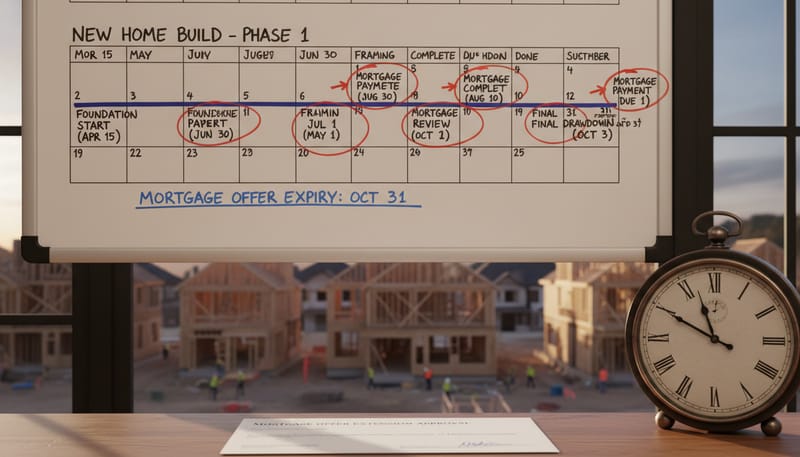
The New Build Purchase Timeline
Every new build purchase follows a similar sequence, but the durations vary dramatically depending on whether you're buying a completed property, one nearing completion, or off-plan.
Timeline by Purchase Type
| Stage | Nearly Complete (1–3 Months) | Under Construction (3–12 Months) | Off-Plan (12–24+ Months) |
|---|---|---|---|
| Reservation | Day 1 | Day 1 | Day 1 |
| Mortgage application | Week 1 | Varies (see strategy below) | Often deferred until nearer completion |
| Mortgage offer received | Weeks 3–6 | Depends on when you apply | Depends on when you apply |
| Exchange of contracts | Weeks 4–8 | Weeks 4–12 | Weeks 4–12 |
| Construction completion | Weeks 4–12 | Months 3–12 | Months 12–24+ |
| Notice to complete | 10–14 days before legal completion | 10–14 days before legal completion | 10–14 days before legal completion |
| Legal completion / keys | Weeks 8–14 | Months 4–14 | Months 13–26+ |
The Critical Alignment
Your mortgage offer must be valid on the day of legal completion. This sounds simple, but it creates a puzzle:
- Apply too early → your offer may expire before completion
- Apply too late → you may not have an offer ready when the developer issues notice to complete
- Apply at the wrong time → you may lock in a rate that's higher than what becomes available later
When to Apply for Your Mortgage
Strategy by Completion Timeline
| Expected Completion | When to Apply | Rationale |
|---|---|---|
| Within 3 months | Immediately after reservation | Offer will comfortably cover the completion period |
| 3–6 months | Immediately or within 1 month | Standard 6-month offers should cover; build in buffer for delays |
| 6–9 months | 3–4 months before expected completion | Applying earlier risks offer expiry; some lenders offer 9-month offers for new builds |
| 9–12 months | 5–6 months before expected completion | Use a lender with 6-month offer + automatic extension, or time the application carefully |
| 12–24 months (off-plan) | 6–8 months before expected completion | Too early to apply now; monitor rates and apply when completion is within offer validity range |
The Two-Stage Strategy for Off-Plan
For purchases where completion is 12+ months away:
- Stage 1 (at reservation): Get an Agreement in Principle (AIP) — this satisfies the developer and confirms your borrowing capacity. Use a soft-search AIP to avoid credit file impact
- Stage 2 (6 months before completion): Submit your full mortgage application. This ensures your offer will be valid at completion while giving you the most current rates
Monitoring Between Stages
During the gap between Stage 1 and Stage 2:
- Keep your finances "mortgage ready" — don't take on new debt, change jobs unnecessarily, or make large unusual transactions
- Monitor interest rates — if rates are falling, you may benefit from applying later. If rising, consider applying sooner
- Stay in contact with your broker — they can alert you to rate changes or new products
- Track construction progress — delays affect your application timing
Mortgage Offer Validity Periods
Standard Offer Validity by Lender Type
| Lender Category | Standard Validity | New Build Validity | Extension Available? |
|---|---|---|---|
| Major high-street banks | 3–6 months | 6 months (most) | Yes — typically 3 months, one extension |
| Large building societies | 3–6 months | 6 months | Often more flexible — 3–6 month extensions |
| Challenger banks | 3–6 months | Varies | Varies — check before applying |
| Specialist new build lenders | 6–9 months | 6–9 months | Often longer validity built in |
What "Validity" Actually Means
The offer validity period is the window during which the lender guarantees the terms of the offer (rate, loan amount, conditions). After expiry:
- The guaranteed rate is no longer available
- You may need to reapply from scratch
- Your circumstances will be reassessed (income, credit, affordability)
- The property may need to be revalued
- Current rates may be higher (or lower) than your original offer
Getting Your Offer Extended
How Extensions Work
| Extension Type | What Happens | Requirements |
|---|---|---|
| Automatic extension | Lender automatically extends by 3 months for new builds | No action needed — check if your lender offers this at application |
| Request-based extension | You or your broker request an extension; lender reviews and approves | Typically a simple phone call or form; may involve a soft credit re-check |
| Extension with reassessment | Lender extends but requires updated income/credit verification | Updated payslips, bank statements; potentially new affordability calculation |
| Extension at new rate | Lender extends but at current rates (not your original rate) | You keep the offer but at whatever rate is available now |
Extension Success Factors
| Factor | Impact on Extension Approval |
|---|---|
| Reason for delay | Construction delays by the developer are generally viewed sympathetically |
| Your financial situation unchanged | If income and debts are the same, extension is straightforward |
| Your financial situation worsened | New debts, job change, or reduced income may trigger reassessment or decline |
| Number of previous extensions | First extension usually easy; second or third may require full reassessment |
| Market conditions | In a rising rate environment, lenders may be less willing to extend at the original rate |
What to Do If Extension Is Refused
- Ask why: Understand the specific reason — it may be fixable
- Reapply with the same lender: Sometimes a fresh application at current rates is approved even when an extension is refused
- Switch lenders: Your broker can quickly identify a new lender with a suitable product
- Consider a product transfer within the lender: Some lenders offer internal switches that don't count as new applications
Managing Construction Delays
Construction delays are common in new build developments. Materials shortages, labour issues, weather, and planning complications all cause slippage.
Typical Delay Scenarios
| Developer's Stated Timeline | Realistic Expectation | Worst Case |
|---|---|---|
| "Completing in 3 months" | 3–5 months | 6–8 months |
| "Completing in 6 months" | 6–9 months | 12+ months |
| "Completing in 12 months" | 12–18 months | 24+ months |
| "Off-plan — 2 years" | 2–3 years | 3+ years or cancelled |
As a general rule, add 30–50% to the developer's estimated timeline for mortgage planning purposes.
Impact of Delays on Your Mortgage
| Delay Duration | Mortgage Impact | Action Required |
|---|---|---|
| 1–2 months | Usually within offer validity | No action if offer has enough remaining validity |
| 3–6 months | Offer may expire; extension needed | Request extension; if refused, reapply |
| 6–12 months | Offer will almost certainly expire | Likely need full reapplication; rates may have changed significantly |
| 12+ months | Complete reset — new application, new rate, new affordability assessment | Start mortgage process from scratch when new completion date is realistic |
Financial Risks of Extended Delays
- Rate rises: If base rates increase during the delay, your new mortgage rate may be higher, increasing monthly payments and potentially failing affordability
- Income changes: Job loss, salary reduction, new debts, or having a baby during the delay can affect your reapplication
- Property value changes: In a falling market, the property may be revalued lower, affecting your LTV
- Deposit erosion: If you're renting while waiting, your savings for the deposit may be depleted
- Reservation fee at risk: Some developers retain the reservation fee if you can't complete
What Happens If Rates Change
Your Rate Is Locked In Your Offer
Once you have a mortgage offer, the rate in that offer is guaranteed for the offer validity period. Even if rates rise the next day, your offer stands.
Rate Change Scenarios
| Scenario | Impact | Strategy |
|---|---|---|
| Rates rise after your offer | You're protected — your offer rate is locked | Complete within the offer period to keep the rate |
| Rates fall after your offer | You're locked into a higher rate (unless you reapply) | Ask your broker to compare: is it worth reapplying at a lower rate? Factor in potential delays and fees |
| Rates rise and your offer expires | New application will be at higher rates | Get the extension at original rate if possible; if not, reapply and budget for higher payments |
| Rates change between AIP and full application | Your AIP rate was indicative only; actual rate is set at application | Apply when you're confident of completion timing; consider rate trends |
Rate Lock Products
Some lenders offer specific features for new build timing:
- Extended rate locks: Lock in today's rate for up to 6–9 months before completion
- Rate drop guarantees: If rates fall before completion, you automatically get the lower rate
- New build-specific products: Longer validity periods built into the product terms
These products are particularly valuable in a volatile rate environment. Ask your broker about availability.
Exchange of Contracts: Timing and Strategy
Exchange of contracts is the point of no return — after exchange, both you and the developer are legally committed.
What Must Be in Place Before Exchange
| Requirement | Status Needed | Why |
|---|---|---|
| Mortgage offer | Issued and valid | Your solicitor won't exchange without a valid offer in place |
| Deposit funds | Available and cleared in solicitor's client account | Exchange deposit (typically 10%) is paid on exchange |
| Searches completed | All satisfactory | Local authority, water, environmental searches |
| Contract reviewed | Your solicitor has reviewed and negotiated terms | Developer contracts are often heavily one-sided |
| Buildings insurance | Arranged (some lenders require it from exchange) | Protects against damage between exchange and completion |
Exchange Timing Strategies
| Strategy | When to Use | Risk Level |
|---|---|---|
| Exchange early (property incomplete) | Developer requires early exchange; off-plan purchases | Higher — you're committed but property isn't finished. Protected by long-stop date |
| Exchange when property is near complete | Property nearing completion; you have confidence in timeline | Lower — shorter gap between exchange and completion |
| Simultaneous exchange and completion | Completed property ready for immediate occupation | Lowest — no gap between commitment and keys |
Developer Pressure to Exchange Early
Developers often push for early exchange because:
- It secures the sale in their figures
- Your exchange deposit provides cash flow
- It reduces the risk of you pulling out
You should resist pressure to exchange before your solicitor is satisfied with all legal matters. However, reasonable exchange timelines (within 28 days of reservation for completed properties) are normal.
Long-Stop Dates and Your Rights
A long-stop date is a contractual deadline by which the developer must complete the property and be ready for legal completion. If they fail to meet this date, you have the right to withdraw and reclaim your deposit.
How Long-Stop Dates Work
| Aspect | Detail |
|---|---|
| Typical duration | 12–24 months from exchange (varies by contract) |
| Who sets it | Negotiated between solicitors; developer's contract usually proposes one |
| What triggers it | Developer fails to issue notice to complete by the long-stop date |
| Your right | You can rescind (cancel) the contract and receive a full deposit refund |
| Developer's right | Some contracts allow the developer to extend the long-stop date — review carefully |
Negotiating Your Long-Stop Date
- Make it reasonable: The long-stop date should give the developer enough time to complete, but not so long that you're committed indefinitely
- Resist unilateral extension clauses: If the contract allows the developer to extend the long-stop date at will, negotiate this out or limit it
- Include interest on deposit: If the long-stop date is reached and you rescind, some contracts include interest on the returned deposit
- Consider mortgage timing: Align the long-stop date with your realistic ability to maintain mortgage offers (including extensions)
Consumer Code for Home Builders Requirements
Under the Consumer Code for Home Builders (2024 edition), developers must:
- Provide a realistic completion date at reservation
- Notify you promptly of any significant delays
- Offer a reasonable long-stop date
- Return your reservation fee if completion is significantly delayed beyond the long-stop date
Notice to Complete: The Final Countdown
The notice to complete is the developer's formal notification that the property is ready for legal completion.
What Happens When You Receive Notice
| Day | Action |
|---|---|
| Day 1 | Notice received — your solicitor confirms the completion date (usually 10–14 days from notice) |
| Days 1–3 | Check mortgage offer is still valid. If expiring, contact lender/broker immediately for extension |
| Days 1–5 | Arrange snagging inspection before completion (recommended but not always possible) |
| Days 3–7 | Solicitor requests mortgage funds from lender (lenders need 5+ working days to release funds) |
| Days 5–10 | Ensure buildings insurance is in place. Arrange utility connections. Book removals |
| Day 10–14 | Completion day — mortgage funds transfer, developer receives payment, you get keys |
What If You Can't Complete on Time?
If you receive notice to complete but can't meet the deadline:
| Reason | Consequence | Action |
|---|---|---|
| Mortgage offer expired | Can't draw down funds | Request emergency extension or product transfer; inform developer of short delay |
| Deposit funds not ready | Can't complete exchange balance | Ensure funds are transferred to solicitor well in advance |
| Solicitor delays | Legal work incomplete | Chase solicitor; request short extension from developer |
| Changed mind | Risk losing deposit if post-exchange | Seek legal advice immediately — options depend on contract terms |
Failure to complete after notice can result in penalty interest charges (typically 4–5% above base rate on the purchase price) and potentially contract rescission with forfeiture of your deposit.
Off-Plan Purchases: Extra Timing Considerations
The Off-Plan Timing Challenge
Off-plan purchases amplify every timing risk because the gap between reservation and completion can be 1–3+ years. During this period:
- Interest rates may change by 1–3%+
- Your employment, income, or debts may change
- Property values may rise or fall
- Lending criteria may tighten or relax
- Government schemes may open or close
Off-Plan Mortgage Strategy
| Phase | Action | Purpose |
|---|---|---|
| Reservation (Month 0) | Get AIP (soft search). Do not apply for full mortgage yet | Satisfy developer; confirm borrowing capacity |
| Monitoring (Months 1–12+) | Maintain mortgage readiness. Track rates. Stay in contact with broker | Be prepared to apply when timing is right |
| Pre-application (6–8 months before completion) | Review finances, gather documents, compare current rates | Prepare for optimal application |
| Application (4–6 months before completion) | Submit full mortgage application | Secure offer with enough validity for completion |
| Completion (Month 0) | Draw down mortgage, complete purchase | Get the keys |
Off-Plan Valuation Issues
Valuations for off-plan properties are inherently uncertain because:
- The property doesn't physically exist yet (or is partially built)
- Comparable sales data may be limited or non-existent
- The valuer is assessing plans and specifications, not a finished product
- Market conditions at completion may differ from when you reserved
Some lenders conduct a "desktop" or "on plans" valuation at application and then a final valuation on completion. If the completion valuation differs, it can affect the mortgage terms.
Common Timing Scenarios and Solutions
Scenario 1: Build Delayed by 3 Months
| Situation | Solution |
|---|---|
| Your 6-month offer has 4 months remaining | No action needed — your offer covers the delay. Monitor for further slippage |
| Your 6-month offer has 2 months remaining | Request a 3-month extension immediately. Most lenders approve this routinely |
| Your 6-month offer has expired | Contact lender for retrospective extension (some allow this). If not, reapply or switch lenders |
Scenario 2: Rates Have Dropped Since Your Offer
| Situation | Solution |
|---|---|
| Rate dropped by 0.1–0.2% | Probably not worth reapplying — the hassle and potential delay outweigh the saving |
| Rate dropped by 0.3–0.5% | Calculate the saving over the deal period. If significant, reapply or ask for a rate match |
| Rate dropped by 0.5%+ | Almost certainly worth reapplying. On a £250,000 mortgage, this saves £100+/month |
Scenario 3: You've Changed Jobs During the Wait
| Situation | Impact | Solution |
|---|---|---|
| Same industry, higher salary | Positive — may improve affordability | If offer still valid, no action needed. If reapplying, you may qualify for more |
| Different industry, in probation | Risky — some lenders decline during probation | Use your existing offer if still valid. If reapplying, seek a probation-friendly lender |
| Became self-employed | Significant problem — most lenders need 2+ years trading history | Try to use existing offer. If reapplying, very limited options. Consider delaying purchase |
Scenario 4: You've Had a Baby
| Situation | Impact | Solution |
|---|---|---|
| On maternity/paternity leave at time of reapplication | Some lenders use maternity pay for affordability, reducing borrowing | If possible, use existing offer. If reapplying, seek a lender that uses your return-to-work salary |
| Returning to work full-time | Affordability based on full salary | Provide employer confirmation of return date and salary |
| Returning part-time | Affordability based on reduced hours | May need to reduce borrowing or find a more flexible lender |
Scenario 5: Developer Goes Into Administration
| Stage | Your Position | Action |
|---|---|---|
| Pre-exchange | You're not legally committed. Reservation fee may be at risk | Do not exchange. Seek return of reservation fee. Look for alternative properties |
| Post-exchange, pre-completion | You have a contract but the developer can't fulfil it | Seek legal advice immediately. Your deposit may be protected in a stakeholder account |
| Another company takes over the development | Your contract may transfer to the new developer | Your solicitor should confirm whether contracts transfer and terms remain the same |
How to Protect Yourself
Before Reservation
- Research the developer's track record — check Companies House, NHBC, and online reviews
- Ask about realistic completion timelines (not marketing timelines)
- Check which lenders accept the developer
- Verify whether the developer participates in Deposit Unlock (if needed)
Contract Protections
| Protection | What It Does | How to Get It |
|---|---|---|
| Reasonable long-stop date | Allows you to withdraw if developer misses deadline | Your solicitor negotiates this into the contract |
| Deposit protection | Your exchange deposit held by a stakeholder (not the developer) | Insist on stakeholder account rather than developer holding deposit |
| Specification schedule | Detailed list of what's included in the property | Attach as a schedule to the contract |
| Delay compensation clause | Developer compensates you for unreasonable delays | Negotiate into contract (developers often resist) |
| NHBC warranty confirmation | Warranty must be in place before completion | Standard requirement — your solicitor should verify |
Financial Buffer
- Maintain 3–6 months' mortgage payments in savings as a buffer
- Don't commit your entire deposit fund — keep a reserve for unexpected costs
- Avoid major financial changes (new car, large purchases) between reservation and completion
- Keep your credit profile clean throughout the entire purchase process
Communication
- Request monthly construction updates from the developer
- Stay in regular contact with your broker about rate movements and offer validity
- Keep your solicitor informed of any timeline changes
- Document everything in writing — don't rely on verbal promises
Frequently Asked Questions
How long does a new build mortgage offer last?
Typically 3–6 months, with some lenders offering automatic extensions of 3 months for new builds. The total validity period (including extension) is usually 6–9 months. Some specialist lenders offer up to 12 months for off-plan purchases.
Can I change my mortgage lender after reserving?
Yes. You're not committed to a specific lender until you exchange contracts with the mortgage in place. You can switch lenders at any point before exchange, though this may cause delays. After exchange, switching is more complex but still possible if your solicitor can manage the timing.
What if the developer asks me to complete before my mortgage offer is ready?
You cannot complete without mortgage funds. Inform the developer that you need your mortgage offer in place before completion. If they're applying unreasonable pressure, your solicitor can push back. You should never exchange without a valid mortgage offer.
Should I lock in a rate now or wait?
This depends on rate trends and your risk tolerance. If rates are stable or rising, locking in sooner protects you. If rates are falling, waiting may get you a better deal — but you risk them rising again. Many buyers compromise by locking in 4–6 months before completion, which balances certainty with timing.
What happens to my reservation fee if I can't get a mortgage?
This depends on the developer's reservation terms. Some refund the fee if you can't secure financing; others keep it. Always check the reservation terms before paying. If possible, ensure there's a "subject to mortgage" clause that protects your fee.
Can construction delays help me if rates have fallen?
Yes, paradoxically. If your offer expires due to a delay and you reapply at lower rates, you benefit from the delay. This is the silver lining of construction slippage in a falling rate environment.