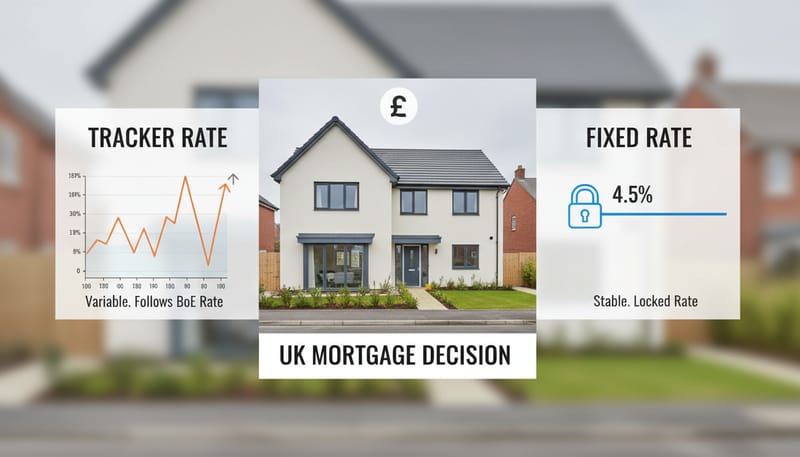
Tracker vs Fixed Rate Mortgages for New Build Homes
An in-depth comparison of tracker and fixed rate mortgages for UK new build buyers, covering how each works, the role of the Bank of England base rate, historical trends, and which suits different financial situations.
Choosing between a tracker and a fixed rate mortgage is one of the most consequential financial decisions you will make when buying a new build home in the United Kingdom. This choice will determine not only your monthly mortgage payment for the next two, three, five, or even ten years, but also how exposed you are to changes in interest rates and how much financial certainty you have during a period when many new build homeowners are already stretching their budgets to furnish and personalise their new properties. The wrong choice could cost you thousands of pounds over the life of your mortgage deal, while the right one could save you a comparable amount. Yet despite its importance, many buyers make this decision based on incomplete information, outdated assumptions, or a general sense of which option feels safer, rather than a thorough analysis of their personal financial circumstances and the prevailing market conditions.
In this guide, we will provide a comprehensive comparison of tracker and fixed rate mortgages specifically tailored to new build buyers in the UK. We will explain exactly how each type of mortgage works, examine the historical performance of the Bank of England base rate that underpins tracker mortgages, analyse the current market conditions and what they mean for your choice, and provide a structured framework for deciding which option is right for you. We will also look at some less common alternatives, including discount variable rate mortgages and capped tracker products, which can offer elements of both fixed and variable rate mortgages. Whether you are a first-time buyer purchasing a starter home or an experienced homeowner moving to a larger new build property, this guide will equip you with the knowledge to make a confident and well-informed decision. For related guidance, explore our article on how rising base rates affect your new build mortgage options.
How Fixed Rate Mortgages Work
A fixed rate mortgage locks in your interest rate for a specified period, typically two, three, five, or ten years. During this fixed period, your interest rate and monthly payment remain exactly the same, regardless of what happens to the Bank of England base rate or wider interest rate markets. This provides certainty and predictability, which is particularly valuable for new build buyers who are managing tight budgets and need to know exactly what their housing costs will be each month.
When the fixed period ends, your mortgage will revert to the lender's standard variable rate (SVR), which is typically significantly higher than the fixed rate you were paying. At this point, most borrowers remortgage to a new fixed or tracker rate deal, either with their existing lender or with a different one. The SVR is essentially the lender's default rate for borrowers who do not have a specific deal in place, and it is rarely competitive. As of early 2025, the average SVR across UK lenders is approximately 7.5% to 8.5%, compared to the best two-year fixed rates of around 4.0% to 4.5% and the best five-year fixed rates of around 3.8% to 4.3%.
The main advantage of a fixed rate mortgage is certainty. You know exactly what your monthly payment will be for the entire fixed period, which makes budgeting straightforward and protects you against the financial stress that can accompany unexpected increases in your housing costs. This certainty is particularly valuable in periods of rising interest rates, where a fixed rate effectively locks in a lower rate before further increases take effect. The main disadvantage is inflexibility: if interest rates fall during your fixed period, your rate stays the same, and you miss out on the benefit. Additionally, fixed rate mortgages typically come with early repayment charges (ERCs) that make it expensive to leave the deal before the fixed period ends, which can be problematic if your circumstances change and you need to move or remortgage.
How Tracker Mortgages Work
A tracker mortgage has an interest rate that is directly linked to the Bank of England base rate. The tracker rate is expressed as a margin above the base rate, for example "base rate plus 0.75%". When the base rate changes, your mortgage rate changes by exactly the same amount, and your monthly payment adjusts accordingly. If the base rate goes down by 0.25%, your mortgage rate and payment go down by the same amount. If the base rate goes up by 0.25%, your rate and payment go up correspondingly.
Tracker mortgages are available in various terms, including two-year, five-year, and lifetime trackers. Two-year tracker products are the most common and typically offer the most competitive margins above the base rate. Lifetime trackers, which track the base rate for the entire term of the mortgage, are less common but can offer exceptional value if rates remain low or fall over time. The margin above the base rate varies between lenders and depends on the LTV ratio, term, and other factors. As of early 2025, with the Bank of England base rate at 4.5%, competitive two-year tracker rates are available from around 4.75% to 5.25% (base rate plus 0.25% to 0.75%).
The main advantage of a tracker mortgage is that you benefit automatically when interest rates fall. If the Bank of England cuts the base rate, your mortgage rate drops immediately, and your monthly payment decreases. This makes tracker mortgages particularly attractive during periods when rates are expected to decline. The main disadvantage is the uncertainty: your monthly payment can increase if rates rise, potentially significantly and at short notice. The Bank of England's Monetary Policy Committee meets eight times a year to set the base rate, and each meeting carries the potential for a change that will directly affect your monthly payment.
Side-by-Side Comparison
To help you compare the two options directly, the following analysis shows the monthly payment on a £250,000 mortgage over 25 years under various interest rate scenarios. This illustrates both the potential savings and the potential risks of each option.
| Scenario | Fixed Rate | Tracker Rate | Monthly Payment Fixed | Monthly Payment Tracker |
|---|---|---|---|---|
| Base rate falls to 3.5% | 4.29% | 4.00% | £1,363 | £1,319 |
| Base rate stays at 4.5% | 4.29% | 5.00% | £1,363 | £1,461 |
| Base rate rises to 5.5% | 4.29% | 6.00% | £1,363 | £1,610 |
| Base rate falls to 2.5% | 4.29% | 3.00% | £1,363 | £1,185 |
The table reveals the fundamental trade-off between the two options. The fixed rate provides absolute certainty: your payment stays at £1,363 per month regardless of what happens to the base rate. The tracker offers potential savings if rates fall but carries significant upside risk if they rise. The difference between the best and worst tracker scenarios in this example is £425 per month, or over £5,000 per year, which represents a substantial range of uncertainty for your household budget.
The Role of the Bank of England Base Rate
The Bank of England base rate is the single most important factor in determining whether a tracker or fixed rate mortgage offers better value. The base rate is set by the Bank's Monetary Policy Committee (MPC), which meets eight times a year to assess the state of the UK economy and determine whether the rate should be raised, lowered, or held. The MPC's primary mandate is to keep inflation close to the government's 2% target, and it uses the base rate as its main tool for achieving this.
When inflation is above target, the MPC tends to raise the base rate to cool the economy and bring inflation down. When inflation is below target or the economy is in recession, the MPC tends to cut the base rate to stimulate economic activity. The recent history of the base rate illustrates this dynamic vividly. In March 2020, the MPC cut the base rate to a historic low of 0.1% in response to the Covid-19 pandemic. It remained at or near this level until December 2021, when the MPC began a series of rapid increases in response to surging inflation. By August 2023, the base rate had reached 5.25%, the highest level since 2008. Since then, the MPC has begun a gradual easing cycle, with the rate reduced to 4.5% by early 2025.
The future path of the base rate is uncertain, but market expectations provide some guidance. As of early 2025, financial markets are pricing in further gradual reductions in the base rate over the next two to three years, with the rate expected to settle in the range of 3.5% to 4.0% by 2027. If these expectations materialise, tracker mortgage holders would benefit from lower rates and reduced monthly payments over this period. However, market expectations are not predictions; they reflect current sentiment and can change rapidly in response to new economic data, geopolitical events, or policy shifts.
Risk Tolerance and Personal Circumstances
Your choice between a tracker and a fixed rate mortgage should be heavily influenced by your personal risk tolerance and financial circumstances. Risk tolerance is a subjective measure of how comfortable you are with uncertainty in your financial outcomes. Some people sleep well at night knowing that their mortgage payment is locked in and cannot change, while others are comfortable with the possibility that their payment might fluctuate in exchange for the chance of paying less if rates fall.
Several factors should inform your risk assessment. If you are a first-time buyer on a tight budget with a single income, a fixed rate mortgage is almost certainly the right choice. The certainty of a fixed payment protects you against rate increases that could stretch your finances to breaking point. If you are a dual-income household with a comfortable margin between your income and outgoings, you can afford to take on the risk of a tracker, knowing that even if rates rise, you have the financial capacity to absorb higher payments.
Your plans for the property also matter. If you expect to stay in your new build home for the full term of the mortgage deal and beyond, a fixed rate provides long-term stability. If you are likely to move within a couple of years, perhaps because you are buying a starter home with plans to upsize, a tracker might offer better value because you will benefit from any rate reductions and may avoid the early repayment charges that typically apply to fixed rate products.
New Build Specific Considerations
New build properties introduce some unique considerations that can influence your choice between a tracker and a fixed rate mortgage. These relate to the construction timeline, the potential for mortgage offer extensions, and the new build premium.
As we discuss in our guide to handling mortgage delays on new builds, construction timelines on new build properties are inherently uncertain. If you fix your mortgage rate well in advance of completion and the construction is delayed, your fixed rate period starts ticking from the date the mortgage offer is issued, not from the date you complete. This means you effectively lose months of your fixed period waiting for the property to be finished. A five-year fix could become a four-year fix in practice if there is a 12-month delay to completion. Tracker mortgages do not have this problem to the same extent, as the rate simply tracks the base rate from whenever the mortgage is drawn down.
The new build premium is another factor to consider. New build properties typically sell at a premium of 10% to 20% above comparable resale properties. This premium can erode in the early years of ownership, which means your property may not increase in value as quickly as a resale home. If property values are flat or declining while interest rates are rising, tracker mortgage holders face a double challenge: their payments are increasing while their equity may not be growing. Fixed rate mortgage holders at least have certainty on the payment side of this equation, even if their property value is not performing as expected.
Alternative Options: Capped Trackers and Discount Rates
If you are torn between the certainty of a fixed rate and the potential savings of a tracker, there are some hybrid products worth considering. These offer elements of both types of mortgage and can be a good middle ground for borrowers who want some rate flexibility without unlimited upside risk.
A capped tracker mortgage tracks the base rate in the normal way but has a maximum (cap) rate that your interest rate cannot exceed, regardless of how high the base rate goes. For example, a capped tracker might be set at base rate plus 0.75% with a cap of 6%. If the base rate rises to 6%, your rate would be capped at 6% rather than rising to 6.75%. This provides a degree of protection against extreme rate increases while still allowing you to benefit from rate reductions. The downside is that capped trackers typically have higher margins above the base rate than uncapped products, reflecting the cost of the cap to the lender.
A discount variable rate mortgage is set at a fixed discount below the lender's SVR, rather than tracking the base rate directly. For example, a discount rate might be set at SVR minus 2%. If the lender's SVR is 7.5%, your rate would be 5.5%. The advantage of a discount rate is that it can be lower than a tracker in some circumstances, and lenders do not always pass on base rate changes in full to their SVR, which can provide a degree of insulation from rate rises. However, the SVR is set at the lender's discretion, and there is no guarantee that it will move in line with the base rate. This makes discount rates less transparent and predictable than trackers.
The Current Market: What Should You Choose in 2025?
As of early 2025, the UK mortgage market is at an interesting juncture. The Bank of England base rate stands at 4.5%, having been reduced from the peak of 5.25% in August 2023. Market expectations suggest further gradual reductions over the coming years, which would favour tracker mortgage holders. However, there is significant uncertainty about the pace and extent of these reductions, with some economists forecasting that rates could settle higher for longer than currently expected if inflation proves more persistent than anticipated.
In the current environment, the case for a tracker mortgage is stronger than it has been for several years. With rates expected to fall, tracker holders are likely to see their payments decrease over the coming months and years, potentially making the tracker cheaper than a comparable fixed rate over the full term of the deal. However, this is not guaranteed, and the certainty of a fixed rate remains valuable for borrowers who cannot afford to see their payments increase if the rate forecast proves wrong.
A practical approach for many new build buyers in the current market might be to take a two-year fixed rate, which locks in a competitive rate while the market evolves, and then reassess when the deal expires. By that point, the base rate trajectory should be clearer, and you can make a more informed decision about whether to fix again or switch to a tracker. Alternatively, if you are confident that rates will fall and you have the financial resilience to handle short-term increases, a two-year tracker could offer savings from day one as each rate cut feeds through to your monthly payment.
Making Your Decision: A Practical Framework
To help you decide between a tracker and a fixed rate mortgage, here is a practical decision framework based on the key factors discussed in this guide.
Choose a Fixed Rate if: you are a first-time buyer or on a tight budget; you have a single income or limited savings; you value certainty and predictability above all else; you plan to stay in the property for the full fixed term; you believe rates could rise further or stay higher for longer; or you would find it stressful to see your mortgage payment fluctuate from month to month.
Choose a Tracker if: you have a comfortable margin between your income and outgoings; you are a dual-income household with financial resilience; you believe the base rate is likely to fall over the coming years; you may move or remortgage within the tracker period; you want to benefit from rate reductions without waiting for a remortgage; or you are comfortable with the possibility of your payment increasing if rates rise.
Consider a Hybrid approach: splitting your mortgage between a fixed rate portion and a tracker portion. Some lenders allow you to split your mortgage into two or more parts, with different rates and terms on each. This allows you to hedge your bets, getting some of the certainty of a fixed rate with some of the potential upside of a tracker. It is a more complex arrangement, but it can be an effective compromise for borrowers who are genuinely torn between the two options.
Final Thoughts
The choice between a tracker and a fixed rate mortgage is never a simple one, and there is no universally right answer. The best choice depends on your personal financial circumstances, your risk tolerance, your plans for the property, and your view of where interest rates are headed. What matters most is that you make the decision based on a thorough understanding of how each option works and a realistic assessment of how you would cope if the worst-case scenario for your chosen option materialised.
For new build buyers specifically, the unique characteristics of new build purchases, including construction delays, the new build premium, and the potential for mortgage retentions, add additional layers of complexity to the decision. Working with a specialist new build mortgage broker who understands these nuances and can provide tailored advice based on your specific situation is the best way to ensure you make the right choice.
Whatever you decide, remember that your mortgage choice is not permanent. Most mortgage deals last two to five years, at which point you will have the opportunity to reassess and switch to a different product. The most important thing is to make a considered decision now, stay informed about market developments, and be ready to act when the time comes to remortgage. For further guidance on managing your mortgage costs, see our article on when it makes sense to overpay your new build mortgage.