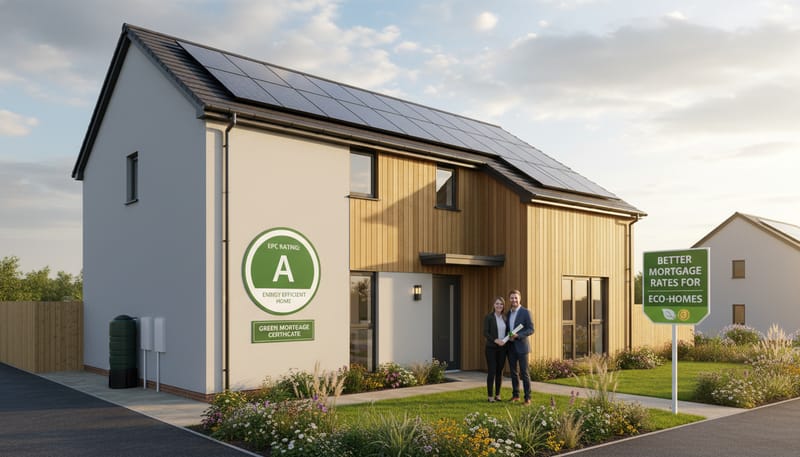
Green Mortgages: Better Rates for Energy-Efficient New Builds
Published by New-Builds Team · 2025
The UK housing market is undergoing a quiet revolution, and it is being driven not by interest rate cycles or government stamp duty holidays, but by energy efficiency. Green mortgages — specialist lending products that offer preferential rates to buyers of energy-efficient properties — have moved from a niche curiosity into the mainstream of UK mortgage lending. For buyers of new build homes, which typically arrive with EPC ratings of A or B as standard, green mortgages represent a genuinely compelling opportunity to secure lower monthly payments, reduced overall borrowing costs, and in many cases direct cashback incentives worth thousands of pounds. With energy bills having surged by over 80% since 2021 and the government's net-zero targets placing ever greater emphasis on the energy performance of the UK's housing stock, lenders are increasingly eager to reward buyers who choose properties that consume less energy. The result is a rapidly expanding market of green mortgage products that can save new build buyers significant sums over the life of their loan.
What makes this particularly relevant for new build purchasers is that most new homes built under current Building Regulations already meet the energy efficiency thresholds required by green mortgage products. Unlike buyers of older Victorian terraces or 1960s ex-council properties who might need to invest £15,000 or more in retrofitting to reach a qualifying EPC band, new build buyers can typically access green mortgage deals straight away — no additional investment required. The savings are meaningful too. Rate discounts of 0.10% to 0.25% might sound modest on paper, but over a 25-year mortgage term on a typical UK new build purchase price of £300,000, these reductions can translate to savings of £5,000 to £15,000 in total interest payments. Combined with cashback offers of up to £2,000 from certain lenders, the financial case for understanding and actively seeking out green mortgage products is becoming impossible for informed buyers to ignore. In this comprehensive guide, we will explore exactly how green mortgages work, which lenders offer the best deals, what EPC ratings you need, and how to ensure you maximise the financial benefits available when purchasing an energy-efficient new build home.
What Exactly Is a Green Mortgage?
A green mortgage is a lending product that offers more favourable terms — typically a lower interest rate, cashback, or both — to borrowers purchasing or remortgaging a property that meets certain energy efficiency criteria. The fundamental principle is straightforward: energy-efficient homes cost less to run, which means borrowers have more disposable income available to service their mortgage payments. This reduced risk profile allows lenders to offer better deals while still maintaining healthy margins. The concept originated in continental Europe, with Dutch and German lenders leading the way in the early 2010s, but has rapidly gained traction in the UK since 2019 when Barclays became one of the first major high-street lenders to launch a dedicated green mortgage product.
The qualifying criteria for green mortgages vary between lenders, but most use the Energy Performance Certificate (EPC) system as their primary benchmark. In the UK, properties are rated on a scale from A (most efficient) to G (least efficient), with the majority of green mortgage products requiring a rating of A or B to qualify. Some lenders extend eligibility to properties rated C, while a smaller number offer green incentives for any property that achieves an improvement in its EPC rating following energy efficiency upgrades. For new build buyers, this is overwhelmingly good news — under Part L of the current Building Regulations, virtually all new homes built in England are required to produce approximately 31% fewer carbon emissions than under previous standards, and most new builds comfortably achieve EPC ratings of A or B without any additional measures beyond standard construction specifications.
It is worth understanding that green mortgages are not a completely separate product category in the way that, say, interest-only mortgages differ from repayment mortgages. Rather, they are typically standard fixed-rate or tracker mortgage products with enhanced terms applied because of the property's energy efficiency. You still go through the same application process, the same affordability assessments, and the same legal conveyancing requirements. The green element simply means you access a better rate tier or receive an additional incentive on top of the standard product features.
EPC Ratings of New Build Homes vs Existing Stock
How Green Mortgages Save You Money
The financial benefits of green mortgages manifest in several distinct ways, and understanding each one is important for calculating the true value of these products. The most common benefit is a straightforward rate discount — the lender offers a lower interest rate than their equivalent standard product for borrowers purchasing an energy-efficient property. As of early 2025, typical green mortgage rate discounts range from 0.05% to 0.25%, with the most generous discounts available at higher LTV bands where the rate differential can be more pronounced. While a quarter of a percentage point might sound trivial, the compounding effect over a full mortgage term is substantial.
Consider a practical example. A buyer purchasing a new build home at £325,000 with a 15% deposit (85% LTV) borrowing £276,250 over 25 years. At a standard rate of 4.49%, their monthly repayment would be approximately £1,533. With a green mortgage rate of 4.24% — a 0.25% discount — the monthly repayment drops to £1,495, saving £38 per month or £456 per year. Over a typical five-year fixed term, that amounts to £2,280 in savings. Over the full 25-year mortgage term, assuming the rate differential persists at each remortgage point, total interest savings could reach £11,400. These figures are not hypothetical — they reflect the actual rate differentials available from lenders like Barclays, Nationwide, and Halifax in the current market.
Monthly Payment Comparison: Green vs Standard Mortgage (£276,250 over 25yrs)
Beyond rate discounts, many green mortgage products include cashback incentives. Barclays, for example, has offered cashback of up to £2,000 on green home mortgage completions, while Nationwide has periodically included £500 cashback as part of its green mortgage range. NatWest has offered fee-free options specifically for green mortgage applicants, saving borrowers the typical £999 product fee that applies to their standard range. When you aggregate the rate savings, cashback, and fee waivers, the total financial benefit of choosing a green mortgage for a new build purchase can comfortably exceed £5,000 over a five-year fixed term — and that is before you factor in the lower energy bills that come with living in an energy-efficient home.
The energy bill savings themselves are significant. According to the Energy Saving Trust, a new build home rated EPC A typically costs around £500 to £700 per year to heat and power, compared to £1,500 to £2,200 for an older property rated EPC D. That potential saving of £1,000 or more per year on energy bills effectively puts an additional £83 per month into the homeowner's pocket — money that could be directed toward overpayments on the mortgage, further reducing the total cost of borrowing. When you combine mortgage savings with energy savings, the total financial advantage of buying an energy-efficient new build with a green mortgage can be genuinely transformative over the long term.
Which UK Lenders Offer Green Mortgages?
The green mortgage market in the UK has expanded considerably since its early days, and most major high-street lenders now offer some form of green or energy-efficient incentive. However, the specific terms, qualifying criteria, and level of discount vary significantly between providers. Understanding the landscape is essential for ensuring you access the best possible deal for your circumstances. Below, we provide a detailed breakdown of the major green mortgage offerings available in the current market.
Green Mortgage Rate Discounts by Lender
Barclays was one of the pioneer high-street lenders in the UK green mortgage space and continues to offer one of the most competitive ranges. Their Green Home Mortgage is available to purchasers and remortgagors of properties with an EPC rating of A or B, offering rate discounts of up to 0.25% across a range of fixed-rate products at various LTV bands from 60% through to 95%. Barclays also periodically includes cashback incentives of up to £2,000 on green mortgage completions, making their overall package particularly attractive. The lender accepts predicted energy assessments (PEAs) for new builds that do not yet have a final EPC, which is especially useful for off-plan purchases where the property has not been completed. For buyers looking at new build valuations, Barclays tends to be pragmatic about new build premiums when the energy efficiency credentials are strong.
Nationwide Building Society offers green mortgage incentives through its Green Reward range, which provides rate discounts of up to 0.20% for properties rated EPC A or B. As a building society with a strong ethical positioning, Nationwide has been proactive in expanding its green lending criteria and has at times extended eligibility to properties rated EPC C. Their green products are available across purchase and remortgage applications, with LTV options up to 95% for first-time buyers — making them a particularly strong option for buyers using schemes like first-time buyer mortgages. Nationwide's standard lending criteria apply, so you still need to pass their affordability assessment, but the green discount is applied automatically once the EPC rating is verified.
Halifax and Scottish Widows (both part of the Lloyds Banking Group) offer green mortgage incentives under the Green Living Reward banner. Rate discounts of up to 0.15% are available for EPC A or B properties, with some products also including fee waivers or cashback. Halifax is one of the largest mortgage lenders in the UK by volume, and their green products are available across their full range of fixed-rate options. The main advantage of Halifax for new build buyers is their extensive experience in lending on new developments — they maintain approved lists for most major housebuilders and have well-established processes for handling the specific requirements of new build transactions, including extended completion deadlines and the use of PEAs in place of final EPCs.
NatWest and Royal Bank of Scotland offer green mortgage products with rate discounts of approximately 0.10% to 0.15% for EPC A or B properties. NatWest has been particularly innovative in its approach, periodically offering fee-free green mortgage products that waive the standard arrangement fee (typically £999 to £1,499), which represents a significant saving in its own right. Their green range is available across purchase and remortgage, with LTV options extending to 90%. NatWest's new build lending team is well-regarded in the broker community for its responsiveness and flexibility in handling complex new build transactions.
HSBC offers green mortgage incentives primarily through rate discounts of around 0.10% for qualifying energy-efficient properties. While their discount is at the lower end of the range, HSBC compensates with competitive base rates that can make their green products attractive in absolute terms even if the green premium itself is modest. HSBC requires an EPC rating of A or B to qualify and their products are available for both purchase and remortgage applications. The lender also maintains a strong new build proposition with dedicated underwriting teams experienced in handling developer incentive structures and complex exchange/completion timelines.
Beyond the high-street lenders, several specialist and challenger banks have entered the green mortgage market with competitive offerings. Ecology Building Society has long been a pioneer in green lending, offering mortgages specifically for energy-efficient and sustainable properties with bespoke criteria that go beyond simple EPC ratings. Perenna, a newer entrant, offers long-term fixed-rate green mortgages. Generation Home provides income-boosting options that can be combined with green incentives. The specialist market is particularly worth exploring if your circumstances do not fit standard high-street criteria or if you are looking at particularly innovative new build properties with features like ground-source heat pumps or Passivhaus certification.
EPC Ratings Explained: What Your New Build Needs
Energy Performance Certificates are the cornerstone of green mortgage qualification in the UK, and understanding how they work is essential for navigating this market effectively. An EPC rates a property's energy efficiency on a scale from 1 to 100, with the score mapped to a letter band from A (most efficient, score 92-100) through to G (least efficient, score 1-20). The certificate also includes a breakdown of estimated energy costs, recommendations for improvements, and an environmental impact rating based on CO2 emissions. EPCs are produced by qualified Domestic Energy Assessors and are valid for 10 years from the date of issue.
EPC Rating Distribution: New Builds vs UK Housing Stock
For new build homes, the EPC picture is overwhelmingly positive. According to the latest government data, approximately 55% of new build homes registered in 2024 achieved an EPC rating of A, with a further 35% rated B. This means that around 90% of all new builds automatically qualify for green mortgage products that require an A or B rating. The remaining 10% are predominantly rated C, often due to factors like the orientation of the property, its size, or the specific heating system installed — and even these would qualify for green products from lenders with extended eligibility criteria. It is exceptionally rare for a new build home constructed under current Building Regulations to receive an EPC rating below C.
The contrast with the existing housing stock is stark. Only around 3% of existing UK homes are rated EPC A, and just 15% achieve a B rating. The most common rating for existing properties is D, which accounts for approximately 35% of the housing stock, while a significant proportion — around 12% — are rated E, F, or G. This means that buyers of existing properties face a much harder path to qualifying for green mortgage incentives, often requiring significant investment in measures such as wall insulation, double or triple glazing, upgraded boilers, or renewable energy systems. New build buyers, by contrast, benefit from these features as standard.
When purchasing a new build off-plan or during construction, you will typically not have a final EPC available at the point of mortgage application. Instead, developers provide a Predicted Energy Assessment (PEA), which is an estimate of the property's expected EPC rating based on the design specifications and materials planned for the build. Most lenders that offer green mortgages will accept a PEA showing a predicted rating of A or B as sufficient to qualify for the green product, with the caveat that the actual EPC (produced on completion) must confirm the predicted rating. In practice, new build PEAs are highly accurate — it is very unusual for a final EPC to differ significantly from the prediction, because the construction methods and materials are standardised and well-understood. However, if the final EPC were to come in lower than predicted, the lender could theoretically withdraw the green rate discount, although this scenario is extremely rare and most lenders would handle it pragmatically.
Energy Efficiency Features That Drive Green Mortgage Qualification
Understanding what makes a new build home energy efficient is useful not just for academic interest but for practical decision-making when comparing developments and negotiating with builders. The key features that contribute to a high EPC rating — and therefore green mortgage eligibility — fall into several categories, each contributing to the overall energy performance score.
Contribution to EPC Score by Feature Category
Insulation is the single biggest factor in energy efficiency, accounting for approximately 30% of a typical EPC assessment. New build homes benefit from modern insulation standards that far exceed those of older properties. Walls in new builds typically feature cavity wall insulation with U-values of 0.18 to 0.26 W/m²K (compared to 1.6 W/m²K for an uninsulated solid wall), while loft insulation depths of 270mm or more are standard. Floor insulation is also routinely installed in new builds but is absent from most pre-2000 properties. The cumulative effect of comprehensive insulation across walls, roof, and floor is a dramatic reduction in heat loss, which directly translates to lower energy consumption and higher EPC scores.
Heating systems contribute around 24% of the EPC score. New builds increasingly feature air-source heat pumps (ASHPs) rather than traditional gas boilers, particularly since the introduction of the Future Homes Standard pathway in 2022. ASHPs operate at efficiencies of 250% to 350% (meaning they produce 2.5 to 3.5 units of heat energy for every unit of electrical energy consumed), compared to gas boilers which operate at around 90% to 94% efficiency. The shift to heat pumps is perhaps the single most impactful change in new build construction for EPC purposes, and homes fitted with ASHPs typically achieve EPC ratings at the upper end of the A band. Many developments now also include underfloor heating systems, which operate at lower temperatures than radiators and complement heat pump installations for maximum efficiency.
Glazing accounts for roughly 20% of the energy assessment. New build homes are fitted with double or triple glazing as standard, with typical U-values of 1.2 to 1.4 W/m²K for double glazing and 0.8 to 1.0 W/m²K for triple glazing. Many premium new build developments now specify triple glazing throughout, which not only improves energy efficiency but also reduces external noise — a particular selling point for urban developments. The window-to-wall ratio is also carefully calculated in new builds to balance natural light with thermal performance, and most new homes feature thermally broken frames that minimise heat transfer through the window structure itself.
Renewable energy generation, primarily through solar photovoltaic (PV) panels, contributes approximately 15% to the EPC score. Under the updated Part L Building Regulations, many new build homes now include solar PV systems as standard, typically sized at 2kW to 4kW depending on the available roof area. These systems not only reduce the property's net energy consumption but can also generate income through the Smart Export Guarantee (SEG), which pays homeowners for surplus electricity exported to the grid. The presence of solar PV can be the difference between an EPC B and an EPC A rating, making it a particularly valuable feature for green mortgage qualification.
Lighting and other features make up the remaining 11% of the assessment. LED lighting throughout is now standard in new builds and contributes positively to the EPC score. Mechanical ventilation with heat recovery (MVHR) systems, which extract warm stale air from kitchens and bathrooms and use it to pre-heat incoming fresh air, are increasingly common in new builds and provide both energy efficiency and indoor air quality benefits. Smart thermostats and zoned heating controls also contribute to the overall rating, allowing occupants to heat only the rooms they are using rather than the entire house.
The Total Savings: Mortgage Rate + Energy Bills Combined
One of the most compelling aspects of purchasing an energy-efficient new build with a green mortgage is the combined financial impact when you consider both the mortgage savings and the energy bill reductions together. Too many buyers focus solely on the purchase price without considering the total cost of ownership, which includes not just mortgage payments but also running costs. When you factor in both elements, the case for new builds with green mortgages becomes particularly persuasive.
5-Year Total Cost of Ownership Comparison
Older Property (EPC D) + Standard Mortgage
New Build (EPC A) + Green Mortgage
Let us work through a detailed comparison. Take two hypothetical buyers, both borrowing £276,250 over 25 years. Buyer A purchases an older property rated EPC D with a standard mortgage at 4.49%. Buyer B purchases a new build rated EPC A with a green mortgage at 4.24%. Over a five-year fixed term, Buyer A pays approximately £91,980 in mortgage payments and £9,500 in energy bills (at £1,900 per year), for a total housing cost of £101,480. Buyer B pays approximately £89,700 in mortgage payments and £3,250 in energy bills (at £650 per year), for a total housing cost of £92,950. The difference is £8,530 over five years — equivalent to £1,706 per year or £142 per month. That is a significant sum that could be redirected toward savings, overpayments, or lifestyle spending.
Extending this analysis over a full 25-year mortgage term (with appropriate assumptions about rate evolution and energy cost inflation), the cumulative savings become even more dramatic. Energy costs have historically risen faster than general inflation, averaging around 5-7% annual increases over the past decade. If this trend continues, the energy bill savings of living in an EPC A property versus an EPC D property will compound significantly over time. Conservative modelling suggests total combined savings of £40,000 to £55,000 over a 25-year period, factoring in both mortgage rate benefits and energy bill reductions. This is not a marginal consideration — it represents a genuinely material financial advantage that should inform property purchasing decisions.
How to Apply for a Green Mortgage: Step by Step
Applying for a green mortgage follows the same general process as a standard mortgage application, but with a few additional requirements related to demonstrating your property's energy efficiency. Understanding these requirements in advance will help ensure a smooth application process and prevent delays that could be problematic if you are working to a tight exchange deadline — a particularly relevant concern for new build purchases where mortgage offer expiry timescales can become a factor.
Step 1: Confirm your property's EPC rating or PEA. Before applying, verify that your intended purchase qualifies for green mortgage products. For completed new builds, request the EPC from the developer — they are legally required to provide one before marketing the property. For off-plan purchases, ask for the Predicted Energy Assessment. Most new build sales offices will have this information readily available, and many developers now prominently advertise their EPC ratings as a selling point. If you are purchasing through a developer incentive scheme, confirm that the green mortgage rate is compatible with any builder deposit contributions or part-exchange arrangements, as some lenders have restrictions on combining incentives. You can check a property's EPC on the government's EPC register at epcregister.com by entering the address or postcode.
Step 2: Consult a mortgage broker with green mortgage expertise. While you can approach lenders directly, working with a whole-of-market mortgage broker who understands the green mortgage landscape will typically yield better results. A good broker will be able to compare green products across all lenders, identify which offers the best deal for your specific circumstances (considering not just the rate but also fees, cashback, and flexibility features), and ensure that the application is structured to maximise your chances of approval. Many brokers now specialise in or have particular expertise with green and energy-efficient property lending. Ask specifically about their experience with new build green mortgages, as the combination of new build-specific requirements and green eligibility criteria requires an understanding of both areas.
Step 3: Gather your documentation. In addition to the standard documentation required for any mortgage application — proof of identity, proof of address, three to six months of bank statements, payslips or tax returns, and details of any existing debts — you will need to provide evidence of the property's energy efficiency. For a completed property, this means the EPC certificate itself. For an off-plan purchase, the PEA from the developer will suffice for most lenders. Some lenders may also request details of specific energy efficiency features installed in the property, though this is less common for new builds where the EPC or PEA provides sufficient evidence.
Step 4: Submit your application and await the valuation. The application process itself is identical to a standard mortgage — you complete the lender's application form, provide your documentation, and the lender conducts an affordability assessment and credit check. The green element is typically confirmed during the valuation process, where the surveyor or valuer will note the property's EPC rating. For new builds, many lenders use desktop valuations rather than physical inspections, and the EPC data is cross-referenced with the government's register. If everything checks out, the green rate discount or cashback incentive is applied to your mortgage offer automatically. Learn more about how mortgage valuations work for new builds to prepare for this stage.
Step 5: Review your mortgage offer carefully. When your mortgage offer arrives, check that the green rate discount has been correctly applied. The offer should clearly state the interest rate and any additional green incentives such as cashback or fee waivers. Compare the offered rate against the lender's standard products to confirm the differential matches what was advertised. If anything looks incorrect, raise it with your broker or the lender immediately — errors at this stage are easier to correct than after completion. Your mortgage offer will typically be valid for three to six months, so ensure it covers your expected completion date with adequate margin.
The Future of Green Mortgages: Regulatory and Market Trends
The green mortgage market is poised for significant expansion in the coming years, driven by a combination of regulatory pressure, lender strategy, and consumer demand. Understanding the direction of travel is valuable for buyers who want to position themselves to benefit from evolving incentive structures and for those considering the long-term resale value of energy-efficient properties.
On the regulatory front, the UK government has signalled its intention to require all rented properties to achieve a minimum EPC rating of C by 2030, and there is growing speculation that similar requirements could eventually be extended to properties being sold. If minimum EPC standards are introduced for property transactions, green mortgages could effectively become the standard product for a large proportion of the housing stock, with properties that fall below the threshold facing restricted mortgage availability or premium pricing. This regulatory trajectory makes investing in an energy-efficient new build an increasingly prudent decision from a future-proofing perspective.
UK Green Mortgage Market Growth
From a lender perspective, green mortgages serve a dual strategic purpose. First, they help banks meet their own Environmental, Social, and Governance (ESG) commitments and regulatory reporting requirements — the Bank of England and the Prudential Regulation Authority are placing increasing emphasis on climate risk in lending portfolios, and a higher proportion of energy-efficient properties in a lender's mortgage book is viewed positively. Second, green mortgages attract a demographic of borrowers who tend to be well-informed, financially stable, and lower-risk — exactly the type of customers lenders want to attract in a competitive market. These dual incentives suggest that green mortgage rate discounts are likely to widen rather than narrow in the coming years, as lenders compete more aggressively for green-eligible business.
The development of green mortgage standards is also evolving. Currently, there is no universal definition of what constitutes a "green mortgage" in the UK, with each lender setting its own eligibility criteria. However, industry bodies including UK Finance and the Green Finance Institute are working toward standardised green mortgage criteria that would provide consistency across the market. Proposed standards include minimum EPC thresholds, requirements for verified energy performance data, and potentially expanding eligibility to include properties that achieve significant improvements in energy efficiency rather than just those that meet an absolute threshold. For new build buyers, standardisation is likely to be positive, as it would increase the number of qualifying products available and make comparison shopping more straightforward.
Consumer awareness of green mortgages is also growing rapidly. A 2024 survey by Rightmove found that 72% of prospective homebuyers said they would consider energy efficiency when choosing their next property, up from 45% in 2020. The same survey found that 58% of buyers were aware of green mortgage products, compared to just 12% three years earlier. This growing awareness is translating into increased demand for green mortgage products, which in turn is encouraging more lenders to enter the market and existing participants to enhance their offerings. For new build developers, the growing importance of green mortgage availability is becoming a marketing consideration, with many now prominently featuring their developments' EPC credentials and green mortgage eligibility in sales materials.
Green Mortgages and the Future Homes Standard
The Future Homes Standard, scheduled for full implementation in 2025, represents a step change in the energy efficiency requirements for new build homes in England. Under the new standard, all new homes must produce at least 75% fewer carbon emissions than those built under the previous (2013) Building Regulations. This is a dramatic improvement that will effectively mandate EPC A ratings for the vast majority of new build properties and make green mortgage qualification almost universal for new construction. The standard requires the installation of low-carbon heating systems (predominantly air-source heat pumps), enhanced insulation, and improved airtightness, among other measures.
For green mortgage applicants, the Future Homes Standard means that from 2025 onwards, virtually every new build home in England will automatically qualify for the best green mortgage rates. This could potentially lead lenders to recalibrate their green mortgage offerings — either by increasing the threshold for the best discounts (perhaps requiring additional features beyond the minimum standard, such as solar PV or battery storage) or by repositioning green mortgages as penalties for inefficient properties rather than rewards for efficient ones. In either scenario, buyers of new build homes are likely to remain in the most favourable position, as new construction will always represent the cutting edge of energy efficiency standards.
The implications for property values are also significant. Research by the Department for Levelling Up, Housing and Communities (DLUHC) has shown that properties with higher EPC ratings command a price premium of 3% to 5% compared to equivalent properties with lower ratings. As energy efficiency becomes an increasingly important factor in buying decisions — driven by both financial considerations and environmental awareness — this premium is likely to grow. For new build buyers, this means that their property's energy efficiency credentials are not just a running cost benefit but a potential capital appreciation advantage. When it comes time to sell or port your mortgage to a new property, an EPC A-rated new build is likely to be more attractive to buyers and command a stronger price than a less efficient alternative.
Common Questions About Green Mortgages for New Builds
Can I get a green mortgage with a 5% deposit? Yes. Several lenders offer green mortgage products at 95% LTV, including Nationwide and Halifax. The rate discount for green eligibility is typically applied on top of the standard rate for the relevant LTV band, so you benefit from the green incentive regardless of your deposit size. However, you will generally access better rates overall with a larger deposit, as with any mortgage product. First-time buyers using government schemes like shared ownership may also be able to access green mortgage products, depending on the lender — check with a broker for the latest availability.
What if my new build's final EPC differs from the PEA? This is an understandable concern for off-plan buyers who apply for a green mortgage based on a Predicted Energy Assessment. In practice, discrepancies between PEAs and final EPCs are rare for new build homes because the construction specifications are well-defined and the assessment methodology is standardised. If the final EPC does come in lower than predicted but still within the qualifying band (A or B), there is no impact on your green mortgage. If it drops below the qualifying threshold — which would be extremely unusual for a new build — the lender may adjust your rate to the standard product equivalent. To mitigate this risk, ask your developer for a written commitment regarding the minimum EPC rating and check whether your contract includes provisions for remediation if the target rating is not achieved.
Are green mortgages available for shared ownership? Availability varies by lender. Some lenders that offer green mortgages on standard purchase products extend the same rates and incentives to shared ownership applications, while others have separate product ranges. The key complication with shared ownership is that the mortgage only covers the share being purchased (typically 25% to 75% of the property's value), with rent paid on the remaining share to the housing association. This can affect affordability calculations and the overall financial benefit of the green rate discount. However, shared ownership new builds benefit from the same energy efficiency features as full-ownership new builds, so the qualifying criteria should be met in most cases.
Can I combine a green mortgage with developer incentives? Generally yes, but with some caveats. Most lenders will allow you to combine a green mortgage rate with standard developer incentives such as contribution to stamp duty, legal fees, or upgrades. However, some lenders have caps on the total value of developer incentives they will accept (typically 5% of the property value), and in some cases, cash-back incentives from the green mortgage may be considered alongside developer incentives when calculating this cap. It is important to discuss the specific combination of incentives with your broker before committing, to ensure everything is compatible and you are not inadvertently breaching any lender restrictions that could delay or jeopardise your application.
Do green mortgages have different early repayment charges? No. Green mortgages are subject to the same early repayment charge (ERC) structures as their standard equivalents. If you take a five-year fixed-rate green mortgage, you will typically face ERCs for early repayment during the fixed period, just as you would with any other five-year fix. The green element affects only the interest rate and any associated incentives — it does not change the fundamental contractual terms of the mortgage. This is worth clarifying because some buyers mistakenly believe that green mortgages come with additional restrictions or penalties. They do not — the terms are identical to standard products except for the enhanced rate or cashback.
Making the Most of Green Mortgage Opportunities
To maximise the financial benefit of green mortgages when buying a new build, consider the following strategic approaches. First, always compare the total cost of the green mortgage product against the lender's standard range. In some cases, a lender's best standard product may actually be cheaper than their green offering if the base rate is significantly lower. A good broker will run these comparisons automatically, but it is worth understanding the principle. The green discount is only valuable if the starting rate is competitive — a 0.20% discount on an uncompetitive base rate may still be worse than a competing lender's standard product with no green discount.
Second, consider whether the cashback element of a green mortgage is worth more or less than a lower rate. A £2,000 cashback on completion is an immediate financial benefit, but a 0.10% lower rate over five years on a £250,000 mortgage saves approximately £1,200 over the fixed term and continues to compound if you re-fix at a similarly discounted rate. The optimal choice depends on your financial situation — if you need the immediate cash injection to cover moving costs or furnishing, the cashback may be more valuable. If you are comfortable with your cash position, the lower rate typically delivers better long-term value.
Third, check whether the green mortgage allows overpayments and whether the overpayment terms are the same as the standard product. The ability to make overpayments (typically up to 10% of the outstanding balance per year without incurring ERCs) is a valuable flexibility feature that allows you to take advantage of the lower monthly payments on your green mortgage to accelerate your mortgage repayment. If your green mortgage saves you £38 per month compared to a standard product, redirecting that saving as a regular overpayment can reduce your mortgage term by several years and save thousands in additional interest.
Finally, bear in mind that the green mortgage landscape is evolving rapidly, and products that are market-leading today may be superseded by better offerings within months. This does not mean you should delay your purchase in anticipation of better deals — time in the property market is generally more valuable than timing the mortgage market — but it does mean you should ensure you have flexibility to remortgage when your initial fixed rate period ends. At that point, the green mortgage market will likely be even more competitive, with a wider range of products and potentially larger discounts available for energy-efficient properties. Your EPC A-rated new build will continue to qualify for the best green deals at each remortgage point, providing an ongoing financial advantage throughout your ownership.
Key Takeaways
- ✓ 90% of new builds automatically qualify for green mortgages with EPC A or B ratings
- ✓ Rate discounts of 0.10% to 0.25% save £5,000 to £15,000 over a full mortgage term
- ✓ Combined with lower energy bills, total savings can exceed £40,000 over 25 years
- ✓ All major UK lenders now offer green mortgage products
- ✓ Use a whole-of-market broker to compare green offerings across lenders
- ✓ The Future Homes Standard will make green qualification even easier from 2025 onwards