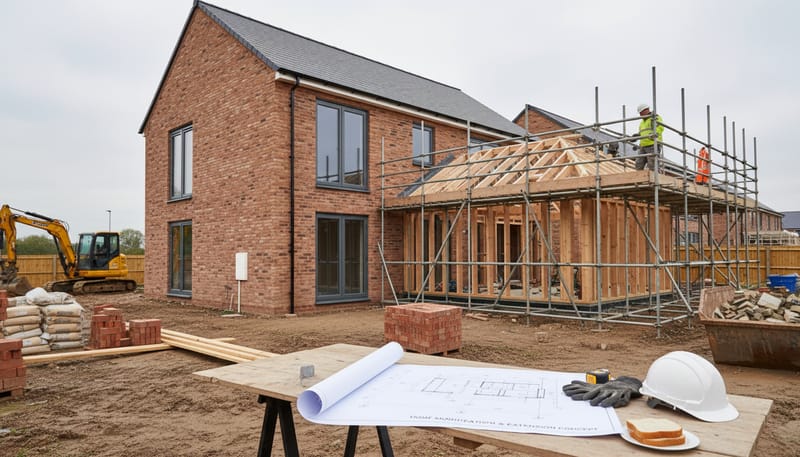
You’ve moved into your brand new home, and already you’re thinking about making changes. Perhaps the kitchen is slightly smaller than you’d like, you want to add a home office in a rear extension, or the loft space is crying out to be converted into a fourth bedroom. Extending or modifying a new build home is entirely possible, but it comes with a unique set of considerations that differ significantly from altering an older property. From planning restrictions and restrictive covenants to warranty implications and building regulations, there is a great deal to understand before you pick up the phone to a builder. This comprehensive guide covers everything UK homeowners need to know about extending or modifying their new build property, including costs, timelines, permissions, and practical advice to help you avoid costly mistakes.
The new build market in the UK has boomed in recent years, with over 200,000 new homes completed annually. But modern new build homes are often designed to maximise the number of units on a site, which means rooms can be compact and storage limited. Many buyers find that within a few years of moving in — or even sooner — they want to extend or reconfigure their home to better suit their needs. The good news is that new build homes, with their modern construction methods, regular layouts, and sound structural integrity, can be excellent candidates for extension. The key is understanding the rules, protecting your warranty, and planning your project carefully.
Can You Extend a New Build Home?
The short answer is yes, you can extend a new build home. However, there are more hurdles to clear than with an older property. New build homes come with several layers of restriction that you need to navigate before any work begins. These include planning restrictions (both statutory and from the developer), restrictive covenants in your title deeds, your new build warranty terms, building regulations, and potentially estate management company rules. Understanding each of these layers is essential for a successful project.
Many new build homeowners are surprised to discover that their permitted development rights — the rights that allow homeowners to make certain changes without planning permission — may have been removed or restricted. Developers often apply for planning conditions that remove permitted development (PD) rights on new estates, sometimes referred to as Article 4 directions. This is done to protect the visual appearance and uniformity of the development, but it means that even minor changes like adding a conservatory, building a garden shed, or installing a satellite dish may require a full planning application. Checking whether PD rights apply to your property is the very first step in any extension project.
Permitted Development Rights Explained
Permitted development rights are a set of automatic planning permissions that allow homeowners to carry out certain types of building work without needing to apply for formal planning permission from the local authority. These rights are set out in the Town and Country Planning (General Permitted Development) (England) Order 2015 (as amended), and they apply to most houses in England. However, they do not apply to flats or maisonettes, and they may be restricted or removed on specific properties or areas.
For new build houses where PD rights have not been removed, the following types of extension and modification are typically permitted without planning permission, subject to specific size, height, and position limits. These limits have been updated several times in recent years, most recently in 2024, so it is important to check the current rules.
Remember, these PD rights only apply if they have not been removed by a planning condition on the original development. If your PD rights have been removed, you will need to apply for a Lawful Development Certificate (to confirm whether work is permitted) or submit a full householder planning application for any changes you wish to make.
Restrictive Covenants on New Build Homes
Beyond planning restrictions, your new build home may be subject to restrictive covenants in the title deeds. These are legally binding restrictions placed on the property by the developer at the time of sale, and they “run with the land,” meaning they bind all future owners, not just the original buyer. Restrictive covenants on new build homes commonly include restrictions on extensions, alterations to the external appearance of the property, erecting fences or walls above a certain height, using the property for business purposes, keeping caravans or commercial vehicles on the drive, and even restrictions on the colour you can paint your front door.
The most relevant covenant for extension projects is typically a restriction requiring you to obtain the developer’s written consent before making any external alteration or addition to the property. Some covenants go further, prohibiting extensions altogether or restricting them to specific types (for example, no two-storey extensions). Breaching a restrictive covenant can have serious legal consequences, including an injunction to demolish unauthorised work, so it is essential to check your title deeds and comply with any requirements.
If you need the developer’s consent to extend, you should write to them setting out your proposals, including plans and drawings. Some developers will grant consent readily, particularly for modest extensions that do not detract from the development’s appearance. Others may charge an administration fee for considering your application — fees of £200–£1,000 have been reported. In some cases, particularly where the developer has ceased trading or is unresponsive, you may need to obtain restrictive covenant indemnity insurance, which covers you against the risk of the covenant being enforced. Your solicitor can advise on the most appropriate course of action.
- ✓ Internal layout changes (non-structural)
- ✓ New kitchen or bathroom
- ✓ Redecorating and new flooring
- ✓ Garden landscaping (subject to covenants)
- ✓ Installing a new boiler or heating system
- ✓ Adding shelving, storage, built-in furniture
- ✗ Any external extension (rear, side, loft)
- ✗ Conservatory or garden room
- ✗ Removing or altering structural walls
- ✗ Changing external appearance (windows, doors)
- ✗ Erecting fences or walls above covenant height
- ✗ Outbuildings on certain estates
Impact on Your New Build Warranty
One of the most important considerations when extending or modifying a new build home is the impact on your new build warranty. Most new build homes in the UK come with a 10-year structural warranty, typically provided by NHBC (Buildmark), LABC Warranty, Premier Guarantee, or Checkmate. These warranties cover structural defects for 10 years, with the first 2 years also covered by the builder’s own warranty for a wider range of issues. Making alterations to your home can potentially affect this warranty cover, so it is essential to understand the rules before you proceed.
The general principle across all warranty providers is that the warranty covers the original structure as built. If you make alterations that affect the structural integrity of the home — for example, by removing a load-bearing wall, altering the foundations, or changing the roof structure — the warranty provider may not cover any defects that arise from those alterations. Crucially, if your alterations cause or contribute to a structural problem, the warranty may not cover the original structure either, if the defect is linked to your changes.
Popular Extension Types for New Build Homes
Certain types of extension are particularly popular on new build homes, driven by the common layout patterns of modern developments. Here is an overview of the most common extension and modification projects, along with typical costs, timescales, and practical considerations for each.
Single-Storey Rear Extension
By far the most popular extension type for new build homes, the single-storey rear extension typically adds an open-plan kitchen-diner or kitchen-living space that transforms the ground floor layout. On new builds, where kitchens are often compact and separate from the living area, this extension can dramatically improve the functionality and feel of the home. Costs range from £30,000 to £80,000 depending on size, specification, and location (London and the South East commanding premium prices). Build time is typically 8–12 weeks, and this type of extension often falls within permitted development rights (if they have not been removed).
Double-Storey Rear Extension
A double-storey extension adds significant floor space over two levels, typically providing an extended kitchen or living area on the ground floor and an additional bedroom or bathroom above. Costs range from £40,000 to £120,000, and the project usually takes 12–16 weeks. Double-storey extensions almost always require planning permission (even with PD rights, the depth is limited to 3 metres) and will require building regulations approval. They also have a greater impact on the existing structure, making warranty considerations particularly important.
Loft Conversion
Loft conversions are an excellent way to add a bedroom and en-suite to a new build home without extending the building’s footprint. However, new build homes present some specific challenges. Many modern new builds use trussed rafter roofs rather than traditional cut roofs, and trussed rafters cannot simply be removed — they require specialist engineering solutions, which add to the cost. A dormer loft conversion on a new build typically costs £35,000–£65,000, while a Velux (rooflight-only) conversion costs £25,000–£45,000. Build time is 6–10 weeks. Planning permission is usually required if PD rights have been removed, and building regulations approval is always required.
Garage Conversion
Converting an integral garage into a living room, home office, or additional bedroom is one of the most cost-effective ways to gain extra space. On new build estates where parking is often limited, however, you need to consider whether losing the garage will create parking problems, breach any parking covenants, or affect the estate management company’s rules. Costs range from £8,000 to £20,000, and the work typically takes 3–6 weeks. Building regulations approval is required, and you should check your covenants carefully, as many new build covenants restrict garage conversions.
Extension Costs: A Detailed Breakdown
Understanding the full cost of an extension project is essential for budgeting and avoiding nasty surprises. The build cost is only part of the story — you also need to factor in professional fees, planning costs, building regulations, and other expenses. Here is a detailed breakdown of the typical costs involved in a single-storey rear extension, which is the most common project on new build homes.
Building Regulations for Extensions
Regardless of whether you need planning permission, almost all extensions require building regulations approval. Building regulations are separate from planning permission and deal with the technical quality of building work — structural safety, fire safety, insulation, ventilation, drainage, and accessibility. You can apply for building regulations approval either through your local authority’s building control team or through an approved inspector (a private sector alternative).
For new build extensions, the key building regulations include Part A (structural safety), Part B (fire safety), Part L (energy efficiency and insulation), Part F (ventilation), Part P (electrical safety), and Part M (access). Your extension must meet current building regulation standards, which may be different from the standards that applied when your original home was built. For example, Part L requirements for insulation have been strengthened significantly in recent years, so your extension may need higher levels of insulation than the original house.
The building regulations process involves submitting plans for approval, then having the work inspected at key stages during construction. A completion certificate is issued once the inspector is satisfied that the work meets the required standards. This certificate is an important document — keep it safe, as you will need it when you come to sell the property. Mortgage lenders will also want to see building regulations approval and completion certificates for any extension work.
The Party Wall Act and Your Neighbours
If your extension involves building on or near a boundary with a neighbouring property, you may need to comply with the Party Wall etc. Act 1996. This law applies when you are building on or at a boundary line, excavating near a neighbouring building, or carrying out work to a shared (party) wall. On new build estates, where homes are often closely spaced, the Party Wall Act is frequently relevant for extension projects.
The Act requires you to serve formal notice on your neighbours before starting work. If they consent in writing, work can proceed. If they dissent or do not respond within 14 days, a party wall surveyor (or two surveyors, one acting for each side) must be appointed to prepare a party wall award that sets out the work to be carried out, protections for the neighbour’s property, and any access arrangements. You, as the building owner, are typically responsible for the costs of the party wall process, which can add £1,000–£2,500 to your project budget.
On new build estates, neighbourly relations are particularly important. You are likely to be living alongside your neighbours for years, and a poorly managed extension project can cause lasting friction. Communicate your plans early, be considerate about noise, dust, and access during construction, and ensure your builders treat the estate and neighbouring properties with respect.
Internal Modifications: What You Can Do
Not all modifications involve extending the footprint of your home. Internal changes can transform how your new build feels and functions, and many can be carried out without planning permission, building regulations approval, or developer consent. However, there are important exceptions, particularly when structural walls are involved.
Non-structural internal walls (stud walls) can generally be removed or repositioned without building regulations approval, as long as the work does not affect fire escape routes, sound insulation between dwellings (in flats), or ventilation. However, load-bearing walls are a different matter entirely. Removing or altering a load-bearing wall always requires a structural engineer’s calculation and building regulations approval, and on a new build, it will also affect your warranty. If you are unsure whether a wall is load-bearing, always commission a structural engineer to inspect before any work begins.
Garden Rooms and Home Offices
The post-pandemic shift to hybrid working has made garden rooms and home offices one of the fastest-growing home improvement categories in the UK. A garden room provides a dedicated, insulated workspace separate from the main house, without the disruption and cost of a full extension. They are particularly popular on new build homes where the open-plan living layout means there is no obvious space for a home office.
A quality, fully insulated garden room typically costs £12,000–£30,000 for a standard size (3m x 4m), with premium suppliers like Green Retreats, Cabin Master, and Garden Spaces charging more for bespoke designs. Basic garden offices from companies like Wickes or B&Q can cost as little as £5,000–£10,000, though insulation and electrical supply may be extra. Most garden rooms fall within permitted development rights, as they are treated as outbuildings, but check your covenants and any PD restrictions on your estate.
How Long Should You Wait Before Extending?
A common question from new build homeowners is how long they should wait before starting an extension project. There are several practical reasons to wait at least 12–24 months before beginning major structural work on a new build home.
First, new build homes undergo a period of settlement in the first year or two. This can cause minor cosmetic issues like hairline cracks, nail pops, and slight movement in joints. These are normal and are covered by the builder’s warranty during years 1–2. Starting extension work during this period can make it difficult to distinguish between settlement issues (covered by warranty) and problems caused by your alterations (not covered). Waiting until settlement is substantially complete avoids this complication.
Second, living in the home for a period allows you to properly understand how you use the space, what works well, and what genuinely needs to change. The extension you think you need in month one may be different from what you actually need after a year of living in the property. Third, the developer’s warranty during years 1–2 covers a wide range of defects beyond structural issues. Any extension work during this period may complicate warranty claims and give the builder grounds to argue that defects were caused by your modifications rather than their workmanship.
Choosing the Right Builder
Selecting the right builder for your extension is one of the most important decisions you will make. A good builder will deliver quality work on time and on budget; a poor one can cause stress, delays, cost overruns, and work that fails building regulations inspection. For new build homes, where warranty considerations add an extra layer of complexity, choosing a builder who understands the specific requirements is particularly important.
Start by getting at least three detailed, itemised quotes from different builders. Avoid builders who provide only a single lump-sum figure with no breakdown — you need to understand what is included and what is not. Check that the builder has appropriate insurance (public liability and employer’s liability), ask for references from recent projects similar to yours, and verify their credentials through trade bodies such as the Federation of Master Builders (FMB), Checkatrade, or TrustMark.
- ☑ Get at least 3 detailed, itemised quotes
- ☑ Check public liability insurance (minimum £2 million)
- ☑ Verify trade body membership (FMB, Checkatrade, TrustMark)
- ☑ Ask for and follow up on references from recent projects
- ☑ Visit a current or recent project if possible
- ☑ Agree a written contract with clear payment stages
- ☑ Never pay more than 10% upfront
- ☑ Ensure the contract includes a retention clause (5% held for 3–6 months)
- ☑ Confirm they will arrange building control inspections
Adding Value: Which Extensions Pay for Themselves?
While the primary motivation for extending your home should be improving your quality of life, it is worth understanding which types of extension add the most value. Not all extensions provide a positive return on investment, and in some cases, overcapitalising (spending more on the extension than it adds to your property value) is a real risk, particularly in areas where property prices have a natural ceiling.
Energy Efficiency Considerations
Modern new build homes are designed to meet high energy efficiency standards, and your extension should match or exceed these standards. Under current building regulations (Part L 2021), extensions must achieve demanding levels of insulation, airtightness, and thermal performance. This means using high-quality insulation materials, thermally efficient windows and doors (typically double or triple glazing with low U-values), and careful attention to thermal bridging where the extension meets the existing structure.
Your extension also needs to comply with ventilation requirements under Part F. This is particularly important for extensions that include kitchens or bathrooms, where moisture levels are high. Mechanical extract ventilation is usually required, and in some cases, a whole-house ventilation system such as MVHR (Mechanical Ventilation with Heat Recovery) may be appropriate, particularly if your new build home already has such a system installed.
If you are adding a significant extension, it is worth considering the opportunity to upgrade the energy efficiency of the existing house at the same time. For example, if you are replacing a rear wall with bi-fold doors, you could also upgrade the insulation in the remaining walls. Adding solar panels to the extension roof, installing underfloor heating connected to a heat pump, or adding battery storage for existing solar panels can all be more cost-effective when combined with an extension project than when done as standalone works.
Extending Flats and Leasehold Properties
If your new build is a flat or leasehold house, the rules for making modifications are significantly more restrictive. Your lease will specify what alterations you can and cannot make, and most leases require you to obtain the landlord’s (freeholder’s) written consent before carrying out any work that alters the structure or external appearance of the property. This applies even to internal work like removing partition walls, changing bathrooms, or installing new flooring.
The landlord cannot unreasonably withhold consent for alterations that improve the property, but they can attach reasonable conditions and charge a reasonable fee for considering your application. They may also require you to reinstate the property to its original condition when the lease ends (though this is less common for long leases). In apartment blocks, the management company or residents’ management company may also need to approve your works, particularly if they affect communal areas, the building’s structure, or services such as plumbing or electrics.
For leasehold flats, the most common modifications are internal reconfiguration, bathroom and kitchen refits, and flooring changes. In some cases, ground-floor flats may be able to extend into a garden area, but this requires both the landlord’s consent and planning permission, and may involve a lease variation or additional premium. Upper-floor flats have very limited extension options, though some top-floor leaseholders have successfully obtained permission to extend into the roofspace, subject to planning approval and structural feasibility.
Step-by-Step Extension Guide
Here is a comprehensive step-by-step guide to extending your new build home, from initial planning through to completion. Following this process will help ensure your project runs smoothly and complies with all necessary requirements.
Common Mistakes to Avoid
Extension projects on new build homes can go wrong in a number of ways. Being aware of the most common mistakes will help you avoid them and ensure your project is a success.
Extending or modifying your new build home can be one of the most rewarding home improvement projects you undertake. With careful planning, proper permissions, and the right professionals, you can create a home that perfectly suits your lifestyle while adding significant value to your property. The key is to be thorough in your research, patient in your timing, and realistic in your budget. Take the time to understand the unique considerations that apply to new build homes, protect your warranty, and choose your builder carefully, and you will be well on your way to creating the home you truly want.