Energy Cost Savings: New Build vs Older Home Bills
By New-Builds Team
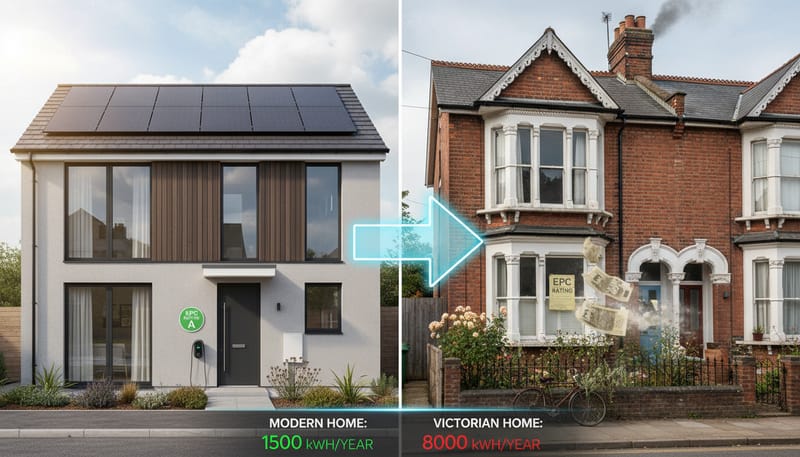
Energy costs have become one of the most significant household expenses in the UK, and for anyone comparing the true cost of living in a new build home versus an older property, the difference in annual energy bills is striking. Following the energy price volatility of recent years, the average UK household spends approximately £1,800 to £2,200 per year on gas and electricity. However, this average masks an enormous variation depending on the age, size, and energy efficiency of the property. A draughty Victorian terrace with single-glazed windows and no cavity wall insulation might cost its occupants well over £3,000 per year to heat, while a modern new build home of similar size, constructed to current building regulations, could achieve the same level of comfort for less than £1,200. Over a 25-year mortgage term, that difference adds up to a staggering £45,000 or more in cumulative savings, which is money that could be redirected towards your financial planning goals, pension contributions, or simply a more comfortable lifestyle.
The reason for this dramatic difference comes down to building standards, materials, and technology. New build homes constructed from 2022 onwards must comply with the updated Part L of the Building Regulations, which requires significantly higher levels of thermal insulation, airtightness, and energy efficiency than ever before. Many developers are going even further than the minimum requirements, incorporating air source heat pumps, solar photovoltaic panels, underfloor heating, mechanical ventilation with heat recovery (MVHR), and triple-glazed windows. These technologies, combined with superior insulation in walls, floors, and roofs, create homes that need far less energy to maintain a comfortable temperature throughout the year. In this detailed guide, we will break down the exact costs and savings across every aspect of home energy use, compare EPC ratings between new and old homes, analyse the running costs of different heating systems, and show you the payback periods for key energy-saving technologies. Whether you are considering buying a new build or trying to understand the energy advantages of the one you already own, this analysis will give you the complete financial picture.
EPC Ratings: The Energy Efficiency Gap
The Energy Performance Certificate (EPC) is the most straightforward way to compare the energy efficiency of different properties. Rated on a scale from A (most efficient) to G (least efficient), the EPC provides an estimated annual energy cost and a breakdown of how the property performs across different efficiency measures. The gap between new builds and older homes is substantial and measurable.
New build homes constructed under current building regulations almost universally achieve an EPC rating of A or B. The vast majority fall into the B category, with a score between 81 and 91, while homes built with additional efficiency measures such as solar panels and heat pumps frequently achieve an A rating with scores above 92. By contrast, the average EPC rating for the existing UK housing stock is a D, with a score around 60. Properties built before 1920, which make up roughly 20 percent of UK homes, typically rate D or E, and many unrenovated pre-war homes score as low as F or G.
The EPC also provides an estimated annual energy cost for the property, which gives a useful benchmark for comparison. A new build three-bedroom semi-detached house with a B rating might show an estimated annual energy cost of £900 to £1,100, while a similar-sized 1960s semi with a D rating could show £1,800 to £2,200, and a Victorian terrace with an E rating might display £2,400 to £3,200. These are estimates based on standardised assumptions about occupancy and usage patterns, so your actual costs may differ, but the relative difference between property types is consistent and significant.
Annual Energy Bills: Direct Comparison
Let us break down the actual energy costs for a three-bedroom home across different property ages and types. These figures are based on current energy prices under the Ofgem price cap (as of early 2025) and typical usage patterns for a family of four. Gas is priced at approximately 6.8 pence per kWh and electricity at 24.5 pence per kWh.
These figures tell a compelling story. A family moving from a typical Victorian terrace to a modern new build could save over £2,000 per year on energy bills alone. Even compared to a relatively modern property built in the 2000s, a new build still offers savings of around £400 per year. For buyers weighing up the cost of a new build versus an older property, these energy savings should be factored directly into the affordability calculation. A saving of £175 per month on energy is equivalent to being able to afford roughly £35,000 more on a mortgage (at current interest rates), which can significantly change the equation when comparing property options.
Where the Savings Come From: Insulation Standards
The single biggest factor in the energy efficiency gap between new and old homes is insulation. Heat loss through walls, roofs, floors, and windows accounts for the vast majority of energy waste in UK homes, and the insulation standards required by current building regulations are dramatically superior to those of previous decades — or in many cases, the complete absence of any insulation in older properties.
New build homes are required to achieve wall U-values (a measure of heat loss, where lower is better) of 0.26 W/m2K or less, compared to around 0.45 W/m2K for homes built in the 1990s and effectively no limit for pre-regulation homes where solid walls can have U-values exceeding 2.0 W/m2K. The roof insulation requirements are equally stringent, with new builds requiring at least 270mm of mineral wool or equivalent insulation in the loft, delivering a U-value of 0.16 W/m2K or better.
Windows represent another major area of improvement. New build homes are fitted with double-glazed or increasingly triple-glazed windows with U-values of 1.4 W/m2K or less. Many developers now specify argon-filled sealed units with low-emissivity coatings that achieve U-values as low as 0.8 W/m2K. Compare this to the single-glazed windows still found in many older properties, which have U-values of 5.0 W/m2K or higher, meaning they lose heat at roughly six times the rate of modern glazing.
Floor insulation is often overlooked but makes a significant difference. New builds have insulated ground floors with U-values of 0.22 W/m2K or better, while older homes with suspended timber floors often have no insulation at all, allowing cold air to circulate freely beneath the floorboards. Retrofitting floor insulation in an older home is possible but can be disruptive and expensive, typically costing £1,500 to £4,000 depending on the floor type and accessibility.
Heat Pump Running Costs vs Gas Boilers
An increasing number of new build homes are being fitted with air source heat pumps (ASHPs) instead of traditional gas boilers. From 2025, the Future Homes Standard effectively mandates that new homes must use low-carbon heating systems, making heat pumps the default choice for most developers. While heat pumps use electricity, which is more expensive per unit than gas, they are significantly more efficient, producing three to four units of heat for every unit of electricity consumed. This efficiency ratio, known as the Coefficient of Performance (COP), means that despite electricity costing roughly 3.5 times more than gas per kWh, a heat pump can still be cheaper to run than a gas boiler in a well-insulated new build home.
The comparison becomes even more favourable for heat pumps when you factor in the direction of energy prices. The UK government is committed to decarbonising the electricity grid, and as more renewable generation comes online, electricity prices are expected to stabilise or decrease relative to gas prices. There is also political pressure to rebalance the green levies on energy bills, which currently make electricity disproportionately expensive compared to gas. If electricity prices fall relative to gas as expected, the running cost advantage of heat pumps will increase significantly over the coming years.
It is worth noting that heat pump performance varies depending on the outdoor temperature. In very cold weather (below -5 degrees Celsius), the COP of an air source heat pump drops from around 3.2 to approximately 2.0 to 2.5. However, the UK's relatively mild climate means that temperatures below -5 degrees are uncommon, and the average seasonal COP across a full year typically sits between 2.8 and 3.5 for a well-installed system. Ground source heat pumps achieve even higher efficiencies (COP of 4.0 or more) because the underground temperature remains relatively stable throughout the year, but they are more expensive to install and are less common in new build developments due to the land required for the ground loop.
Solar PV: Free Electricity and Export Income
Many new build developments now include solar photovoltaic (PV) panels as standard, or offer them as an optional upgrade. A typical new build installation consists of a 3 to 4 kWp system, which is usually 8 to 12 panels on a south or southwest-facing roof. This size of system generates approximately 2,700 to 3,600 kWh of electricity per year in southern England, or 2,300 to 3,100 kWh in northern England and Scotland.
At current electricity prices of 24.5 pence per kWh, the electricity generated by a 4 kWp system is worth approximately £735 to £880 per year if you use all of it. In practice, a typical household without battery storage will use around 30 to 50 percent of the generated electricity directly (the rest is generated during the day when you might be out at work), which equates to a saving of £220 to £440 per year on electricity bills. The remainder can be exported to the grid under the Smart Export Guarantee (SEG) at rates of 4 to 15 pence per kWh, adding a further £75 to £270 per year in income.
Adding a battery storage system (typically 5 to 10 kWh capacity) can increase self-consumption to 70 to 85 percent, substantially boosting the financial benefit. A battery allows you to store excess daytime generation for use in the evening when electricity demand (and sometimes price) is highest. The total annual saving with solar panels plus battery storage in a new build home can reach £600 to £900 per year. Battery storage systems currently cost between £4,000 and £8,000 depending on capacity, which means the payback period for the battery alone is approximately 6 to 10 years.
Payback Periods for Energy-Saving Technologies
For buyers considering new build homes with various energy efficiency features, understanding the payback period helps quantify the financial benefit. The payback period is the time it takes for the energy savings to cover the additional cost of the technology. For features included as standard in a new build, the effective payback period is zero because you are not paying extra for them. For optional upgrades or technologies that command a price premium, the payback calculations are worth examining.
Solar PV panels offer one of the best payback periods, typically recovering their cost in 6 to 8 years and then providing free electricity for the remaining 17 to 19 years of their 25-year warranty period (with panels typically lasting 30 years or more). When included in a new build, the cost is rolled into the mortgage, meaning the monthly energy savings often exceed the additional mortgage payment from day one, creating an immediate net benefit.
Heat pumps have a longer payback period when retrofitted to older homes (10 to 15 years), primarily because of the high installation cost of £8,000 to £15,000 (after the government's Boiler Upgrade Scheme grant of £7,500). However, when installed in a new build, the additional cost compared to a gas boiler system is much smaller (typically £3,000 to £5,000), and the payback period drops to 5 to 8 years. The heat pump also has a longer lifespan than a gas boiler (20 to 25 years versus 12 to 15 years), which further improves the lifetime economics.
Water Heating and Hot Water Costs
Hot water heating accounts for approximately 15 to 20 percent of the average household's energy bill, and new build homes offer advantages here too. Modern hot water cylinders are much better insulated than older models, losing less heat while the water is stored. Homes with heat pumps typically use the heat pump to heat the water cylinder, benefiting from the same efficiency gains as space heating. Some new builds also feature solar thermal panels specifically for water heating, or the solar PV system can be used to heat water during peak generation periods through a diverter switch.
In an older home with a traditional gas boiler and a poorly insulated hot water cylinder, the annual cost of heating water for a family of four is typically £350 to £450. In a new build with a heat pump and a well-insulated cylinder, this drops to approximately £180 to £250. Homes with solar thermal or PV diverter systems can reduce this further to £100 to £180, as a significant portion of hot water heating occurs during sunny periods when solar generation is at its peak.
Airtightness and Ventilation
One of the less visible but critically important energy efficiency features of new build homes is their superior airtightness. Building regulations require new homes to achieve an air permeability of no more than 10 m3/hr/m2 at 50 Pascals, and many developers target much lower levels of 3 to 5 m3/hr/m2. Compare this to older homes, where air permeability is often 15 to 25 m3/hr/m2 or even higher, with draughts coming through gaps around windows, doors, floorboards, and electrical fittings.
To prevent the condensation and air quality issues that can arise in airtight buildings, many new builds now incorporate Mechanical Ventilation with Heat Recovery (MVHR) systems. These extract stale, moist air from kitchens and bathrooms and pass it through a heat exchanger that recovers up to 90 percent of the heat before it leaves the building. This recovered heat is used to warm the fresh air being drawn in from outside. The result is a constant supply of fresh, filtered air without the heat loss associated with opening windows or using standard extractor fans. MVHR systems typically cost £80 to £150 per year in electricity to run, but the heat recovery saves an estimated £200 to £400 per year in reduced heating demand, making them a net financial benefit.
Smart Home Technology and Energy Management
New build homes are increasingly equipped with smart energy management systems that help occupants optimise their energy use. Smart thermostats, which are now standard in most new builds, learn your heating patterns and adjust the schedule to minimise waste. Studies have shown that smart thermostats reduce heating costs by 10 to 15 percent compared to a standard programmable thermostat, which translates to a saving of approximately £60 to £120 per year.
Smart meters, which are required in all new homes, provide real-time data on energy consumption that helps occupants identify and reduce wasteful habits. The in-home display shows exactly how much energy you are using at any moment and what it is costing you, which has been shown to reduce consumption by an average of 3 to 5 percent simply through increased awareness. Over a year, this awareness saving amounts to £40 to £80 for the average household.
For homes with solar PV and battery storage, smart energy management systems can optimise when energy is stored, used, or exported to maximise financial benefit. Some systems can automatically shift energy-intensive tasks like electric vehicle charging and water heating to periods of peak solar generation or off-peak tariff periods, further reducing costs. With the growing availability of time-of-use tariffs like Octopus Agile, savvy homeowners can save an additional 10 to 20 percent on their electricity bills by timing their consumption to take advantage of the cheapest half-hour slots.
The Total Cost of Ownership Picture
When you combine all the energy-related cost advantages of a new build home, the total financial benefit is substantial. Let us calculate the full picture for a typical new build three-bedroom home compared to a 1970s property of similar size over a 25-year period.
These figures are based on current energy prices. If we factor in energy price inflation of just 3 percent per year (which is conservative given recent trends), the 25-year cumulative saving rises to well over £55,000. This is a significant sum that directly impacts the total cost of homeownership and should be carefully considered when comparing property options. For a detailed look at how these savings fit into your broader financial picture, see our guide on financial planning after buying a new build.
Electric Vehicle Charging: The Hidden New Build Advantage
Since June 2022, all new homes with associated parking must have an electric vehicle charge point installed. This is not just a convenience feature; it represents a significant financial advantage for new build owners as the UK transitions to electric vehicles. Installing a home charge point retrospectively costs between £800 and £1,200, and in older homes, the electrical supply may need upgrading to handle the additional load, which can add a further £500 to £2,000.
For new build homeowners with solar PV panels, charging an electric vehicle at home using solar-generated electricity is virtually free. A typical electric car uses approximately 3.5 kWh per mile, and a solar PV system can generate enough surplus electricity to cover 20 to 40 miles of daily driving during sunny months at zero marginal cost. Even when charging from the grid, home charging costs approximately 8 to 10 pence per mile compared to 15 to 20 pence per mile for petrol, representing a saving of £600 to £1,200 per year for an average driver covering 8,000 miles annually.
Future-Proofing and Long-Term Value
The energy efficiency of a home is becoming an increasingly important factor in property valuation. Research from the Department for Energy Security and Net Zero has found that homes with an EPC rating of A or B sell for a premium of 5 to 14 percent compared to otherwise identical homes with a D rating. As energy costs continue to rise and government regulations become stricter (the proposed minimum EPC rating of C for rental properties and eventual extension to all homes at point of sale), the gap between energy-efficient and inefficient homes is likely to widen further.
For new build owners, this means your property's energy efficiency is not just saving you money today but is also protecting and potentially enhancing its resale value for the future. An older home that needs significant energy upgrades to meet future standards could see its value reduced, while your new build, already exceeding current requirements, will remain compliant and desirable for decades to come. This is an important consideration for your long-term financial planning, as the combination of lower running costs and protected asset value makes a new build home a compelling financial choice.
Your new build warranty also covers the energy-related systems in your home during the initial years, giving you additional protection against the cost of replacing or repairing heating systems, insulation, and other efficiency features. Combined with the dramatically lower energy bills, the total cost of ownership for a new build home is substantially less than for an equivalent older property, making the often-quoted price premium for new builds much less significant when viewed through the lens of lifetime costs.
Regional Variations in Energy Savings
It is important to recognise that energy savings from a new build home vary considerably depending on where in the UK you are located. Homes in northern England, Scotland, and Wales experience colder winters and longer heating seasons than those in the south of England, which means the absolute savings from better insulation and more efficient heating systems are actually greater in colder regions. A new build home in Newcastle or Edinburgh will save proportionally more on heating costs compared to an older home than a similar comparison in Southampton or Bristol, simply because the heating demand is higher and the efficiency gap is therefore more valuable.
Conversely, solar PV generation varies by latitude and local weather patterns. Properties in southern England receive approximately 10 to 15 percent more annual solar irradiation than equivalent properties in northern Scotland, which translates to higher electricity generation and greater financial benefit from solar panels. However, even in Scotland, a well-positioned 4 kWp system will generate over 3,000 kWh per year, which is still a substantial contribution to household electricity needs. The combined effect of higher heating savings and slightly lower solar generation means that the total energy cost advantage of new builds over older homes is remarkably consistent across the UK, typically ranging from £1,000 to £2,000 per year regardless of region.
Wind exposure is another regional factor. Properties in exposed coastal or upland areas experience greater heat loss from wind chill effects on the building fabric. The superior airtightness of new builds provides a particularly significant advantage in these locations, as older homes in exposed positions can lose enormous amounts of heat through air infiltration that is difficult and expensive to address through retrofitting. Some new build developments in exposed locations incorporate additional wind-resistance measures such as enhanced airtightness detailing and sheltered external spaces that further improve energy performance.
The Future Homes Standard and What It Means for Buyers
The Future Homes Standard, which takes full effect in 2025, represents a step change in the energy efficiency of new build homes. Properties built to this standard will produce 75 to 80 percent less carbon dioxide emissions than those built under the previous 2013 regulations. In practical terms, this means even lower energy bills for buyers of the newest homes, as the standard mandates higher levels of insulation, low-carbon heating systems such as heat pumps as standard, and significant levels of renewable energy generation.
For buyers considering whether to purchase a new build now or wait, the Future Homes Standard adds an interesting dimension. Homes built from 2025 onwards will be among the most energy-efficient residential buildings ever constructed in the UK, with annual energy bills that could be as low as £500 to £700 for a typical three-bedroom family home. This compares to the £1,050 average for current new builds and £2,100 for a 1970s home, demonstrating the continuing trajectory of improvement. However, homes built to current building regulations are already vastly more efficient than the existing housing stock, so the marginal improvement from waiting for Future Homes Standard compliance should be weighed against the costs of continuing to rent or live in a less efficient property in the meantime.
The government has also indicated that minimum EPC requirements for all homes may be tightened in the coming years, potentially requiring a minimum rating of C for all properties at point of sale or rental. If implemented, this would require owners of older, less efficient homes to spend significant sums on energy upgrades before they could sell. For new build owners, whose homes already exceed these requirements comfortably, this represents a future-proofing benefit that protects the resale value of their property. The energy efficiency advantage of new builds is therefore not just an ongoing operational saving but also a safeguard against potential future regulatory costs that could affect older property values.