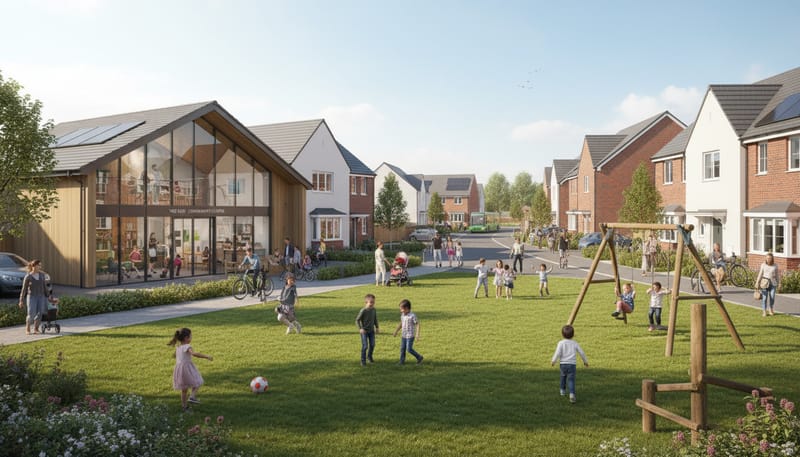
Building homes is only part of the story. The most successful new developments in the UK are those that create not just collections of houses but genuine communities — places where people want to live, where neighbours know each other, where children play safely, and where a sense of belonging develops naturally over time. This concept, known in the industry as placemaking, has moved from the margins of development philosophy to the very centre of how UK housebuilders plan, design, and deliver their largest and most ambitious schemes. Leading developers including Barratt, Taylor Wimpey, Bellway, Persimmon, and Berkeley Group are investing significant resources in the community infrastructure, green spaces, and social programming that transform a housing development into a thriving neighbourhood. Their efforts are supported by an evolving planning framework that increasingly recognises the importance of social and community value alongside the provision of new homes.
The shift towards genuine community building reflects a growing body of evidence linking the quality of the neighbourhood environment to residents' health, happiness, and quality of life. Research by the NHS, Public Health England, and numerous academic institutions has consistently demonstrated that people who live in well-designed communities with access to green spaces, community facilities, and good transport links enjoy better physical and mental health, stronger social connections, and higher overall life satisfaction than those in poorly planned environments. For developers, this evidence provides both a moral imperative and a commercial rationale — developments that deliver strong community outcomes attract more buyers, command higher prices, and generate the positive word-of-mouth that drives future sales. This article examines the key strategies UK developers are using to create thriving communities, profiles exemplary developments from across the country, and explores what buyers should look for when assessing the community credentials of a new development.
The Art and Science of Placemaking
Placemaking is a multi-faceted approach to the planning, design, and management of public spaces that draws on a community's assets, inspiration, and potential. In the context of new build developments, it encompasses everything from the layout of streets and the positioning of buildings to the design of parks, the provision of community facilities, and the creation of opportunities for social interaction. The best placemaking creates environments where the physical design naturally encourages people to meet, talk, play, and connect — where community happens organically rather than being forced.
The National Design Guide, published by the Department for Levelling Up, Housing and Communities, provides a framework for good placemaking that developers are expected to follow. The Guide identifies ten characteristics of well-designed places: context, identity, built form, movement, nature, public spaces, uses, homes and buildings, resources, and lifespan. While all ten are important, the characteristics most directly relevant to community building are public spaces (the quality and usability of shared outdoor areas), uses (the mix of activities and facilities available), and movement (the ease of walking, cycling, and connecting to the wider area).
UK developers are increasingly working with specialist placemaking consultants, landscape architects, and community development professionals to ensure that their developments deliver genuine community value. This represents a significant evolution from the approach of previous decades, when the focus was primarily on housing numbers and physical infrastructure, with community considerations treated as secondary. Today, the best developers embed placemaking thinking from the very earliest stages of the design process, before a single home has been laid out, ensuring that community infrastructure is integral to the development's DNA rather than an afterthought.
Barratt Developments has established a dedicated Placemaking team that works alongside its design and planning teams on every major development. The team includes landscape architects, urban designers, and community engagement specialists who bring a depth of expertise that ensures developments are designed for people, not just for cars and buildings. Barratt's placemaking principles prioritise walkability (ensuring that homes are within easy walking distance of key facilities), permeability (creating a network of connected routes that make it easy to move through the development on foot or by bicycle), and legibility (designing a layout that is easy to understand and navigate, with clear landmarks and focal points). These principles have been applied to developments across the UK, from the 2,500-home Kingsbrook development in Aylesbury to the 3,000-home Darwin Green scheme in Cambridge.
Green Spaces: The Heart of Healthy Communities
Access to quality green space is one of the most important determinants of community wellbeing, and UK developers are investing more than ever in creating parks, gardens, nature reserves, and green corridors within their developments. The evidence base for the benefits of green space is overwhelming — regular access to nature reduces stress, improves mental health, encourages physical activity, and strengthens social connections. A study by the University of Exeter found that people who spend at least 120 minutes per week in green spaces are significantly more likely to report good health and high wellbeing, regardless of other socioeconomic factors.
Planning policy requires most new developments to incorporate a minimum quantum of public open space, typically calculated at around 2.4 hectares per 1,000 population. However, many leading developers significantly exceed this minimum, recognising that generous, well-designed green space adds enormous value to a development — both in terms of resident wellbeing and in commercial terms. Research by the HBF has found that homes adjacent to parks and green spaces attract a price premium of approximately 8-12%, and that developments with above-average green space provision sell faster and generate more positive buyer feedback.
Taylor Wimpey's approach to green space design focuses on creating a hierarchy of outdoor spaces that caters to different needs and activities. A typical Taylor Wimpey development will include a central park or village green that serves as a focal point for the community, smaller pocket parks and play areas distributed throughout the development for everyday use, nature corridors and woodland walks that connect the development to the wider landscape, and community growing spaces (allotments or raised beds) that bring residents together around a shared activity. This layered approach ensures that every resident has access to quality outdoor space within a few minutes' walk of their home, regardless of where on the development they live.
Barratt's Kingsbrook development in Aylesbury provides an outstanding example of green space-led community design. The 2,450-home development incorporates over 100 hectares of green space — more than 40% of the total site area — including a 50-hectare nature reserve developed in partnership with the RSPB. The reserve features a mosaic of habitats including grassland, woodland, wetland, and hedgerows, and has already attracted over 100 bird species, including red kites, skylarks, and barn owls. For residents, the reserve provides exceptional recreational opportunities, from walking and cycling trails to bird watching and nature photography, all within a few minutes' walk of their front door.
Berkeley Group has established a reputation for creating exemplary green spaces within urban and suburban developments. The company's developments at Kidbrooke Village in South East London and Green Park Village near Reading feature extensive landscaped parks, water features, and biodiversity areas that provide a genuine sense of escape and tranquillity within busy urban contexts. Berkeley's design philosophy treats green space not as the leftover area between buildings but as the primary structuring element around which the development is organised — an approach that creates a fundamentally different relationship between homes, nature, and community.
Industry Insight: Biodiversity Net Gain (BNG) requirements, introduced in February 2024, have given developers an additional incentive to invest in high-quality green spaces. All new developments must now deliver at least a 10% net gain in biodiversity, and many developers are targeting 20% or more. This has led to more creative and ecologically rich landscape designs that benefit both wildlife and residents, creating green spaces that are not just attractive but genuinely teeming with life.
Play Areas and Children's Facilities
High-quality play provision is a cornerstone of family-friendly community design. UK developers are moving well beyond the utilitarian play areas of the past — with their standard swings, slides, and roundabouts — to create imaginative, stimulating play environments that encourage physical activity, creative play, and social interaction among children of all ages. This investment in play reflects both the expectations of today's family buyers and a growing body of evidence about the importance of outdoor play for child development.
The Fields in Trust benchmark standard recommends that all residents should have access to a play area within 400 metres (approximately a five-minute walk), and most major developers comply with or exceed this standard. On larger developments, a hierarchy of play provision typically includes toddler play areas (for children aged 0-5) positioned within residential streets for easy parental supervision, junior play areas (ages 5-12) featuring more adventurous equipment such as climbing structures, zip lines, and natural play features, and youth recreation spaces (ages 12+) including multi-use games areas, outdoor gym equipment, and social seating areas.
Play Provision by Developer (per 500 homes)
Bellway has partnered with specialist play equipment designers to create bespoke play areas that reflect the character and heritage of each development's location. At its Harbour Village development on the Isle of Sheppey, the play area features nautical-themed equipment including a climbing ship, rope bridges, and sand play areas that connect children to the coastal setting. At a development in the Chilterns, the play area incorporates natural materials — log stepping stones, willow tunnels, and boulder climbing features — that complement the rural landscape. This site-specific approach creates play areas that feel integral to the development rather than generic additions, enhancing the overall sense of place.
Natural play — using landscape features, water, planting, and natural materials rather than manufactured equipment — is a growing trend in new development play design. Research by Natural England has shown that children who regularly play in natural environments develop better physical coordination, creativity, and resilience than those whose play is limited to conventional equipped play areas. Developers including Taylor Wimpey and Crest Nicholson are incorporating natural play elements into their developments, creating environments where children can explore, build, and imagine in ways that manufactured equipment cannot replicate.
Community Facilities and Local Centres
Larger new developments are increasingly designed to be self-sustaining communities with their own local centres providing the shops, services, and facilities that residents need for daily life. The provision of community facilities is typically secured through Section 106 agreements (planning obligations) between the developer and the local planning authority, which may require the developer to build, fund, or contribute towards schools, healthcare facilities, community halls, sports pitches, and local retail provision. In 2024, the UK housebuilding industry contributed approximately £4.2 billion in Section 106 and Community Infrastructure Levy (CIL) payments — a substantial investment in community infrastructure that benefits not just new residents but the wider area.
Annual S106 & CIL Contributions by UK Housebuilders
Schools are often the single largest community infrastructure investment associated with new developments. A development of 2,000 homes will typically generate sufficient demand for a new two-form entry primary school (420 places) and make a substantial contribution towards secondary school provision. Developers including Barratt, Taylor Wimpey, and Persimmon have delivered dozens of new primary schools across the UK in recent years, often working with specialist education providers to create facilities that serve as both school buildings and community hubs, available for use by local groups and organisations outside school hours.
Healthcare provision is another critical community requirement. While the direct provision of GP surgeries by developers is relatively rare (healthcare commissioning being primarily the responsibility of NHS England and local Integrated Care Boards), developers make significant financial contributions towards healthcare infrastructure through Section 106 agreements. On larger developments, these contributions can fund the construction or expansion of GP surgeries, dental practices, and pharmacy facilities within or close to the development. Taylor Wimpey's Sherford development in Devon, a major urban extension of 5,500 homes, includes a purpose-built health centre that provides GP, dental, and pharmacy services for residents, demonstrating what is possible when healthcare planning is integrated with development design from the outset.
Community halls and meeting spaces provide vital gathering points for new communities. These flexible venues serve a wide range of functions, from hosting community events and social activities to providing space for children's groups, fitness classes, and local clubs. Bellway has delivered over 40 community buildings across its developments in the past five years, each designed in consultation with local residents and community groups to ensure that the facilities meet genuine needs rather than ticking a planning box. The company's approach to community building design has evolved significantly, with recent examples featuring modern, energy-efficient buildings with flexible internal spaces, commercial kitchens, and outdoor terraces that can accommodate a variety of uses.
Mixed Tenure and Inclusive Communities
The most resilient and vibrant communities are those that include a mix of housing tenures, household types, and income levels. UK planning policy requires most new developments to include a proportion of affordable housing — typically 20-40% depending on the local authority's planning policy — and leading developers are increasingly designing their developments to ensure that affordable homes are seamlessly integrated with market housing, creating genuinely mixed communities where tenure is indistinguishable from the exterior of the homes.
The approach to affordable housing design has evolved significantly. In the past, affordable homes were sometimes clustered in a single area of the development, visually differentiated from market homes through lower-specification materials or less generous proportions. Today, best practice — and most local planning policies — require affordable homes to be distributed or "pepper-potted" across the development and built to the same external specification as market homes, so that an observer cannot distinguish between tenure types by looking at the homes from the street. This approach promotes social cohesion and prevents the stigmatisation that can arise when affordable housing is concentrated and visibly different.
Vistry Group (formerly Bovis Homes and Countryside Properties) has become the UK's largest provider of affordable housing, delivering thousands of affordable homes each year through partnerships with housing associations across the country. Vistry's model integrates affordable and market housing within a single development design, with shared access to all community facilities, green spaces, and play areas. The company's developments demonstrate that mixed tenure communities can be commercially successful as well as socially beneficial — market home buyers are attracted by the diversity and vibrancy of mixed communities, and the presence of affordable housing helps to ensure that local workers and young families can continue to live in the areas where they grew up or work.
Age diversity is another important dimension of inclusive community design. Developments that cater exclusively to one demographic — whether young professionals, families, or retirees — can feel one-dimensional and may struggle to develop the social richness that characterises thriving communities. Forward-thinking developers are creating developments that include a mix of housing types to attract different age groups, from starter apartments and family homes to bungalows and retirement living options. This demographic diversity creates natural opportunities for intergenerational interaction, mutual support, and community resilience.
Community Programming and Social Events
Physical infrastructure alone does not create community — it is the social interactions and shared experiences that take place within these spaces that build the bonds between neighbours. An increasing number of developers are investing in community programming and social events during the early years of a development's life, recognising that new residents arriving in an unfamiliar area often need a catalyst to help them connect with their neighbours and begin building the social networks that underpin community life.
Taylor Wimpey's Community Fund provides grants of up to £1,000 per development per year to support community-led initiatives such as street parties, seasonal celebrations, running clubs, gardening groups, and children's activity programmes. The fund is administered locally by Taylor Wimpey's regional community liaison officers, who work with resident groups to identify priorities and provide practical support. Since its launch, the Community Fund has supported over 3,000 community events and activities across the UK, helping to kickstart community life on new developments and providing a foundation for ongoing social activity.
Barratt Developments employs community development coordinators on its largest developments during the early occupation phases. These coordinators serve as the link between new residents and the wider community, organising welcome events, establishing community communication channels (typically through WhatsApp groups or dedicated community apps), and connecting residents with local services, clubs, and volunteer organisations. Barratt's experience is that developments which benefit from active community coordination during their first 18-24 months develop stronger social networks and report higher resident satisfaction than those without this support.
Digital community platforms are complementing physical events. Several developers provide dedicated online platforms or partner with community apps such as Nextdoor to help new residents connect with each other and with the wider neighbourhood. Bellway's community platform, launched across its largest developments, allows residents to share recommendations, organise events, report local issues, and sell or give away unwanted items. The platform has proved particularly popular with new residents who may not yet have established local connections and provides a low-barrier way to begin building relationships with neighbours.
Transport and Connectivity
A well-connected community is an accessible community. The quality of transport links — both within a development and connecting it to the wider area — is a critical factor in community success. Developments that are isolated or car-dependent tend to generate less social interaction and poorer wellbeing outcomes than those that are well-connected by foot, cycle, and public transport. UK developers are increasingly prioritising transport connectivity as a core element of their placemaking strategies.
Walking and cycling infrastructure receives significant investment on modern developments. Wide, well-lit pedestrian and cycle paths connect residential areas to local centres, schools, parks, and public transport stops, creating safe and pleasant alternatives to the car for everyday journeys. Taylor Wimpey's design guidelines specify minimum widths for pedestrian footpaths (2 metres) and shared-use paths (3 metres), and the company requires all paths to be overlooked by habitable rooms for safety and natural surveillance. Dedicated cycle storage is provided at community facilities and local centres, and many developments include cycle repair stations and pump stations to encourage active travel.
Public transport contributions are a key component of Section 106 agreements for larger developments. These contributions may fund new or enhanced bus services, the construction of bus stops and shelters within the development, or contributions towards wider transport improvements such as new railway stations or park-and-ride facilities. Persimmon's Great Oldbury development near Stonehouse in Gloucestershire includes a new bus service that connects the development to the town centre, railway station, and nearest secondary school — a service that was planned from the outset and launched before the first residents moved in, ensuring that public transport was available from day one.
Buyer Tip: When evaluating a new development, look beyond the home itself and assess the community infrastructure. Visit the development at different times of day to get a sense of the atmosphere and activity levels. Check what community facilities are planned (and when they will be delivered — phasing matters). Ask about green spaces, play areas, schools, and transport links. A well-planned community development will enhance your quality of life and protect the value of your investment for years to come.
Long-Term Community Management and Stewardship
The long-term management of community spaces and facilities is a crucial but sometimes overlooked aspect of community building. Beautifully designed parks, play areas, and community buildings can quickly deteriorate without proper maintenance and management, undermining the investment that developers and communities have made. UK developers are increasingly giving careful thought to the long-term stewardship of community assets, establishing management structures that ensure these spaces remain well-maintained and responsive to residents' needs for decades to come.
Several models of community management exist. On some developments, green spaces and community facilities are transferred to the local authority, which assumes responsibility for their maintenance using council tax revenue. On others, management is handled by a resident management company (RMC) funded through a service charge paid by homeowners. A growing third model involves community land trusts or development trusts — independent, community-led organisations that take ownership of community assets and manage them in perpetuity for the benefit of residents.
Barratt Developments has pioneered the use of community trusts on several of its largest developments. At Kingsbrook in Aylesbury, a community trust manages the extensive green spaces, nature reserve, and community facilities, funded by a modest annual charge per household. The trust is governed by a board that includes resident representatives, ensuring that management decisions reflect the priorities and preferences of the people who live on the development. This model gives residents a genuine stake in the future of their community and provides a transparent, accountable framework for the management of shared assets.
Taylor Wimpey has partnered with FirstPort and other specialist management companies to provide professional estate management on its developments. These management arrangements are disclosed to buyers before purchase, including details of the services provided, the service charge level, and the governance arrangements. Taylor Wimpey's approach emphasises transparency and value for money, with regular resident surveys used to assess satisfaction with the management service and to identify areas for improvement. The company has also committed to capping service charge increases at the rate of inflation for the first five years of a development's life, providing residents with cost certainty during the community's formative period.
Exemplary Developments: Community Building in Practice
Several UK developments stand out as examples of exceptional community building that demonstrate what is possible when developers commit to placemaking as a core principle rather than an afterthought.
Sherford in Devon, being delivered by a consortium led by Taylor Wimpey and Vistry, is perhaps the most ambitious community-building project in the UK. Planned as a complete new town of 5,500 homes, Sherford will eventually include its own town centre with shops, restaurants, and services, three primary schools and a secondary school, a health centre, a sports hub with swimming pool and multi-use sports hall, a community arts centre, and an extensive network of parks and green spaces including a community farm. What makes Sherford particularly notable is the pace at which community life has developed — resident-led groups and activities were established within months of the first occupations, supported by a dedicated community development team that provides practical and financial support for resident initiatives.
Kidbrooke Village in South East London, developed by Berkeley Group, demonstrates that outstanding community building is achievable in an urban context. The regeneration of the former Ferrier Estate has created a mixed-tenure community of 4,800 homes set within 35 hectares of new parkland. The development features a village square with shops and cafes, a healthcare centre, a community centre, and extensive sports and play facilities. The mix of tenures — including market sale, affordable rent, shared ownership, and private rental — has created a diverse, vibrant community that reflects the broader social mix of London. Kidbrooke Village has won multiple awards for placemaking excellence, including the Housing Design Award for Best Masterplan and the RIBA Award for Urban Design.
What Community Building Means for Buyers
For anyone considering the purchase of a new build home, the quality of the community infrastructure is at least as important as the quality of the home itself. A beautiful home in a poorly planned development will never deliver the quality of life that a good home in a well-planned community can provide. The community environment affects your daily experience — from the view from your window and the route you walk to work, to the friends your children make and the clubs and activities available on your doorstep.
When assessing a development's community credentials, look for evidence of thoughtful placemaking. Is the development designed around pedestrian routes and green spaces, or around roads and car parks? Are there community facilities planned, and if so, when will they be delivered? What is the mix of housing types, and does the development include a range of tenures? Are play areas imaginative and well-positioned, or tokenistic? Is there a plan for long-term management of shared spaces, and is the management charge transparent and reasonable? These questions will help you distinguish between developments that genuinely prioritise community and those that treat it as a box-ticking exercise.
The financial benefits of good community design should not be underestimated either. Homes in well-planned communities with strong infrastructure and attractive shared spaces consistently outperform the broader market in terms of value retention and growth. Research by Savills has found that homes on developments with above-average placemaking quality command prices 10-14% above comparable developments with standard community provision. Over the typical period of homeownership, this premium can translate to tens of thousands of pounds of additional equity — a compelling financial argument for choosing a development with strong community credentials. For more on choosing the right development, read our guide to what to look for in a new build development.
Key Takeaway: The best UK housebuilders are no longer just building homes — they are building communities. From green spaces and play areas to schools, healthcare facilities, and community programming, the investment in community infrastructure has never been greater. For buyers, this means that choosing a well-planned development is not just about getting a good home — it is about investing in a better quality of life. Look beyond the bricks and mortar, assess the community as a whole, and choose a development where you can see yourself not just living but thriving. For a broader perspective on the industry's evolution, explore our article on how developers are improving customer experience.