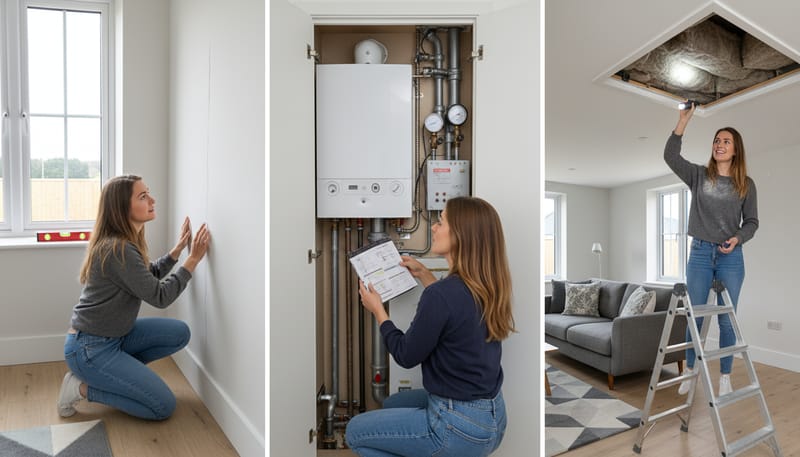
Month 1: The Excitement (and the Drying Out)
The Drying Out Period Is Real
A brand new house contains thousands of litres of water — in the plaster, the screed, the mortar, and the concrete. This moisture needs to evaporate, and it takes 9–12 months for a new build to fully dry out. During this time you'll notice:
- Condensation on windows: Especially in winter. You'll wake up to water pooling on windowsills. This isn't a fault — it's moisture leaving the building fabric. Wipe it up daily and ventilate well
- Hairline cracks in plaster: As the plaster dries and the house settles, small cracks appear along joins — where walls meet ceilings, around door frames, and along staircase strings. These are cosmetic settlement cracks, not structural. Don't fill them yet — wait until the drying out period ends or they'll just reappear
- Stiff doors and windows: Timber frames absorb moisture during construction and may swell initially. As they dry, they shrink — you might find doors that stuck in winter swing freely in summer, and vice versa
- Musty or damp smells: New plaster and wet trades create moisture that can smell damp. This doesn't mean you have a damp problem. Keep trickle vents open, use extractor fans when cooking and showering, and if you have a mechanical ventilation system (MVHR), make sure it's running
How to Help Your Home Dry Out
Ventilation is everything. Keep trickle vents on windows open (even in winter), run bathroom and kitchen extractor fans for at least 20 minutes after use, and avoid drying clothes on radiators — a single load of wet laundry releases about 2 litres of water into the air. If condensation is severe, a dehumidifier in the worst-affected room makes a noticeable difference within days. Aim for 40–60% relative humidity.
Don't be tempted to crank the heating up to "dry the house out faster." Excessive heat causes the plaster to dry too quickly, leading to more cracking. Normal heating patterns (18–21°C) combined with good ventilation is the right approach.
Your First Snag List
Walk through every room with a critical eye on your first day. Common snags include:
- Paint touch-ups needed (marks, thin coverage, overspray on window frames)
- Scratched or chipped worktops, sinks, or bath panels
- Doors that don't close properly or scrape the floor
- Unfinished sealant around baths, showers, and sinks
- Missing or loose handles, hinges, or fixings
- Gaps between skirting boards and walls or floors
- Uneven tiling or grout
- External items: unfinished pointing, driveway damage, missing fence panels
Report everything to the site manager in writing (email, not just verbal). Most developers give you a formal snagging period — often 7–14 days — to report initial defects. But under your NHBC warranty, you can report defects for the first 2 years. Take photos of everything and keep a log. For a thorough approach, consider hiring a professional snagging company (£300–£500) — they typically find 50–100+ items that most buyers miss.
Months 2–3: The Snagging Reality
Why Snags Take So Long to Fix
You've reported 30 snags. The site manager said they'd be fixed within two weeks. It's been six weeks and half are still outstanding. This is, unfortunately, normal. Here's why:
- The site team is focused on completing and selling remaining plots — your snags are lower priority than finishing the next phase
- Some trades (specialist tilers, electricians, kitchen fitters) visit the site on rotation, not daily
- Materials for your specific specification may need ordering
- Subcontractors who did the original work may have moved to another site entirely
Patience and persistence are the strategy. Email the site manager weekly with an updated list. Be polite but firm. If progress stalls after 8 weeks, escalate to the customer care team at the developer's head office. If that fails, contact the NHBC (or your warranty provider) — this usually gets things moving because developers don't want warranty claims on their record.
The Snags That Aren't Actually Snags
Some things that feel like defects are actually within tolerance:
- Small gaps between skirting and floor: Floors and walls are never perfectly level. Gaps up to 3mm are within industry tolerance
- Slight unevenness in walls: Plasterwork has a tolerance of about 5mm over a 2-metre span. Hold a straight edge against the wall to check — minor waviness is acceptable
- Nail pops: Small bumps appearing in plasterboard ceilings and walls. These are nails or screws pushing through as timber dries and shrinks. They're cosmetic and easily fixed during your end-of-year touch-up
- Shrinkage gaps in woodwork: Gaps between architraves and walls, or between stair treads and strings, are caused by timber drying. Fill them after 12 months
Months 3–6: Living on a Building Site
Construction Noise and Disruption
If you've moved into an early phase of a large development, you're living next to an active construction site. This means:
- Early starts: Construction typically runs 7:30am–6pm weekdays and 8am–1pm Saturdays. Some sites have permission for 7am starts
- Noise: Piling, concrete pours, and heavy machinery are the worst. Internal finishing work is much quieter. The noise levels depend on what phase is being built and how close it is to your plot
- Dust: Mud and dust are unavoidable on an active site. Your car will need washing more often. Keep windows closed during earthworks nearby
- Restricted access: Roads may be unfinished, parking can be limited, and access routes change as construction progresses. Delivery drivers often struggle to find new build addresses
- Temporary landscaping: The promised parkland, play areas, and mature trees won't appear until late in the development — sometimes years after you move in
What You Can Do About It
Check the site's planning conditions for permitted working hours — if they're breaching them, you can report it to the local council's environmental health team. For excessive dust, the developer should be using wheel washes and damping down roads. For damaged shared areas or your property, document everything and report it to the site manager. The developer is responsible for maintaining a safe, reasonably clean living environment even while construction continues.
The good news: construction noise reduces significantly once the plots immediately around yours are completed. The worst phase is typically the first 6–12 months if you bought on an early phase.
The Garden Situation
New build gardens are often the last thing finished — and sometimes barely finished at all. You might receive:
- A turfed lawn on compacted builder's soil (which drains poorly)
- Basic fencing (often 1.2m, not the 1.8m you expected)
- No gate, no path, and no planting whatsoever
- Builder's rubble mixed into the topsoil
Before doing any major garden work, wait until the development is further along. Heavy machinery on adjacent plots can damage fencing and landscaping. In the meantime, check what the developer is contractually obligated to provide (it's in your specification document) and chase anything missing. If the turf dies because it was laid on subsoil with no preparation, that's a snag — report it.
Months 6–9: Things Start Settling (Literally)
Settlement Cracks: When to Worry and When Not To
By month 6, you'll see cracks you didn't notice before — or existing hairline cracks that have widened slightly. The vast majority are normal settlement as the building adjusts to its foundations and the ground beneath compacts under the new load.
- Hairline cracks (under 1mm): Completely normal. Cosmetic only. Fill and repaint after 12 months
- Cracks 1–5mm: Still usually settlement. Monitor them — stick tape across the crack and date it. If the tape breaks within a month, the crack is still moving and you should report it to your warranty provider
- Cracks over 5mm or stair-step patterns in brickwork: Potentially structural. Report to NHBC/warranty provider and the developer immediately. These are rare on new builds but not unheard of, particularly on clay soils or sites with filled ground
- Cracks around windows and doors: Often caused by lintel deflection as the building settles. Usually cosmetic but should be reported if they're wider than 2mm or if doors/windows are becoming difficult to operate
The First Winter
Your first winter in a new build is the real test. On the positive side:
- Energy bills will be noticeably lower than older properties. A new build with an EPC A or B rating typically costs £800–£1,200/year to heat, compared to £1,800–£2,500 for a comparable older property
- Draughts are minimal. Modern building regulations require airtight construction, and new builds are tested for air permeability
- Your boiler is under manufacturer's warranty (typically 5–10 years). Register it within 30 days of moving in or you may void the warranty
On the challenging side:
- Condensation peaks in winter due to the drying out process. Run dehumidifiers and ventilate daily
- The garden becomes a mud bath. New turf on compacted soil doesn't drain well — stay off it as much as possible through winter to let it establish
- You'll discover any heating distribution issues. Rooms that don't warm up properly, cold spots near external walls, or radiators that need bleeding should be reported. Your plumber can balance the system
Energy Performance in Practice
New builds are marketed with impressive EPC ratings, but your actual energy use depends on how you live. Key points:
- Learn how to program your thermostat and hot water timer — many new build owners leave systems running 24/7 because the controls are unfamiliar
- If you have an air source heat pump instead of a gas boiler, it runs differently: lower output over longer periods. Don't treat it like a gas boiler by turning it on and off — set it to a constant lower temperature
- Underfloor heating (if fitted) is slow to respond. Set it and forget it rather than adjusting daily
- If your EPC predicted bills significantly lower than what you're paying, check your tariff first — then check whether the insulation specification matches what was promised
Months 9–12: The Home Starts Feeling Like Yours
The Cosmetic Touch-Up
Around the 11–12 month mark, most developers offer a cosmetic rectification visit. This is your chance to get settlement cracks, nail pops, and minor cosmetic issues fixed before your initial snagging period closes. Prepare by:
- Walking every room with your original snag list and checking what was actually fixed
- Noting any new cracks, nail pops, or cosmetic issues that appeared during the drying out period
- Checking all doors and windows operate properly (they may have shifted as the house settled)
- Testing all mechanical and electrical items: extractor fans, boiler, shower pumps, smoke alarms
- Inspecting external areas: pointing, render, drainage, paths, and any shared areas
Submit your list in writing with photos. Be thorough — after this visit, you're into the general warranty period where only genuine defects (not cosmetic issues) are covered.
The 2-Year Defect Period
Under the NHBC Buildmark warranty (or equivalent from other providers), the first 2 years are the "builder warranty period." During this time, the developer is responsible for fixing defects that breach NHBC standards. After 2 years, the NHBC takes over for structural issues only (years 3–10).
Common year-1 warranty claims include:
- Plumbing leaks (joints that weren't fully tightened or sealed)
- Boiler issues (often installer error rather than boiler fault)
- Drainage problems (blocked or incorrectly graded drains)
- Damp patches on internal walls (usually from external defects like missing cavity trays or poor pointing)
- Faulty windows or doors (mechanisms, seals, or alignment)
Report issues promptly — the 2-year deadline is strict. If the developer won't fix a valid defect, escalate to your warranty provider. For serious disputes, the NHBC offers a resolution service.
What Gets Better After Year One
The first year is the hardest. By month 12:
- The house is largely dried out — condensation reduces dramatically in your second winter
- Settlement cracks have stabilised and can be filled permanently
- Most snags are resolved (or you know the escalation process for outstanding ones)
- The garden turf has established and you can start proper landscaping
- Surrounding plots are more likely to be completed — less construction noise and disruption
- You understand your home's systems — heating, ventilation, appliances — and running costs have settled into a predictable pattern
- The community is forming. Neighbours have moved in, and many new build estates develop strong communities because everyone moved in around the same time
Month-by-Month Quick Reference
- Month 1: Complete snag list. Set up utilities. Learn heating controls. Start ventilating for drying out. Register boiler warranty
- Month 2: Chase initial snag fixes. Order furniture you didn't have for day one. Set up broadband (if not already done)
- Month 3: Second walk-through for new snags. Assess garden situation. Join any residents' Facebook group or WhatsApp
- Month 4–5: Settle into routine. Monitor any cracks. Review energy use against predicted EPC costs
- Month 6: Midpoint check — photograph all cracks for monitoring. Review remaining outstanding snags and escalate if needed
- Month 7–8: Start thinking about cosmetic rectification list. Research garden plans for spring
- Month 9: First winter preparations. Bleed radiators. Check external drainage is clear. Test heating system
- Month 10–11: Compile comprehensive touch-up list. Contact developer to schedule 12-month visit
- Month 12: Developer's cosmetic rectification visit. Fill settlement cracks. Repaint where needed. Celebrate surviving year one
The Honest Truth About New Build Living
New build forums and Facebook groups can paint a bleak picture. Every development has unhappy buyers sharing horror stories. But the reality is more nuanced:
- Most new build issues are cosmetic, not structural. Settlement cracks, stiff doors, and missing sealant are annoying but fixable
- The warranty exists for a reason. Unlike buying a 1930s semi, you have 10 years of structural protection and 2 years of builder liability for defects
- Energy savings are real and significant. Lower bills year after year compound into meaningful savings over a decade
- The building site doesn't last forever. Even the largest developments eventually finish, and the infrastructure (roads, parks, schools) that was promised does get delivered — just on developer timelines, not buyer timelines
- Your home will feel different at 12 months than at 12 weeks. The drying out period, the snagging frustration, and the building site disruption are all temporary. What's permanent is a modern, energy-efficient home that you own
The buyers who have the best experience are the ones who go in with realistic expectations. A new build isn't a finished product on day one — it's a new product that needs 12 months to fully settle and reveal its quirks. Now you know what to expect.
Essential Contacts to Have Ready
- Site manager: For snags and on-site issues during construction
- Customer care team: The developer's dedicated aftercare department (for when the site manager can't help)
- NHBC or warranty provider: For disputes or unresolved defects. NHBC claims line: 0800 035 6422
- Emergency plumber/electrician: Even with a warranty, emergency call-outs outside business hours aren't always covered. Have a trusted local tradesperson's number saved
- Your solicitor: For any contractual disputes about what was promised vs delivered
- Local council: For council tax queries, bin collection setup, and construction noise complaints