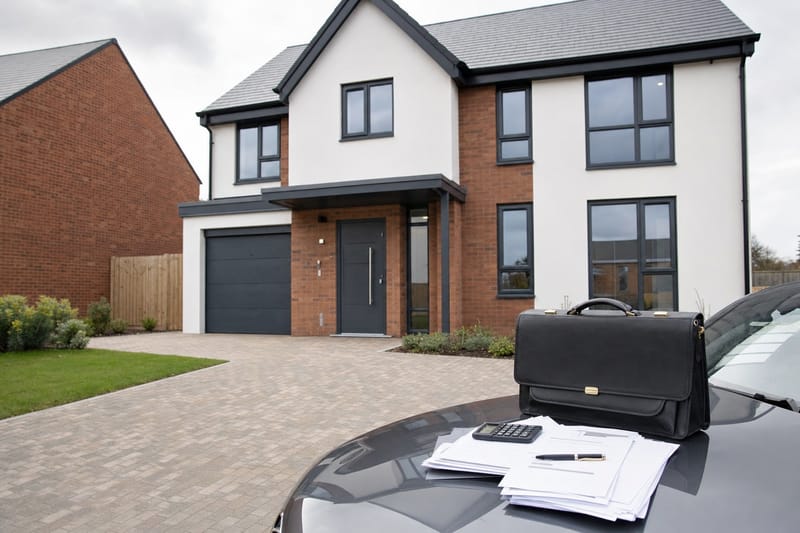
A bridging loan is short-term finance that "bridges" a gap between two events — most often between buying a new property and selling an existing one, or between a developer's completion deadline and a mortgage offer that hasn't yet been released. For new build buyers specifically, bridging finance new build purchases has become a recognised, if niche, tool because new homes come with fixed dates that ordinary house sales don't: a developer's long-stop completion date, a reservation deadline, or a build-stage payment schedule that doesn't wait for your buyer's solicitor to catch up.
Unlike a standard residential mortgage, which can take four to eight weeks (or longer) to underwrite, a bridging loan can typically be arranged and drawn down within one to three weeks, sometimes faster in a genuine emergency. That speed comes at a cost: bridging finance is priced monthly rather than annually, with rates that dwarf a typical mortgage rate when annualised, plus arrangement fees, valuation fees, legal fees on both sides, and often an exit fee.
This guide sets out how bridging works in practice, the situations where it genuinely solves a new build purchase problem rather than just delaying one, what it costs compared with waiting for a standard mortgage, and the questions to ask a broker or lender before you sign anything. It also looks at the alternatives worth ruling out first, because in many cases a phone call to your developer or mortgage lender resolves the timing gap without any bridging finance at all.
If you're still weighing up the wider mortgage process, it's worth reading alongside How to Handle Mortgage Delays on New Build Purchases and How Build Stage Payments Work for Off-Plan New Builds, both of which cover the timing pressures that often lead buyers to consider bridging in the first place.
How Bridging Finance Actually Works
A bridging loan is secured against property, usually with a first or second legal charge, and is designed to be repaid within a short, fixed window — typically 1 to 12 months, occasionally extending to 18 or 24 months for more complex cases. Lenders are less concerned with your income multiple than a mortgage lender would be, and far more concerned with your exit strategy: the specific, provable way you intend to repay the loan.
Open vs closed bridging
- Closed bridging — you have a fixed, contracted exit date, such as an exchanged sale on your existing home with a known completion date, or a mortgage offer already issued and awaiting only a completion date. Lenders price these more favourably because the risk of non-repayment is lower.
- Open bridging — you don't yet have a confirmed exit date, for example your current home is on the market but unsold. These are riskier for the lender, cost more, and are usually capped at a shorter maximum term.
First charge vs second charge
If you own your current home outright or the bridging loan will fully replace your existing mortgage on completion, the bridge is usually a first charge. If you're keeping an existing mortgage in place on your current home and borrowing additional short-term funds against it to release a deposit for the new build, the bridge sits behind the existing lender as a second charge — which typically costs more and requires your existing lender's consent.
How interest is charged
Bridging interest is usually quoted monthly (commonly in the region of 0.5% to 1.5% a month as of 2026, though always check the current figure with a broker, since rates move with the base rate and lender risk appetite). You can usually choose to:
- Service the interest monthly — pay it as you go, which keeps the final balance lower but requires spare monthly income.
- Roll up (retain) the interest — the interest is added to the loan and paid off in one lump sum at the end, which is more common for chain-break bridges where cash flow is already tight.
A bridging loan is priced as a solution to a dated, provable problem. If a lender can't see a credible exit within the term, they will decline the application or price it so high it stops making sense — which is itself useful information.
The New Build Timing Problems Bridging Actually Solves
New build purchases create timing pressure that resale purchases don't, largely because the developer's schedule doesn't move to accommodate your buyer's chain. The situations where bridging finance is most often genuinely useful include:
1. Developer completion deadline arrives before your sale completes
Reservation agreements and contracts for new builds almost always include a long-stop completion date, and once your new home reaches practical completion, the developer will typically give you 10 to 28 days' notice to complete. If your existing home sale hasn't yet completed — even if it's exchanged and just a few days behind — a bridging loan lets you complete on the new build on time, then repay the bridge the moment your sale proceeds land.
2. You need to exchange faster than your mortgage offer allows
Occasionally a developer wants a quick exchange to secure a plot, incentive, or price before a rate review, but your mortgage offer is still weeks away from being issued. A short bridge can fund the deposit or purchase so you don't lose the plot, with the mortgage then repaying the bridge once it completes.
3. Chain break on your existing sale
If your buyer pulls out late in the process — after you've already committed to a completion date on your new build — a chain break bridging loan covers the shortfall until you find a new buyer. This is the single most common reason new build buyers end up looking at bridging finance, and it's covered in more detail below.
4. Part-exchange or assisted move shortfall
Some developers offer part-exchange or an assisted move service, but the valuation or timing doesn't always match what you need on completion day. A bridge can cover a temporary shortfall while the part-exchange sale is finalised.
5. Auction-style or fast-reservation new build plots
Some development launches, particularly for the final few plots on a phase, are sold on tight reservation windows with financial penalties for missing deadlines. Bridging can secure the plot while a standard mortgage application proceeds in parallel.
Chain Break Bridging Loans in Detail
A chain break bridging loan is arguably the most common bridging scenario new build buyers encounter, because new build chains are unusually inflexible on one side (the developer's date) while remaining exactly as fragile as any resale chain on the other (your buyer's onward chain).
The mechanics typically work like this:
- You've exchanged contracts on your new build purchase with a fixed completion date.
- Your existing home sale falls through — the buyer withdraws, their mortgage is declined, or their own chain collapses — after your completion date is already locked in.
- You apply for a bridging loan secured against your existing (unsold) home, sized to cover the shortfall between your new build purchase price and the funds you actually have available.
- You complete on the new build on time using the bridge plus your available funds.
- You remarket and sell your existing home, using the sale proceeds to repay the bridge in full.
What lenders want to see
- A realistic, ideally recent, valuation of your existing property with clear equity.
- Evidence the property is genuinely marketable — an estate agent instruction, marketing history, or a fresh valuation if the previous sale fell through some time ago.
- A repayment strategy if the bridge term expires before a sale completes, sometimes called a "backstop" exit (for example, refinancing onto a mortgage against the existing property, or a family loan).
Why speed matters here
Because the trigger event — your buyer pulling out — often happens with only days or weeks' notice before your new build completion date, chain break bridges are usually arranged under real time pressure. Specialist bridging lenders and brokers who work regularly with new build completions can sometimes turn an application around faster than a mainstream lender, precisely because this is their core business rather than an edge case.
Losing a new build reservation because a buyer pulled out at the last minute can mean forfeiting your deposit and any incentives negotiated with the developer — which is often the real cost comparison against a few weeks of bridging interest.
What Bridging Finance Costs Compared With a Standard Mortgage
The headline reason bridging loans get a poor reputation is cost, and it's a fair criticism if the loan is used for longer than necessary. The table below sets out typical, indicative figures as of 2026 — always get current quotes from a broker, since bridging rates move more quickly than mortgage rates and vary significantly by lender and risk profile.
| Cost element | Standard new build mortgage | Bridging loan |
|---|---|---|
| Typical interest basis | Annual rate, e.g. 4.5%–5.5% fixed | Monthly rate, e.g. 0.55%–1.25% a month |
| Annualised cost equivalent | 4.5%–5.5% | Roughly 7%–16%+ depending on term and risk |
| Arrangement fee | £0–£2,000 (often added to loan or fee-free deals available) | Typically 1.5%–2% of the loan amount |
| Valuation fee | Often free or a few hundred pounds | A few hundred to over £1,000, sometimes on an expedited basis |
| Legal fees | Standard conveyancing costs | Both your solicitor and the lender's solicitor, often at your cost |
| Exit fee | Usually none (bar early repayment charges) | Sometimes 1% of the loan, though many lenders no longer charge this |
| Typical term | 25–35 years | 1–12 months, occasionally to 24 |
| Speed to funds | 4–8+ weeks | 1–3 weeks, sometimes faster |
A worked example
Suppose you need a £60,000 bridge for six weeks to cover a chain-break gap on a new build completion. At 0.85% a month rolled up, that's roughly £1,300 in interest for the six weeks, plus a 2% arrangement fee (£1,200) and legal and valuation costs that might total £1,500–£2,000 across both sides. All in, a six-week bridge of this size might cost £4,000–£4,500 — expensive in isolation, but potentially far less than losing a reservation deposit, an incentive package, or having to renegotiate the purchase price after a delayed completion.
New Build Completion Deadlines and Long-Stop Dates
New build contracts typically include a long-stop date — the latest date by which the developer must give you notice to complete, often 12 to 24 months after exchange for off-plan purchases. Once the home reaches practical completion (sometimes evidenced by a certificate from NHBC, LABC, Premier Guarantee or another warranty provider), the developer usually issues formal notice requiring completion within a set window, commonly 10 to 28 days depending on the contract.
This notice period is where bridging finance most often becomes relevant, because:
- The developer's date is largely non-negotiable beyond a short grace period, since sales teams are managing build programmes and incentive deadlines across an entire phase, not just your plot.
- Missing the completion date can trigger contractual penalties, typically interest charged daily on the purchase price at a rate specified in the contract (often a margin over the Bank of England base rate), and in a worst case, the developer can serve notice to rescind the contract and keep your deposit if completion doesn't happen within a further specified period.
- Your own onward sale, remortgage, or mortgage offer timeline was set months earlier and may simply not have kept pace with the actual build programme, which can run ahead of or behind schedule.
What to do before reaching for a bridge
- Contact the developer's sales office as soon as you sense a timing risk — many will grant a short, informal extension, particularly if you can show your mortgage offer or sale is genuinely close.
- Ask your solicitor to confirm exactly what the contract says about late completion interest and rescission rights, so you know the real financial exposure if you do nothing.
- Check whether your mortgage offer has any flexibility on completion date, and whether an extension is possible without a full re-application.
Only once those options are exhausted, or the numbers show a bridge is genuinely cheaper than the contractual penalty or lost deposit, does bridging finance become the sensible next step rather than the first one.
The contract's long-stop and completion notice clauses are the real driver of new build bridging demand — read them at exchange, not when the notice letter arrives.
Risks and Pitfalls to Weigh Up Before You Apply
Bridging finance solves a timing problem, but it introduces new risks of its own that are worth taking seriously before you commit.
Exit risk
The whole loan depends on your exit strategy actually happening on schedule. If your existing home takes longer to sell than expected, or your mortgage application hits a further delay, you may need to extend the bridge (at additional cost) or refinance onto a second bridge — both of which erode any saving the bridge was meant to deliver.
Valuation risk
Bridging lenders instruct their own valuation, and if the market has softened since you last had your existing home valued, the loan-to-value the lender will offer may be lower than you expected, leaving a funding gap.
Interest cost compounding
If interest is rolled up rather than serviced monthly, it compounds, and a bridge that overruns its planned term can end up costing considerably more than the original quote, particularly if the lender's standard rate after the initial term is higher than the discounted rate.
Double debt exposure
For a period, you may be carrying the bridging loan, a new build mortgage, and potentially an existing mortgage on your unsold home simultaneously. Lenders will stress-test your ability to service this, but it's worth doing your own realistic budget too, including a buffer for the bridge running longer than planned.
Early repayment charges elsewhere
If part of your exit strategy involves porting or replacing an existing mortgage, check for early repayment charges on that mortgage that could eat into the funds you expected to use to clear the bridge. See Porting Your Mortgage to a New Build Home for how porting interacts with new build timelines.
Regulated vs unregulated bridging
A bridging loan secured against a property you intend to live in is usually a regulated bridging loan, which comes with Financial Conduct Authority protections. A loan secured against a property you don't intend to occupy (an investment property, for example) is typically unregulated, with fewer consumer protections. Always confirm which type you're being offered and check the lender is FCA authorised for the regulated version if that applies to you.
Alternatives Worth Ruling Out First
Bridging finance is rarely the cheapest option available, so it's worth working through the alternatives before committing, even under time pressure.
| Alternative | How it helps | Watch out for |
|---|---|---|
| Developer completion extension | Buys time without any borrowing cost at all | Not guaranteed; developers may still charge late completion interest per the contract |
| Part-exchange or assisted move | Developer buys your existing home directly, removing the chain entirely | Valuation is usually below open-market value; not offered on every development |
| Mortgage offer extension | Avoids a second borrowing arrangement altogether | Some lenders' offers expire strictly and require a fresh application if missed |
| Family loan or gifted bridge | No lender fees, flexible repayment | Needs clear documentation for mortgage lenders and, if it's a gift, a gifted deposit letter |
| Let-to-buy on existing home | Keeps the existing property as a rental instead of selling under pressure | Requires its own mortgage underwriting and landlord obligations |
| Negotiating a short delay with your buyer | Cheapest fix if your buyer is willing and able to flex | Depends entirely on their own chain and patience |
When bridging genuinely wins
Bridging tends to be the right call when the alternative is losing a reservation deposit, forfeiting a negotiated incentive, or facing contractual late-completion interest that costs more than the bridge itself — and when you have a clear, dated, provable exit within a few weeks or months. It's a poor choice when it's being used to paper over an application you're not confident will complete at all, or when the "exit" is really just hope that your existing home sells quickly in an uncertain market.
It's also worth reviewing your overall incentive package before assuming the bridge is worth it — some developer discounts and offers, covered in New Build Incentives in 2026: What Discounts Are Really on Offer, may include flexibility on completion timing as part of the deal, which is worth asking about directly.
Types of Bridging Lender and How Eligibility Differs
The bridging market includes high street banks with specialist bridging arms, dedicated bridging lenders, and smaller private or challenger lenders. Eligibility criteria and speed vary considerably between them.
| Lender type | Typical speed | Typical strengths | Typical drawbacks |
|---|---|---|---|
| High street bank bridging arm | 3–6 weeks | Competitive rates, familiar process | Slower, more paperwork, stricter criteria |
| Specialist bridging lender | 1–3 weeks | Fast decisions, used to chain-break and new build scenarios | Rates and fees typically higher |
| Private/challenger lender | As little as days in a genuine emergency | Maximum flexibility on unusual cases | Highest cost; requires careful due diligence on the lender itself |
What lenders assess
- Security — the value and marketability of the property (or properties) offered as security, including your existing home and sometimes the new build itself once contracts are exchanged.
- Exit strategy — the single most scrutinised factor; a confirmed mortgage offer or an exchanged sale is viewed far more favourably than "I expect to sell soon."
- Loan-to-value — bridging lenders are typically more conservative than mortgage lenders, often capping loans at 65–75% of the security property's value.
- Affordability of interest — even where interest is rolled up, lenders check you can afford it if the term needs to extend.
Using a broker
Because bridging products aren't standardised in the way mortgages are, and because speed matters, most buyers use a specialist bridging broker rather than approaching lenders directly. A good broker will typically hold panels with multiple lenders, know which ones are genuinely fast for new build completion scenarios, and can often get an agreement in principle within a day or two of a full fact-find.
Ask any broker or lender directly: "What happens if my exit doesn't complete on time?" A credible answer that names a specific fallback plan is a good sign; a vague answer is not.
How the Application Process Works, Step by Step
Because timing is usually the whole point of a bridging loan, it helps to know exactly what a lender needs from you and in what order, so you can move as quickly as possible without missing a document that stalls the case.
- Initial enquiry and agreement in principle — a broker or lender assesses the basic facts: loan amount, security property value, exit strategy, and term. This can often be turned around within 24–48 hours.
- Valuation instruction — the lender instructs an independent valuer, sometimes offering an expedited "desktop" or "drive-by" valuation for straightforward cases, though a full physical valuation is more common for higher loan amounts.
- Legal work — you'll need a solicitor to act for you, and the lender will appoint (or approve) a solicitor to act for them. Using a solicitor already familiar with bridging transactions, rather than a general conveyancer unfamiliar with the product, can save meaningful time.
- Offer and conditions — the lender issues a formal offer, usually with conditions to satisfy before drawdown (proof of exit, insurance in place, any existing charge-holder consent).
- Drawdown — once conditions are met and legal completion documents are ready, funds are released, often directly to your solicitor's client account in time for your new build completion date.
- Servicing or accrual — depending on your chosen structure, you either make monthly interest payments or the interest accrues until repayment.
- Repayment (exit) — the bridge is repaid in full, either from your existing home sale proceeds, a new mortgage, or another agreed source, and the lender's charge is removed from the property title.
Documents to have ready
- Proof of identity and address for all borrowers.
- Evidence of the exit strategy — a mortgage offer, an exchanged sale contract, or an estate agent's marketing confirmation and recent valuation.
- Details of any existing mortgage or charge on the security property, including an up-to-date redemption statement.
- The new build purchase contract and details of the completion notice or long-stop date, if that's the trigger.
Building a Credible Exit Strategy
Every bridging application lives or dies on the exit strategy, so it's worth thinking about it as the core of your application rather than a box to tick.
Strong exit strategies
- An exchanged sale on your existing home with a completion date, even if that date is a few weeks after your new build completion.
- A formal mortgage offer already issued on the new build, where the bridge only needs to cover a short gap before the mortgage funds are released.
- A confirmed remortgage or further advance on another property with an agreed completion date.
Weaker exit strategies
- "My house is on the market" with no offer accepted yet.
- "I'm confident my mortgage application will be approved" with no agreement in principle in place.
- Relying on a future event with no fixed date, such as an inheritance or a bonus payment.
Lenders will often still consider weaker exit strategies, but expect a lower loan-to-value, a higher rate, and closer scrutiny of a fallback plan. It's worth building your own fallback into the plan regardless of what the lender requires: if your primary exit slips by a month, what happens next? A pre-agreed extension option with the same lender, or a second, ready-to-go marketing valuation on your existing home, are both sensible things to have lined up before you need them.
Talk to your solicitor early
Your conveyancing solicitor will usually need to confirm to the bridging lender's solicitor that the exit route is legally sound — for example, that contracts are genuinely exchanged on your sale, or that a mortgage offer is unconditional. Looping your solicitor in as soon as you're considering a bridge, rather than after you've applied, avoids delays caused by them needing to catch up on the full picture.
An exit strategy isn't a formality for the lender's file — it's the plan you'll actually be relying on to avoid an extended, more expensive bridge.
Working With Your Broker, Solicitor and Developer Together
New build bridging cases move fastest when the three parties who each hold a piece of the timeline — your broker, your solicitor, and the developer's sales team — are all aware of the pressure at the same time, rather than finding out sequentially.
Your mortgage or bridging broker
A broker experienced in new build completions will understand developer notice periods and can often flag a likely timing gap before it becomes urgent, simply by asking about your build stage and your onward sale progress at the same time as arranging your main mortgage.
Your solicitor
Ask your solicitor directly, at exchange, what the contract says about the long-stop date, the completion notice period, and any late-completion interest or rescission clauses. This single conversation often reveals the real financial stakes of a missed deadline, which is the number you need before deciding whether bridging finance is worth its cost.
The developer's sales team
Developers generally prefer a buyer who completes late but with certainty over one who withdraws, so it's usually in your interest to be upfront if you're at risk of missing the completion date. Many will consider a short extension, particularly if you can show the money is genuinely close (an exchanged sale, a mortgage offer, or a bridging loan already agreed in principle). Silence or last-minute surprises tend to produce the least flexible response.
Keeping everyone aligned
- Share your anticipated completion timeline with your broker as soon as you have a build-stage update from the developer.
- Ask your solicitor to flag, in writing, any date that's contractually significant, not just the expected completion date.
- Give the developer as much notice as possible if a delay looks likely, rather than waiting for their formal notice letter to arrive first.
If your situation involves a warranty or build-quality question feeding into the completion timing — for example, a snagging list that's holding up practical completion — it's worth understanding how that process works too; see how developers and warranty providers handle disputes in New Build Plaster Cracks: Snagging Issue or Normal Settlement? for a sense of how these issues are typically resolved.
Frequently Asked Questions
Is a bridging loan the same as a mortgage?
No. A mortgage is long-term finance repaid over 25–35 years and priced on an annual rate; a bridging loan is short-term finance, typically repaid within 1–12 months, priced on a monthly rate, and designed to be replaced by a mortgage, sale proceeds, or another source of funds rather than run to term.
Can I get a bridging loan alongside my new build mortgage application?
Yes, and this is a common structure — the bridge covers you until your new build mortgage completes, then the mortgage funds repay the bridge. Some lenders will even coordinate the two if you use the same broker, though the mortgage and the bridge remain two separate, legally distinct facilities.
What happens if I can't repay the bridging loan on time?
Most bridging lenders will discuss an extension if you can show the delay is short and the exit is still credible, though this usually comes at a higher rate or an additional fee. If no credible exit emerges, the lender can ultimately take steps to recover the loan through the security property, which is why an honest, realistic exit strategy matters more than an optimistic one.
Do all bridging lenders require a second valuation on my existing home?
Most do, since they lend against their own view of value rather than relying on an estate agent's marketing price or a previous mortgage valuation. Some lenders offer faster desktop or automated valuations for lower-risk cases, which can shave days off the process.
Is bridging finance regulated by the Financial Conduct Authority?
It depends on the security. A bridging loan secured against a property you or an immediate family member will live in is usually regulated; one secured purely against an investment or buy-to-let property is typically not. Always ask which applies and confirm the lender's FCA authorisation for the regulated product if relevant to you.
Will taking a bridging loan affect my new build mortgage application?
It can affect affordability calculations while both facilities are live, since some mortgage lenders will factor in the bridging commitment. Tell your mortgage lender about the bridge upfront rather than letting it surface during underwriting, as undisclosed debts are a common cause of last-minute mortgage delays.
Are there cheaper short-term alternatives to a commercial bridging loan?
A family loan, a developer completion extension, or a let-to-buy arrangement on your existing home can all be cheaper if available to you. Bridging finance tends to make most sense when none of these alternatives are workable within your timeframe and the cost of the bridge is clearly lower than the cost of missing the developer's deadline.
How much can I typically borrow with a bridging loan?
Loan-to-value limits vary by lender but are commonly capped in the region of 65–75% of the security property's value, sometimes higher for strong applications with a very short, low-risk exit. The amount you actually need should be based on the specific timing gap you're covering, not the maximum the lender is willing to offer.
Next Steps
Bridging finance is a specialist tool, so the most useful next step is usually a conversation with a broker who arranges bridging loans regularly, alongside your usual new build research and comparisons.
- Compare developments and completion timelines across areas on /developments before you commit to a plot with a tight build programme.
- Check a builder's track record and typical completion reliability via /builders, since some developers are more prone to slippage than others.
- Browse live listings and reservation deadlines on /properties to understand how much notice you're realistically being given.
- Use /map to weigh up whether a slightly later-phase plot on a different site might remove the timing pressure altogether.
- Explore mortgage and finance calculators under /tools to model how a short bridging period would affect your overall borrowing costs.
- Use /compare to line up new build price, incentives and completion terms side by side before deciding whether a tight deadline is worth the risk.
Whatever you decide, get bridging quotes and your solicitor's read on the contract's completion clauses at the same time, rather than one after the other — the numbers and the legal risk both need to be in front of you before you commit to a short-term loan for a new build purchase.