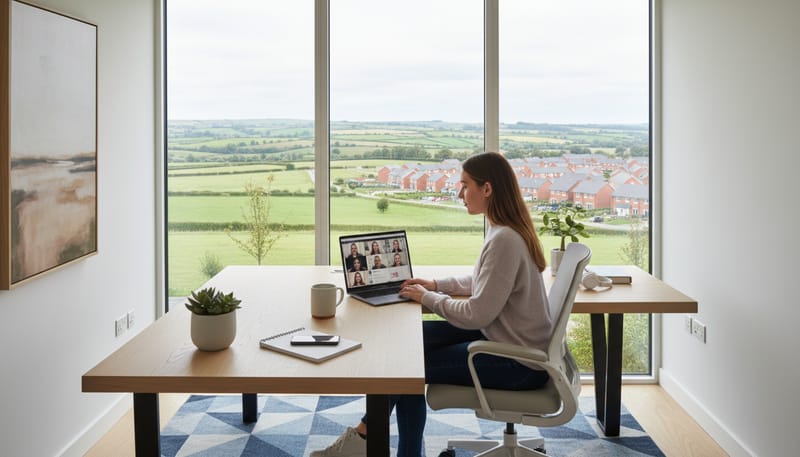
The pandemic-era experiment with remote working has matured into a permanent structural shift in how and where millions of British workers earn their living. ONS data for 2025 shows that 38% of the UK workforce now works from home at least part of the week, with 14% working remotely full-time. This is not a temporary hangover from lockdown — it represents a fundamental reorganisation of the relationship between workplace and residence that is rewriting the rules of residential property demand. For the new build housing sector, the implications are profound and far-reaching, touching everything from where developers acquire land and what type of homes they build to how local authorities plan for growth and how transport infrastructure is prioritised.
The traditional model of UK housing demand — centred on daily commutability to a workplace, with property values declining in concentric rings from major employment centres — is being progressively disrupted. When a knowledge worker needs to be in a London office only two or three days per week rather than five, the viable commuting radius expands dramatically. A 90-minute rail journey that was unsustainable as a daily commute becomes perfectly manageable twice a week. This expansion of the "commutable zone" is unlocking demand in towns and rural areas that were previously overlooked by both buyers and developers, creating new growth corridors and, in some cases, threatening to price out local populations who do not benefit from metropolitan salary levels. This article examines the data, the trends, and the practical consequences for anyone buying, building, or investing in new homes across the UK.
The Scale of the Remote Working Shift
Before examining the housing market implications, it is worth establishing the scale and nature of the remote working phenomenon. The shift has not been uniform across sectors, age groups, or geographies — and these variations directly determine where housing demand is being redirected.
The 24% hybrid working figure is particularly significant for the housing market because it represents the cohort with the greatest locational flexibility. Fully remote workers can live anywhere with adequate broadband, but they represent a smaller group and are more likely to already be geographically dispersed. Hybrid workers — who typically need to commute to a specific office two or three times per week — represent the large, affluent, and growing demographic that is actively reshaping demand patterns. These are predominantly professionals in financial services, technology, consulting, legal, and public administration roles, with above-average household incomes and a strong propensity to purchase rather than rent.
The data reveals a clear socioeconomic gradient: the sectors with the highest remote working adoption are also those with the highest household incomes. This means the demand being redistributed away from traditional commuter hotspots is disproportionately affluent, professional demand — exactly the buyer profile that new build developers target with their premium pricing and specification levels.
The Expanding Commuter Belt
The most immediate and measurable impact of hybrid working on new build demand has been the expansion of the effective commuter belt around major cities, particularly London. When five-day-a-week commuting was the norm, the practical limit for London commuters was approximately 60-75 minutes door-to-door — encompassing established commuter towns like Reading, Chelmsford, Sevenoaks, and Guildford. At two or three days per week, commuters are willing to accept journeys of 90-120 minutes, bringing entirely new towns and even regions into the London commuting orbit.
The price growth data is revealing. The strongest appreciation is not in the traditional commuter belt — where prices were already high and further growth is constrained by affordability — but in the "new hybrid belt" at 90-120 minutes from London. Towns like Canterbury, Peterborough, Stamford, and Bristol are experiencing new build demand that would have been unthinkable pre-pandemic. Land Registry data shows that new build transaction volumes in these areas increased by 32% between 2022 and 2025, compared to a national average of 8%.
This pattern is not unique to London. Similar commuter belt expansion is evident around Manchester (with demand pushing into North Wales, the Peak District, and Lancashire), Birmingham (extending into Worcestershire, Shropshire, and Warwickshire), and Edinburgh (spreading into the Scottish Borders and Fife). The common thread is professional workers earning metropolitan salaries choosing to live in areas where their housing budget stretches dramatically further.
Rural New Builds: A Growing Niche
Beyond the expanding commuter belt, fully remote working is creating demand for new build homes in genuinely rural locations that have traditionally seen very little new development. Villages and small towns in counties like Devon, Cornwall, Norfolk, Suffolk, Shropshire, Cumbria, and Northumberland are experiencing a wave of interest from remote workers seeking space, nature, and community — a trend that developers are beginning to respond to, albeit cautiously given the planning constraints and smaller scale of rural sites.
NHBC registration data shows that new build registrations in Predominantly Rural local authorities (as classified by DEFRA) increased by 18% in 2025 compared to 2022, while registrations in Major Urban areas grew by only 4% over the same period. This is a significant rebalancing, though it starts from a low base — rural areas still account for just 12% of total new build registrations.
The rural new build market serves a distinct buyer profile: typically a couple aged 35-50, with at least one partner working remotely in a professional role, household income above £70,000, and often relocating from a city or large town. They prioritise space (both internal and external), energy efficiency (recognising that they will be home during the day), broadband speed (a non-negotiable requirement), and character — expecting a new build in a rural setting to be architecturally sympathetic rather than generically suburban.
Broadband availability remains the single biggest barrier to rural new build demand. While Project Gigabit (the government's £5 billion rural broadband programme) has made significant progress, Ofcom data for 2025 shows that 7% of rural premises still cannot access speeds above 30 Mbps — the minimum generally considered necessary for reliable video conferencing. Smart developers are investing in full-fibre connections as part of their site infrastructure, recognising that gigabit broadband is as essential as mains water for the remote working buyer.
Home Office Requirements: What Buyers Demand
The shift to remote and hybrid working has fundamentally changed what buyers expect from a new build home. A dedicated home office is no longer a luxury — it is a core requirement for a large and growing segment of the market. Research by the HBF and Savills found that 67% of new build buyers in 2025 rated a "dedicated workspace" as essential or very important, up from 34% in 2019. This has forced developers to rethink their standard house designs, room configurations, and marketing approaches.
The demand for a dedicated home office room has fundamentally altered house design. Where a 2019-vintage 3-bedroom house might have offered a living room, kitchen-diner, and three bedrooms, the 2025 equivalent increasingly features a ground-floor study or "flex room" that can serve as a dedicated office. This has implications for plot sizes (homes need to be slightly larger), internal layout (ground-floor office spaces need natural light and a degree of acoustic separation from living areas), and specification (with dedicated circuits for office equipment, Cat6 cabling, and multiple USB/ethernet points).
The appetite for garden and outdoor space has also increased markedly, driven by the fact that remote workers are spending significantly more time at home during daylight hours. Research suggests that homes with gardens of 10 metres or more achieve a 5-8% premium over equivalent homes with smaller outdoor spaces, a gap that has widened from 2-3% pre-pandemic.
Regional Migration Patterns: Where People Are Moving
The ONS Internal Migration data provides a clear picture of where the remote working cohort is moving. The dominant pattern is a net outflow from London and, to a lesser extent, other major cities towards market towns, coastal areas, and rural locations within their expanded commuting range. This is not a new phenomenon — the "race for space" began during the pandemic — but what is notable in the 2024-2025 data is that the trend has stabilised at a level significantly above pre-pandemic norms, confirming that this is not a temporary blip but a structural shift.
The South West has been the single biggest beneficiary of the remote working migration, with net domestic inflows of 18,400 in 2025. Cities like Bristol and Exeter — which combine good transport links, thriving tech sectors, and proximity to countryside and coast — have seen particularly strong new build demand. Towns like Taunton, Bridgwater, Chippenham, and Trowbridge, which sit within the 90-120 minute hybrid commuting belt from London, have seen new build sales velocity increase by 25-40% above 2019 levels according to local developer reports.
The East of England tells a similar story, with areas around Cambridge, Bury St Edmunds, Ipswich, and Norwich benefiting from a combination of relative affordability, good rail links to London, and the prestige of the Cambridge tech corridor. The East Midlands, particularly Northamptonshire and Rutland, has also seen above-average new build demand growth as hybrid workers on London salaries discover they can afford four-bedroom detached homes at prices below the average two-bedroom flat in zones 2-4 of the capital.
Developer Responses: How Builders Are Adapting
Major UK housebuilders have recognised the remote working shift and are adapting their strategies across multiple dimensions — from land acquisition and house design to marketing and customer journey.
Several major builders have disclosed that their land acquisition strategies now explicitly target locations benefiting from the hybrid working trend. Taylor Wimpey's 2025 annual report noted that "the durability of hybrid working is now a core assumption in our land appraisal models, enabling us to bring forward sites in secondary and tertiary locations that would not have met our hurdle rates pre-2020." Barratt Redrow has increased its land bank in the South West and East Midlands by 34% since 2022, while reducing its London and inner South East exposure by 12%.
Every major builder has now introduced or updated house types to include dedicated home office provision. Persimmon's "Worksmart" range features a ground-floor study as standard on 3-bed and larger homes, with Cat6 cabling pre-installed and a dedicated 32A circuit for office equipment. Bellway's "Artisan" collection includes optional garden office pods that can be added to selected plots. David Wilson Homes (part of Barratt Redrow) offers a "Flex Room" concept that can be configured as a study, playroom, or additional reception room depending on the buyer's needs.
Developer marketing now prominently features home working credentials alongside traditional selling points. Show homes routinely include a styled home office, and site sales literature highlights broadband speeds, proximity to co-working spaces, and the rail journey time to the nearest major city on a two-days-per-week basis rather than a daily commute basis. Virtual tours — which became essential during lockdowns — have remained a core part of the marketing toolkit, allowing prospective buyers who live far from the development to explore the property in detail before making the journey to visit in person.
On larger strategic sites, developers are now incorporating shared workspaces and community hubs that cater to remote workers. Crest Nicholson's Arborfield Green development near Reading includes a co-working space within the community centre, available to residents at a subsidised rate. L&Q's Barking Riverside development features a dedicated work hub with bookable meeting rooms, hot desks, and professional-grade video conferencing facilities. These amenities recognise that remote working, while reducing the need for a traditional office, can be isolating — and that social infrastructure is essential for community building.
Impact on Local Communities and Affordability
The influx of remote workers into previously lower-demand areas is not without controversy. In popular relocation destinations — particularly coastal towns in Devon, Cornwall, Dorset, and North Yorkshire — local residents have expressed concern that metropolitan-salary remote workers are pricing them out of their own communities. Average house prices in towns like Totnes, Padstow, Whitby, and Ludlow have risen by 35-50% since 2019, far outpacing local wage growth of 15-18% over the same period.
There is a genuine tension between the economic benefits that remote worker migration brings to smaller communities (increased spending, higher council tax revenues, support for local services) and the displacement effect on existing residents who cannot compete for housing. This has led several local authorities in high-demand areas to introduce or strengthen policies requiring a higher proportion of affordable housing on new build sites. For a detailed analysis of how affordable housing requirements are evolving, see our article on affordable housing supply trends in new build development.
New build development can actually help mitigate this tension, provided it is planned thoughtfully. Unlike the conversion of existing housing stock to second homes or holiday lets (which removes supply from the local market), new build development adds net supply. When accompanied by appropriate Section 106 requirements for affordable housing, new developments can simultaneously serve the incoming remote worker demand and provide below-market homes for local residents. The challenge is ensuring that affordable housing obligations are genuinely delivered rather than negotiated away through viability assessments — a persistent problem that the government's ongoing review of Section 106 is attempting to address.
Transport and Infrastructure Implications
The shift in commuting patterns has significant implications for transport infrastructure and, by extension, for where new build demand materialises. Rail operators are adapting to the new reality of reduced daily commuting volumes but more dispersed travel patterns, with several operators introducing part-time season tickets and off-peak carnet products aimed at hybrid workers who commute two or three days per week. These new products have made previously uneconomical commutes financially viable, further expanding the hybrid commuter belt.
The data shows a dramatic structural shift in commuting patterns. Traditional season ticket sales remain 38% below pre-pandemic levels, reflecting the permanent reduction in five-day-a-week commuting. But flex season ticket take-up has surged, and midweek ridership (Tuesday to Thursday, the most popular hybrid office days) has recovered to 78% of pre-pandemic levels. This creates a distinctive pattern: trains are quieter on Mondays and Fridays but relatively busy midweek, with implications for service planning and capacity.
For new build location planning, the key insight is that proximity to a railway station remains important for hybrid workers — but the nature of the requirement has changed. Rather than needing to be within a 10-minute walk of a station with high-frequency peak-hour services, hybrid workers can accept a 15-20 minute drive to a station with a reasonable midweek service. This significantly expands the catchment area around each station and opens up locations that would have been impractical for daily commuters.
The Digital Infrastructure Premium
If location is the first consideration for a remote working homebuyer, broadband connectivity is a very close second. The correlation between broadband quality and new build sales velocity has strengthened dramatically since 2020, and developments without gigabit-capable broadband are now at a measurable disadvantage.
Analysis of Land Registry transaction data cross-referenced with Ofcom broadband availability data reveals a clear price premium for properties with full-fibre connections. New build homes with access to gigabit-capable broadband (typically 1 Gbps or faster FTTP) achieve an average price premium of 2.4% over otherwise comparable homes limited to superfast broadband (30-100 Mbps), and a premium of 5.1% over homes with only standard broadband (below 30 Mbps). In rural areas, where broadband variation is greater, the premiums are even larger — up to 8% for gigabit versus standard broadband.
Do not rely solely on the developer's marketing claims about broadband speeds. Use Ofcom's broadband availability checker (checker.ofcom.org.uk) and Openreach's fibre checker (openreach.com/fibre-checker) to verify exactly what is available at the specific postcode. For new build sites that are still under construction, ask the developer which broadband provider has been contracted to serve the development and what speeds are guaranteed. Full fibre (FTTP) should be the minimum expectation for any new development — indeed, the Building Regulations now mandate gigabit-capable infrastructure for all new homes.
The Potential Return-to-Office Risk
Any analysis of remote working's impact on housing demand must address the possibility that the trend could reverse. Several high-profile employers — including major banks, consultancies, and technology companies — have attempted to mandate a return to full-time office attendance in 2024-2025, with mixed results. Amazon, JPMorgan, and Goldman Sachs have all pushed for five-day office attendance, while others like HSBC, Lloyds Banking Group, and Nationwide have embraced hybrid working as a permanent feature of their operating model.
The evidence suggests that forced return-to-office mandates face significant headwinds. The CIPD's 2025 Working Lives Survey found that 62% of hybrid workers would consider leaving their employer if required to return to the office full-time, and 28% would actively seek alternative employment. In a competitive labour market, this gives employees significant leverage. Furthermore, the Employment Rights Bill 2024 established flexible working as a "day one" right for UK employees, making it more difficult for employers to unilaterally impose full-time office attendance without a clear business justification.
For homebuyers who have relocated based on a hybrid working arrangement, the risk is not negligible but appears manageable. The structural shift towards flexible working is supported by multiple reinforcing factors — employee expectations, employer cost savings on office space, improved technology, and now legal protections. Even in a scenario where hybrid working becomes less prevalent (say, falling from 24% to 18% of the workforce), the expansion of the commuter belt would likely be only partially reversed, as many relocated workers would choose to change employers rather than reverse their lifestyle decisions.
Frequently Asked Questions
Looking Ahead: The 2026 Outlook
The impact of remote working on new build location demand is not a temporary phenomenon — it is a structural realignment that will continue to shape the housing market for years to come. Looking ahead to 2026 and beyond, several trends are likely to intensify. The government's investment in digital infrastructure through Project Gigabit will progressively remove broadband barriers in rural areas, opening up new locations for development. The continued rollout of flexible rail ticketing products will make extended commutes more affordable. And the growing body of evidence that hybrid working improves both productivity and employee wellbeing will make it increasingly difficult for employers to mandate a full return to the office.
For the new build sector, the opportunity is substantial. Developers who embrace the shift — by targeting the right locations, designing homes that genuinely support remote working, and marketing to the hybrid worker demographic — will capture a growing and affluent segment of demand. Those who cling to the pre-pandemic model of commuter-belt three-beds with a bedroom optimistically labelled as a "study" will find themselves increasingly out of step with buyer expectations. For more on how the overall market is performing, see our analysis of new build sales velocity and market confidence trends.
For buyers, the message is clear: if remote or hybrid working is a stable part of your professional life, the new build market offers an unprecedented breadth of choice in locations and specifications that were simply not available five years ago. The key is to buy with clear-eyed realism about your working patterns, connectivity needs, and the potential for change — and to ensure that any home you choose would retain its appeal even if your working arrangements shifted. A well-located, well-designed new build in a thriving market town with good transport links and gigabit broadband is a sound investment regardless of how the remote working debate evolves.
Data sources: ONS, CIPD Working Lives Survey, HBF/Savills New Build Buyer Survey, NHBC, Land Registry, Ofcom Connected Nations Report, UK Finance, Network Rail, DEFRA Rural Statistics. Data current as of January 2026.