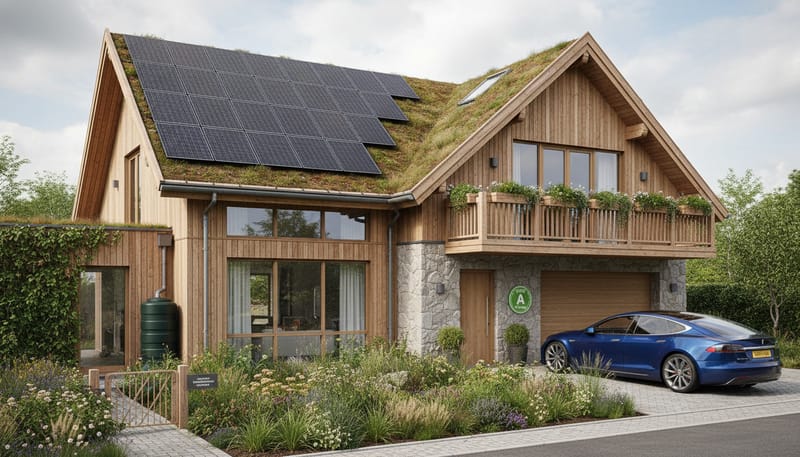
The UK property investment landscape is undergoing a fundamental transformation driven by energy efficiency, environmental regulation, and changing tenant expectations. For investors purchasing new build homes in 2025-2026, these shifts present a remarkable opportunity: properties built to the highest energy efficiency standards are not only cheaper to run and more comfortable to live in, but they also command measurable financial premiums in both the sales and rental markets. Research from the Department for Energy Security and Net Zero indicates that homes rated EPC A or B sell for an average of 3% to 5% more than equivalent properties rated D or below, while rental premiums for the most energy-efficient homes can reach 6% to 10% in some markets. In a sector where margins matter, these percentages translate directly into stronger yields and faster capital appreciation.
The regulatory backdrop makes the investment case even more compelling. The UK government has legislated that all new homes built from 2025 onwards must comply with the Future Homes Standard, producing 75-80% fewer carbon emissions than those built under the previous 2013 Building Regulations. Meanwhile, the Minimum Energy Efficiency Standards (MEES) for rental properties continue to tighten, with proposals to require all privately rented homes to achieve EPC C or above by 2030. For investors, this creates a clear strategic advantage: buying new builds that already meet or exceed these future requirements avoids the potentially enormous cost of retrofitting older properties, while positioning your portfolio on the right side of the regulatory direction of travel. This article provides a comprehensive analysis of why eco-homes represent the smartest investment choice for forward-thinking property investors, drawing on the latest data, regulations, and market trends. For foundational guidance on new build investment, see our new build buy-to-let guide for UK investors.
Understanding EPC Ratings and Their Investment Significance
Energy Performance Certificates (EPCs) rate properties on a scale from A (most efficient) to G (least efficient) and have become one of the most important metrics in UK property investment. Every property in England and Wales must have a valid EPC before it can be marketed for sale or rent, and the rating directly impacts both the legal ability to let a property and its financial performance.
The current Minimum Energy Efficiency Standards (MEES) regulations, introduced under the Energy Efficiency (Private Rented Property) (England and Wales) Regulations 2015, require all privately rented properties to achieve a minimum EPC rating of E. Landlords who let properties below this threshold face penalties of up to £5,000 per property. However, the government has signalled its intention to raise this minimum to EPC C by 2030, with potential interim requirements along the way.
New build homes constructed in 2025 and beyond will typically achieve EPC ratings of A or B as standard, thanks to the combination of the updated Part L Building Regulations (which came into force in June 2022 as an interim measure) and the full Future Homes Standard. This means that as an investor, purchasing a new build automatically places you well above both the current and proposed future minimum standards, eliminating the regulatory risk that hangs over owners of less efficient properties.
According to data from the English Housing Survey, approximately 39% of privately rented homes in England are rated EPC D, with a further 25% rated E, F, or G. These properties face significant regulatory risk and will require substantial investment to bring them up to the proposed EPC C minimum. The Energy Saving Trust estimates that upgrading a typical D-rated Victorian terrace to EPC C can cost between £10,000 and £25,000, with some properties requiring even more extensive work. By contrast, a new build that already achieves EPC A or B requires no such expenditure, representing a significant competitive advantage in the investment landscape.
The Future Homes Standard: What Investors Need to Know
The Future Homes Standard (FHS) represents the most significant change to residential building standards in a generation. Announced by the UK government as part of its net-zero strategy, the FHS mandates that all new homes built from 2025 onwards must produce 75-80% fewer carbon emissions than homes built to the 2013 Part L standards. This is achieved through a combination of high-performance building fabric (insulation, airtightness, and glazing), low-carbon heating systems (typically heat pumps), and renewable energy generation (typically solar PV panels).
For property investors, the Future Homes Standard creates several important dynamics:
Built-in Energy Efficiency
Homes built to the FHS will have energy bills that are dramatically lower than existing stock. The government estimates annual energy cost savings of £400 to £1,000 compared to homes built under previous regulations. For tenants, this makes FHS-compliant new builds significantly more attractive, potentially allowing landlords to command higher rents while tenants still save money overall on their housing costs.
Heat Pump Installation as Standard
The FHS effectively mandates the use of heat pumps as the primary heating system in new homes, as gas boilers cannot achieve the required carbon emission reductions. Air source heat pumps cost approximately £8,000 to £15,000 to retrofit into an existing property, while ground source heat pumps can cost £20,000 to £35,000. Having this technology included in the build cost of a new home eliminates a major future expense.
Solar PV Generation
Many FHS-compliant homes will include solar photovoltaic panels as standard. A typical 3-4kW domestic solar installation generates approximately 3,000 to 4,000 kWh per year, worth £500 to £800 at current electricity rates. Any surplus generation can be exported to the grid under the Smart Export Guarantee, providing additional income. Solar PV systems also contribute positively to the EPC rating.
Superior Insulation and Airtightness
FHS homes feature significantly improved thermal performance, with U-values (a measure of heat loss through building elements) approximately 25-30% better than homes built to 2013 standards. Combined with improved airtightness and mechanical ventilation with heat recovery (MVHR), these homes maintain comfortable temperatures with minimal energy input.
The Green Premium: Quantifying the Financial Advantage
The 'green premium' refers to the additional value that energy-efficient properties command over less efficient equivalents. Multiple studies and market analyses have now documented this premium in the UK property market, providing hard evidence for its existence and magnitude.
| Study / Source | Green Premium (Sales) | Green Premium (Rental) |
|---|---|---|
| DESNZ / BRE Analysis (2024) | 3-5% for EPC A-B vs D | N/A |
| Rightmove Energy Report (2024) | Up to £56,000 avg premium | 6-8% rental premium |
| Savills Research (2024) | 3.5% for A vs D | 5-7% in key cities |
| Knight Frank ESG Analysis (2024) | 4-6% premium | Up to 10% in London |
| ONS House Price Data Cross-Reference | 2-4% nationwide avg | Correlates with EPC band |
To put these figures in context, consider a new build property purchased for £300,000 with an EPC rating of A. If the green premium is conservatively estimated at 4%, this property commands approximately £12,000 more than an equivalent property rated D. Over a 10-year holding period, assuming the green premium grows as regulations tighten (which historical trends suggest it will), the cumulative advantage could be significantly larger. Meanwhile, the rental green premium of 5-8% on a property achieving £1,200 per month in rent translates to an additional £720 to £1,152 per year in income — a meaningful boost to yield.
Green Premium Investment Impact Example
Consider two identical 2-bed new build apartments — one rated EPC B (standard 2022 regs) and one rated EPC A (built to Future Homes Standard with solar PV). Purchase price: £250,000.
- Rental Income: EPC B: £1,100/month | EPC A: £1,170/month (+6.4% green premium)
- Annual Rental Advantage: £840/year additional income for EPC A property
- Tenant Energy Savings: Approx. £600-£900/year in lower bills, improving tenant retention
- Capital Value Premium: At resale, EPC A commands ~4-5% more, equating to £10,000-£12,500
- 10-Year Extra Income: £8,400 additional rent over the decade, plus enhanced capital growth
Tenant Demand for Energy-Efficient Homes
The cost of living crisis that began in late 2021 and intensified through 2022-2024 has permanently shifted tenant priorities. Energy efficiency, once a 'nice to have,' has become a top-three consideration for renters alongside location and price. According to research by the National Residential Landlords Association (NRLA) and tenant surveys by SpareRoom, energy costs now rank as the single biggest concern for private tenants after rent itself.
This shift in tenant priorities creates a direct competitive advantage for energy-efficient new builds in the rental market. Properties with low energy bills let faster, experience shorter void periods, and attract higher-quality tenants who tend to stay longer — all factors that improve investment returns.
The reduced running costs of energy-efficient new builds also improve tenant affordability metrics, which is increasingly important in a market where affordability constraints are limiting rent growth in many areas. A tenant paying £1,200 per month in rent plus £130 per month in energy costs (for an EPC A new build) has total housing costs of £1,330. The same tenant in an older EPC D property might pay £1,100 in rent but £220 per month in energy, totalling £1,320 — roughly the same overall cost but with a lower quality of living environment. Many tenants would prefer to pay the slightly higher rent for the new build, recognising the superior comfort, lower total costs, and modern amenities it provides.
Retrofit Costs Avoided: The Hidden Advantage
Perhaps the most powerful financial argument for investing in new build eco-homes is the retrofit cost avoided. The UK has approximately 29 million existing homes, the vast majority of which were built before modern energy efficiency standards. Bringing these homes up to acceptable standards — particularly the proposed EPC C minimum for rental properties — will require billions of pounds of investment across the housing stock.
For individual landlords, the retrofit costs for older properties can be substantial and are often underestimated until the work is actually scoped and quoted. The following table illustrates typical costs for common energy efficiency improvements in existing homes:
| Retrofit Measure | Typical Cost | EPC Impact | New Build Equivalent |
|---|---|---|---|
| Cavity Wall Insulation | £1,500–£3,500 | +5 to +15 points | Included in build spec |
| External Wall Insulation | £8,000–£22,000 | +10 to +20 points | Included in build spec |
| Loft Insulation (top-up) | £400–£1,500 | +3 to +8 points | Included in build spec |
| Double to Triple Glazing | £5,000–£12,000 | +5 to +10 points | Included in build spec |
| Air Source Heat Pump | £8,000–£15,000 | +15 to +30 points | Included in build spec |
| Solar PV (3-4kW) | £5,000–£8,000 | +5 to +15 points | Often included |
| Total Potential Retrofit Cost | £28,000–£62,000 | D→A/B improvement | £0 (built in) |
The contrast is stark. An investor purchasing an older property rated EPC D with the intention of improving it to meet future minimum standards faces potential costs of £10,000 to £25,000 or more, whereas a new build buyer receives this efficiency as part of the purchase price. Even accounting for the typically higher purchase price of new builds compared to older equivalents, the net financial position often favours the new build when retrofit costs are included in the calculation.
Important: The Boiler Upgrade Scheme
The UK government's Boiler Upgrade Scheme (BUS) offers grants of £7,500 toward the cost of installing an air source heat pump or ground source heat pump in existing properties. While this reduces the retrofit cost for older homes, the scheme is time-limited and subject to ongoing funding. It also requires the property to have adequate insulation before a heat pump can be installed, meaning the insulation costs must still be met. New build homes avoid this entire process by having heat pumps designed into the building from the outset.
Green Mortgage Products and Financing Advantages
The mortgage market has responded to the growing importance of energy efficiency with a range of 'green mortgage' products that offer preferential terms for energy-efficient properties. These products provide a tangible financial incentive for investing in eco-friendly new builds, reducing the cost of borrowing and improving overall investment returns.
As of 2025, the following major lenders offer green mortgage products or EPC-related incentives for buy-to-let properties:
Barclays Green Home BTL
Rate discount of up to 0.10% on standard BTL products for properties rated EPC A-C. Available on 2-year and 5-year fixed rates. Cashback also available.
NatWest Green BTL Mortgage
Cashback of up to £500 for properties with EPC A or B. Additional benefits for energy efficiency improvements. Partnership with energy assessors.
Halifax / Scottish Widows Green BTL
Reduced rate products for new builds rated EPC A-B. Additional borrowing available for green home improvements on existing properties.
Nationwide Green Additional Borrowing
Preferential rates for additional borrowing to fund energy efficiency improvements. Applicable to both residential and BTL customers.
The financial impact of green mortgage products may seem modest on a per-month basis, but over the full mortgage term, the savings compound significantly. A 0.10% rate reduction on a £200,000 buy-to-let mortgage over 25 years saves approximately £3,000 in total interest. Combined with the rental premium and capital value premium of an energy-efficient property, the cumulative financial advantage of investing in new build eco-homes becomes substantial. For more on mortgage strategies, see our guide on financing new build investments.
Key Eco-Technologies in Modern New Builds
Understanding the specific technologies incorporated into modern new build eco-homes helps investors appreciate both the value proposition and the maintenance considerations. Here is a guide to the key technologies you will encounter in 2025-2026 new builds:
Air Source Heat Pumps (ASHP)
ASHPs extract heat from outside air and use it to heat water and provide central heating. Modern units achieve coefficients of performance (COP) of 3.0 to 4.5, meaning they produce 3 to 4.5 units of heat for every unit of electricity consumed. Expected lifespan: 15-20 years. Annual service cost: £100-£200.
Solar Photovoltaic Panels
Solar PV panels convert sunlight into electricity. A typical 3-4kW domestic installation consists of 8-12 panels and generates approximately 3,000-4,000 kWh per year. Expected lifespan: 25-30 years with minimal degradation. Maintenance: minimal, occasional cleaning.
Mechanical Ventilation with Heat Recovery (MVHR)
MVHR systems provide continuous fresh air ventilation while recovering up to 90% of the heat from the extracted stale air. Essential in airtight modern homes to maintain air quality without heat loss. Expected lifespan: 15-20 years. Annual service: £100-£150, plus regular filter replacement.
Battery Storage Systems
Home battery systems (such as Tesla Powerwall or similar) store excess solar generation for use during evening peak hours. Increasingly common in premium new builds. Typical capacity: 5-13kWh. Expected lifespan: 10-15 years.
EV Charging Points
All new homes with associated parking must now include an EV charger (Building Regulations Part S, effective June 2022). This future-proofs the property for the transition to electric vehicles and adds to tenant appeal. Typical unit: 7kW untethered smart charger.
The Regulatory Timeline: What Is Coming and When
Understanding the regulatory timeline is crucial for investment planning. The direction of travel is clear — ever-tighter energy efficiency requirements — and investors who position themselves ahead of these changes will benefit most. Here is the timeline of key regulatory milestones affecting property investors:
2018
MEES Introduced (New Tenancies)
Minimum EPC E required for new tenancies. Properties below E cannot be newly let.
2020
MEES Extended (Existing Tenancies)
Minimum EPC E extended to all existing tenancies. All rental properties must now meet E.
Jun 2022
Part L 2021 Building Regulations
Interim update: new homes must produce 31% less carbon than 2013 standards. Step towards FHS.
Jun 2022
Part S Building Regulations (EV Charging)
All new homes with associated parking must include an EV charge point.
2025
Future Homes Standard
All new homes must produce 75-80% fewer carbon emissions. Heat pumps effectively mandatory. Gas boilers prohibited in new builds.
2030
Proposed MEES Uplift to EPC C
All rental properties proposed to require minimum EPC C. Non-compliant properties unlettable without exemption.
2035
Gas Boiler Phase-Out (Existing Homes)
Government target to phase out new gas boiler installations in all homes by 2035. Existing boilers can be maintained but not replaced like-for-like.
Eco-Home Certifications Beyond EPC
While the EPC rating is the legally mandated measure of energy efficiency, several additional certifications and standards can indicate superior environmental performance and potentially enhance the investment appeal of a new build. Investors should be aware of these when evaluating new build developments:
Passivhaus Standard
The gold standard for ultra-low energy buildings. Passivhaus homes use up to 90% less energy for heating than conventional buildings. Increasingly adopted by forward-thinking UK developers, though still a small fraction of total output. Premium over standard new build: approximately 5-15%.
BREEAM (Building Research Establishment)
The world's leading sustainability assessment method for buildings. BREEAM ratings range from Pass to Outstanding. Commonly used for large-scale developments and increasingly requested by institutional investors. A BREEAM rating provides independent verification of environmental credentials.
Home Quality Mark (HQM)
Developed by BRE specifically for new UK homes, HQM assesses five key areas: carbon footprint, running costs, wellbeing, resilience, and digital connectivity. Rated from one to five stars. Growing awareness among buyers and tenants as a quality indicator.
Maintenance and Long-Term Cost Considerations
While new build eco-homes offer significant advantages in running costs and regulatory compliance, investors should also understand the maintenance requirements and long-term cost profile of green technologies. Proper maintenance ensures optimal performance and protects the investment value.
| Technology | Service Frequency | Annual Cost | Replacement Lifespan |
|---|---|---|---|
| Air Source Heat Pump | Annual | £100–£200 | 15-20 years |
| Solar PV Panels | Every 2-3 years (clean) | £50–£100 | 25-30 years |
| MVHR System | Filters: quarterly; Full: annual | £100–£200 | 15-20 years |
| Battery Storage | Self-monitoring | Minimal | 10-15 years |
| Underfloor Heating | Every 2-3 years | £50–£80 | 50+ years |
The total annual maintenance budget for green technology in a new build eco-home is typically £300 to £600 — comparable to or less than the annual gas boiler service and maintenance costs in an older property. The key difference is that heat pump and solar maintenance costs are predictable and relatively stable, whereas older heating systems become increasingly expensive to maintain and more likely to require emergency repairs as they age. For detailed insurance considerations relating to these technologies, see our guide on insurance and protection for new build investment properties.
Case Study: Comparing Eco-Home vs Standard Investment Over 10 Years
To illustrate the total return advantage of investing in a new build eco-home versus a standard older property, consider the following comparative scenario based on realistic 2025 market conditions:
10-Year Investment Comparison
| Metric | New Build Eco-Home (EPC A) | 1990s House (EPC D) |
|---|---|---|
| Purchase Price | £280,000 | £240,000 |
| Monthly Rent | £1,250 | £1,100 |
| 10-Year Gross Rent | £150,000 | £132,000 |
| EPC Retrofit Cost (by 2030) | £0 | £15,000–£25,000 |
| Maintenance (10 years) | £5,000 | £12,000 |
| Avg Void Period | 1 week between lets | 3 weeks between lets |
| Capital Growth (est.) | £364,000 (+30%) | £288,000 (+20%) |
| Total 10-Year Return | ~£229,000 | ~£143,000–£153,000 |
Despite the higher initial purchase price, the eco-home generates a significantly higher total return over the ten-year period due to higher rental income, lower maintenance costs, no retrofit expenditure, shorter void periods, and stronger capital growth driven by the green premium. The gap widens further when factoring in the reduced risk of regulatory non-compliance and the improving trend in green premiums as regulations tighten.
Choosing the Right Eco-Home Development
Not all new build developments are created equal in terms of environmental performance. While all must meet minimum Building Regulations, some developers go significantly further, incorporating additional green features that enhance both the investment value and the tenant experience. When evaluating new build eco-home investments, consider the following factors:
Developer Eco-Credentials Checklist
- EPC Rating: Aim for EPC A or high B. Request the SAP calculation summary to understand exactly how the rating is achieved.
- Heating System: Confirm whether the development uses air source heat pumps, ground source heat pumps, or an alternative low-carbon heating system. Avoid developments still using gas boilers.
- Solar PV: Check whether solar panels are included as standard and, if so, the capacity of the installation. Some developers offer these as optional upgrades.
- Insulation Specification: Request the U-values for walls, roof, floor, and glazing. Lower U-values mean better insulation.
- Airtightness: Check the design air permeability target. FHS-compliant homes should achieve less than 5 m3/h/m2 at 50Pa.
- Water Efficiency: Look for water-saving fixtures and fittings. The Building Regulations target is 125 litres per person per day, but the best developments achieve 110 litres or less.
- Biodiversity and Landscaping: Under the Environment Act 2021, developments must deliver a minimum 10% biodiversity net gain. Quality landscaping and green spaces enhance both the environment and property values.
Frequently Asked Questions
Are eco-homes more expensive to buy than standard new builds?
Homes built to the Future Homes Standard may carry a modest premium of 3-5% over those built to previous regulations, reflecting the additional cost of higher-specification insulation, heat pumps, and other green technologies. However, this premium is typically offset by lower running costs, higher rental values, and stronger capital appreciation. Green mortgage products can also reduce the financing cost.
Do tenants really care about energy efficiency?
Yes, and increasingly so. Survey data consistently shows that 70-80% of tenants now consider energy efficiency when choosing a rental property, with many willing to pay a premium for lower running costs. The cost of living crisis has made energy bills a front-of-mind concern, and this is unlikely to reverse even if energy prices moderate.
What happens if EPC C does not become mandatory by 2030?
Even if the specific 2030 deadline slips (as the previous proposal for 2025 did), the direction of travel toward higher minimum standards is clear. Investing in energy-efficient properties remains sound regardless of exact implementation dates, as the green premium, tenant demand, and running cost advantages exist independently of regulation.
Are heat pumps reliable for UK climates?
Modern air source heat pumps operate efficiently in temperatures down to -15 degrees Celsius or lower, well below typical UK winter temperatures. Countries with significantly colder climates than the UK — including Norway, Sweden, and Finland — have widespread heat pump adoption with excellent results. The technology is mature, reliable, and well-suited to UK conditions when properly specified and installed.
Can I claim capital allowances on green technology in a rental property?
For individual landlords, capital allowances on plant and machinery in residential lets were abolished in 2016. However, limited company landlords can claim capital allowances on qualifying equipment including heat pumps and solar PV systems. The Annual Investment Allowance (AIA) of £1 million allows 100% of qualifying expenditure to be deducted from profits in the year of purchase. Consult a specialist property tax accountant for guidance specific to your situation.
Conclusion: The Investment Case Is Clear
The evidence overwhelmingly supports new build eco-homes as the smartest property investment choice for 2025-2026 and beyond. The combination of measurable green premiums in both sales and rental markets, dramatically lower running costs for tenants, avoidance of potentially massive retrofit expenditure, favourable mortgage terms, reduced regulatory risk, and stronger tenant demand creates a compelling investment proposition that only grows stronger as environmental regulations tighten.
For investors thinking about exit strategies, the long-term trajectory also favours eco-homes. As the 2030 EPC C deadline approaches and the green premium widens, energy-efficient properties will become increasingly desirable to both owner-occupiers and investors, supporting stronger capital growth. Properties that already meet or exceed future standards will command a premium that less efficient homes simply cannot match. For analysis of how regional factors influence returns, see our detailed comparison of new build investment yields across Northern and Southern England.
The future of UK housing is energy-efficient, low-carbon, and technology-enabled. By investing in new build eco-homes today, you are positioning your portfolio not just for the market of 2025, but for the market of 2035 and beyond. That is what genuine future-proofing looks like.