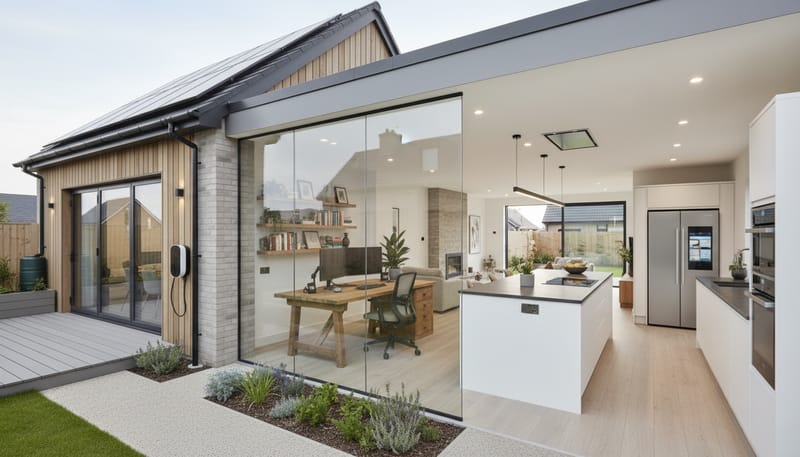
The profile of the UK new build buyer has changed significantly in recent years, and 2026 marks a further evolution in what prospective purchasers consider essential, desirable, and non-negotiable when choosing their next home. The legacy of the pandemic years — with their emphasis on working from home, outdoor space, and wellbeing — has matured from a reactive shift into a permanent recalibration of buyer expectations. This is now layered on top of the cost-of-living experience that dominated 2023 and 2024, which sharpened buyer focus on running costs, energy efficiency, and long-term value retention. Add in the full implementation of the Future Homes Standard, rapid advances in smart home technology, and a generation of first-time buyers who are digitally native and environmentally conscious, and you have a demand landscape that is more sophisticated and multi-dimensional than ever before.
For developers, understanding these demand trends is not optional — it is existential. In a market where buyers have more information, more choice, and more bargaining power than in previous cycles, the ability to deliver homes that genuinely meet buyer expectations is the difference between strong sales rates and languishing stock. For buyers, understanding the trends helps inform decisions about which developments and which specifications represent the best value and the most future-proof investment. This article draws on the latest survey data from the Home Builders Federation, NHBC, RICS, and major property consultancies, as well as primary research from developer sales teams across England, Scotland, Wales and Northern Ireland, to map out the demand trends shaping the new build market in 2026.
The Top Buyer Priorities: 2026 Ranking
The Home Builders Federation's annual buyer survey, conducted in Q4 2025 with over 12,000 respondents, provides the most comprehensive picture of what new build buyers consider most important when choosing a home. The following data shows the percentage of respondents who rated each factor as "very important" or "essential" in their purchase decision.
The most striking trend is the continued and growing dominance of energy efficiency as the top buyer priority. At 94%, this is the highest score ever recorded in the HBF survey for any single factor. The cost-of-living crisis of 2023–24, during which average household energy bills peaked at over £2,500 per year, has left a lasting imprint on buyer psychology. Even as energy prices have moderated, the experience of budget-stretching bills has made energy performance a permanent fixture in the buyer checklist. The full implementation of the Future Homes Standard means that all new builds now deliver EPC A or B performance as standard, providing a tangible competitive advantage over existing stock.
Energy Efficiency: From Nice-to-Have to Deal-Breaker
The elevation of energy efficiency from a marketing talking point to an absolute buyer requirement has been one of the most significant shifts in the new build market over the past three years. This trend is driven by multiple converging factors: the lived experience of high energy costs, growing awareness of climate change, the availability of green mortgages with preferential rates, and the regulatory direction of travel which makes energy-inefficient homes increasingly costly to own, maintain, and sell.
The financial case for energy-efficient new builds is now unarguable. The HBF estimates that a typical new build home compliant with the Future Homes Standard saves its occupant approximately £2,100 per year compared to the average existing home, based on 2025/26 energy prices. Over the typical 5-year mortgage fixed rate period, this amounts to over £10,000 in savings — a figure that many buyers actively factor into their affordability calculations. Green mortgages, which offer rate reductions of 0.15–0.30% for homes rated EPC A or B, further enhance the financial attractiveness of new builds. On a £250,000 mortgage, a 0.25% rate reduction saves approximately £350 per year, or £1,750 over a five-year fix.
Beyond the immediate financial benefits, buyers are increasingly aware of the long-term value implications of energy performance. RICS valuers are now required to consider EPC ratings as a material factor in their assessments, and there is growing evidence that the value gap between energy-efficient and energy-inefficient homes is widening. Research by the University of Cambridge and the Energy Saving Trust found that homes rated EPC A or B commanded a price premium of 6–8% compared to equivalent homes rated D or below, a premium that has increased from 3–4% just three years ago.
When comparing new build options, ask the developer for the predicted energy costs based on the SAP (Standard Assessment Procedure) calculation, not just the EPC rating. Two homes can both be rated EPC B but have significantly different predicted running costs depending on the heating system, insulation specification, and orientation. Also check whether the home is pre-wired for solar PV panels and battery storage, as retrofitting these later is significantly more expensive than integrating them from the outset.
Flexible Living Spaces and the Home Office
The demand for flexible, multi-use living spaces has consolidated as a permanent feature of buyer expectations. While the initial pandemic-driven rush for home offices has moderated, the reality of hybrid working — with ONS data showing that approximately 28% of UK workers now work from home at least part of the week — means that the home office is no longer a luxury add-on but a functional requirement for a significant proportion of the market.
The most popular approach among developers in 2026 is to offer what the industry calls "flex rooms" — spaces that can function as a home office, guest bedroom, playroom, or hobby room depending on the household's needs. These rooms are typically sized at 8–12 square metres and are positioned away from the main living areas to provide acoustic separation. Several major developers have introduced standard house types with dedicated home office spaces, including Taylor Wimpey's "Work from Home" series, Bellway's "Flexi" range, and Barratt Redrow's "Studio" layouts.
An interesting counter-trend is the partial rehabilitation of the separate living room. After years of the open-plan revolution, a significant proportion of buyers (64%) now want a separate living or "snug" room in addition to the open-plan kitchen-diner, reflecting a desire for quieter, more private spaces within the home. This is partly driven by the work-from-home reality — when one partner is on a video call in the kitchen, the other needs somewhere else to be — and partly by a broader recognition that different activities (relaxation, socialising, work, children's play) require different environments. Developers are responding, with several introducing "broken plan" layouts that provide visual and acoustic separation without fully closed rooms.
Smart Home Technology
The demand for smart home technology in new builds has seen the sharpest increase of any factor in the 2025 survey, jumping 8 percentage points to 74%. This reflects both the maturation of smart home products and the growing expectation among younger buyers (particularly millennials and Gen Z first-time buyers) that a new home should come equipped with integrated technology rather than requiring retrofitting.
The technology features most in demand include:
App-controllable heating zones, learning thermostats, and heat pump optimisation systems. Buyers want to manage their energy use remotely and receive real-time consumption data.
Video doorbells, smart locks, alarm systems with app control, and integration with home hubs. Security is the second-most-demanded smart feature across all age groups.
Dedicated EV charging points are now required by Building Regulations for all new homes with parking. Buyers want smart chargers that can schedule off-peak charging and integrate with solar panels.
Cat 6 ethernet cabling throughout, mesh WiFi pre-installation, and full fibre broadband connection. Reliable connectivity is now considered as fundamental as plumbing.
Major developers have responded with increasingly sophisticated technology packages. Several now offer a base-level smart home package as standard, with premium upgrades available. Typical standard packages in 2026 include a smart thermostat, video doorbell, smart lighting in key rooms, and a central hub for voice control. Premium packages add features such as automated blinds, multi-room audio, advanced security systems, and energy monitoring dashboards. The cost of these packages has fallen significantly as the technology has matured, with base packages now adding approximately £2,000–3,500 to the build cost — a figure that developers are increasingly absorbing rather than passing on, given the competitive advantage it provides.
Outdoor Space and Garden Design
Private outdoor space remains the second-most-important factor for new build buyers at 89%, and the nature of what buyers want from their gardens has evolved. The traditional lawn-and-fence approach is giving way to more considered outdoor design that reflects the broader lifestyle changes in how people use their homes.
Key outdoor space trends for 2026 include:
78% of buyers want a paved patio area large enough for an outdoor dining table and chairs. The trend towards "outdoor rooms" — with defined zones for cooking, dining, and relaxation — reflects the influence of continental European lifestyle culture and the investment many households made in their gardens during lockdown.
62% of buyers want their garden to include wildlife-friendly features such as hedgehog highways, bird boxes, native planting, and pollinator-friendly borders. This reflects both the Biodiversity Net Gain requirement (which mandates ecological enhancements at the development level) and a genuine personal interest in supporting nature. Developers are increasingly incorporating these features into their standard garden designs.
54% of buyers want space for growing food, whether through raised beds, allotment areas within the development, or community gardens. This trend is strongest among families and downsizers, and several developers have introduced community allotment gardens as a feature of larger developments.
72% of buyers consider external storage (shed, garden store) important or essential. This practical requirement is often overlooked in new build design, where gardens are small and storage is limited. Developers who include a quality garden store as standard report positive buyer feedback.
Location Preferences: The Post-Pandemic Settlement
The location preferences of new build buyers have stabilised into what might be called the "post-pandemic settlement" — a pattern that is neither the pre-2020 commuter-focused model nor the 2020–21 countryside rush, but a more considered balance of factors. The key driver is hybrid working, which has permanently altered the trade-off between commute time and living environment for millions of workers.
Suburban locations remain the most popular choice for new build buyers, with 42% preferring this setting — typically characterised by good transport links to a city, local shops and services, schools, and a balance of space and connectivity. The slight increase in suburban preference reflects the maturation of hybrid working patterns: many buyers are happy to live further from the office if they only commute two or three days a week, and suburban locations offer more space and value than city centres while avoiding the isolation of deep rural settings.
The city centre has seen a partial recovery in preference, rising to 22%, driven primarily by younger buyers and professionals who value walkability, cultural amenities, and the social infrastructure of urban life. The apartment market, particularly in cities such as Manchester, Birmingham, Leeds, and Bristol, is benefiting from this trend. For more on this, see our analysis of new build apartment market trends and buyer preferences.
Rural and village locations, which saw a surge of interest in 2020–21, have continued to decline as a primary preference, now at just 8%. The practical challenges of rural living — limited public transport, poor broadband in some areas, distance from services — have reasserted themselves as the novelty of the rural idyll has faded. However, for those who do want rural new builds, developments in well-connected market towns and large villages remain popular.
Property Type Preferences
The type of property buyers want is closely linked to their life stage, household composition, and budget. The following breakdown from the HBF survey shows preferences among new build buyers:
The three-bedroom detached house remains the single most popular property type at 32%, reflecting its versatility for a wide range of household types — from couples planning to start a family to downsizers wanting a guest room and home office. The demand for bungalows (7%) is modest in percentage terms but strongly growing, driven by the ageing population and the limited supply of new build single-storey homes. Several developers have noted that bungalow plots sell out significantly faster than house plots on mixed developments, suggesting that latent demand exceeds the current supply. For more on the apartment segment specifically, see our analysis of new build apartment market trends.
Community Design and Placemaking
One of the most significant shifts in buyer expectations is the growing importance placed on the wider development — not just the individual home. The concept of "placemaking" — designing developments that function as attractive, liveable communities rather than just collections of houses — has moved from a planning policy aspiration to a genuine buyer consideration. In the 2025 HBF survey, 68% of buyers rated community facilities and walkability as very important or essential, a 6 percentage point increase on the previous year and the biggest year-on-year change after smart home technology.
The features that buyers associate with good placemaking include tree-lined streets, green spaces within the development, safe pedestrian and cycling routes, proximity to local shops and services, community buildings or meeting spaces, children's play areas, and attractive public realm design. The Building for a Healthy Life (BHL) assessment framework, which evaluates the design quality of new housing developments, has become an increasingly influential benchmark. Developments that score well on BHL criteria tend to sell more quickly and at a premium, according to research by the Design Council.
The best new build developments in 2026 are those that create a genuine sense of place. Look for:
- Varied streetscapes with different house types and architectural character areas
- Green infrastructure including street trees, pocket parks, and sustainable drainage features
- Pedestrian-priority design with safe walking routes to local amenities
- Community facilities such as local shops, cafes, or community centres
- Play areas designed for different age groups, not just toddler swings
- Cycle storage and safe cycling routes connecting to the wider network
- Public art, landmark buildings, and distinctive entrance features
Generational Differences in Demand
Different generations approach the new build market with distinctly different priorities and expectations. Understanding these differences is important for both developers designing their product and buyers assessing whether a development is aimed at their demographic.
Gen Z buyers, now entering the market in significant numbers as first-time buyers, are the most technology-oriented and environmentally conscious generation. They place a premium on smart home features (91%), environmental credentials (89%), and walkability/public transport access (88%), reflecting a lifestyle that is less car-dependent and more digitally connected than older generations. Millennials share many of these priorities but add a stronger emphasis on family-oriented features such as garden size and school catchment areas. Gen X and Baby Boomer buyers prioritise space, quality, and increasingly accessibility features as they plan for later life — with 78% of Boomers rating accessibility as important, compared to just 22% of Gen Z. For a broader market context, see our spring 2026 market outlook.
Kitchen and Bathroom Specification: Rising Expectations
The kitchen has long been described as the heart of the home, and in 2026 it has become the single most scrutinised room in any new build property. The HBF survey shows that 79% of buyers rate kitchen quality as very important or essential, making it the fifth most important factor overall. But behind this headline figure lies a substantial shift in what "quality" means to today's buyer. A decade ago, a new build kitchen with standard laminate worktops, basic handles, and a freestanding cooker was considered acceptable. Today, buyers expect integrated appliances as standard — including dishwasher, fridge-freezer, oven, induction hob, and extractor — along with quartz or composite worktops, soft-close drawers, and a handleless or contemporary design aesthetic that would have been considered a premium upgrade just five years ago.
The influence of social media and home design platforms such as Instagram, Pinterest, and TikTok cannot be overstated. Younger buyers in particular arrive at show homes with a clear visual expectation formed by the curated interiors they see online. Developers who fail to deliver a kitchen that photographs well and feels premium risk losing sales to competitors who have invested in specification. Major developers have responded by partnering with brand-name kitchen suppliers — Symphony, Howdens, and Magnet feature prominently — and offering a degree of buyer choice in colours, worktop materials, and layouts. The ability to personalise the kitchen within the developer's specification range has become an important selling point, with Taylor Wimpey, Bellway, and Barratt Redrow all offering online configuration tools that allow buyers to select their preferred options before construction reaches fit-out stage.
Bathrooms have followed a similar trajectory. The standard expectation for a three-bedroom or larger new build is now a family bathroom plus an en-suite shower room to the master bedroom. Walk-in showers with frameless glass screens have overtaken bath-and-shower-over as the preferred configuration in en-suites, while the family bathroom is still expected to include a bath — essential for families with young children. Large-format tiling (600x600mm or larger), wall-hung toilets, vanity basins with storage, and heated towel rails are all now considered standard rather than premium features. Chrome brassware remains the most popular finish, though brushed brass and matt black have gained significant ground among younger buyers seeking a more contemporary look.
Before reserving a new build, request the full kitchen and bathroom specification documents — not just the show home brochure. Show homes are typically fitted with upgraded specifications that may not be included in the base price. Ask specifically: which appliances are included and which are upgrades? What worktop material is standard? Are soft-close hinges and drawers included? What bathroom fittings (taps, shower, toilet) are included? What tile choices are available? Understanding the base specification helps you compare like with like between developers and budget accurately for any upgrades you want.
Build Quality and Warranty Protection
Build quality has been one of the most scrutinised aspects of the new build sector in recent years, and buyer expectations around quality assurance have risen significantly. The establishment of the New Homes Quality Board (NHQB) in 2022 and the introduction of the New Homes Quality Code have created a strengthened framework for consumer protection that all major housebuilders have committed to. The code requires developers to provide clear, accurate information during the sales process, deliver homes to an acceptable standard, and offer a robust complaints and redress mechanism through the New Homes Ombudsman service.
The NHBC 10-year Buildmark warranty remains the industry standard, covering structural defects for 10 years and builder defects for the first 2 years. However, buyers should be aware that some developers use alternative warranty providers — such as LABC Warranty, Premier Guarantee, or Checkmate — which offer broadly similar coverage but with different claims processes and provider reputations. The HBF's annual customer satisfaction survey showed that 91% of buyers in 2025 would recommend their builder, up from 87% in 2020, indicating a genuine improvement in quality standards across the industry. Nevertheless, approximately 98% of new build buyers report at least one snag at the point of handover, though the vast majority of these are minor cosmetic issues resolved within the two-year builder warranty period.
For buyers, the practical advice is to commission an independent snagging inspection before or immediately after completion. Professional snagging companies typically charge £300–£500 depending on the property size and will produce a detailed report identifying any defects or issues that the developer should rectify. This investment can save significant time and frustration and provides a documented record of the property's condition at handover. Most developers now accept professional snagging reports and commit to rectifying identified issues within agreed timeframes as part of the New Homes Quality Code commitments.
The Customisation and Personalisation Trend
One of the most notable demand trends in 2026 is the growing desire for personalisation and customisation within the new build buying process. Historically, new build homes offered limited scope for buyer input — you chose a house type, perhaps selected a kitchen colour, and that was largely it. The modern buyer expects significantly more. A survey by Savills in late 2025 found that 72% of new build buyers wanted the ability to customise their home during the build process, and 58% said they would pay a premium for this ability.
Developers have responded with increasingly sophisticated buyer choice programmes. At the basic level, these allow buyers to select kitchen and bathroom finishes (cabinet colours, worktop materials, tile choices) from a curated range. More advanced programmes offer structural customisation — such as the option to configure a bedroom as a dressing room, add a downstairs WC, specify a bi-fold door to the garden, or upgrade to underfloor heating throughout. Some developers now offer online design portals where buyers can visualise their choices in a 3D model of their home before confirming their selections. This level of personalisation was once the preserve of custom-build projects; its adoption by volume housebuilders represents a significant shift in the market and directly responds to buyer demand for homes that feel individual rather than mass-produced.
The customisation trend is closely linked to the broader self-build and custom-build movement, which, while still small in overall terms (accounting for approximately 7,000–10,000 homes per year in the UK), has influenced mainstream buyer expectations. The Right to Build legislation requires local authorities to maintain a register of individuals and groups interested in self-build and custom-build projects and to grant sufficient planning permissions to meet this demand. While take-up has been variable, the principles of buyer-led design are increasingly filtering into the mainstream market through the choice programmes described above.
Frequently Asked Questions
Energy efficiency and low running costs are the number one priority, rated as essential or very important by 94% of buyers. This has been the top factor for three consecutive years, driven by the cost-of-living experience and the tangible savings offered by homes built to the Future Homes Standard.
Under Building Regulations Part S, which took effect in June 2022, all new homes with associated parking must have at least one electric vehicle charge point installed. This applies to both houses with driveways and apartments with allocated parking spaces. The charge point must have a minimum output of 7kW and be a smart charger capable of responding to signals from the energy grid.
Yes, but with nuance. Open-plan kitchen-living-dining remains popular (76% demand, 82% provision), but there is growing demand for a separate additional living space — a snug or formal lounge — to provide quieter, more private areas. The trend is towards "broken plan" layouts that offer the sociability of open-plan with the option of visual and acoustic separation.
This varies by developer, but a typical 2026 standard smart home package includes a smart thermostat (often integrated with the heat pump), a video doorbell, pre-wiring for a smart home hub, Cat 6 ethernet cabling, and an EV charger. Premium upgrades typically add smart lighting, automated blinds, multi-room audio, and advanced security systems. Always ask the developer for a detailed specification before purchasing.
The HBF estimates that a new build home built to the Future Homes Standard saves approximately £2,100 per year in energy costs compared to the average existing home, based on 2025/26 energy prices. Homes with additional features such as solar PV panels and battery storage can save even more. Over a 25-year mortgage term, the cumulative savings can exceed £50,000, making energy efficiency one of the strongest financial arguments for buying new build.
Conclusion
The new build buyer of 2026 is more informed, more demanding, and more sophisticated than ever before. Energy efficiency has cemented its position as the top priority, not just as an environmental aspiration but as a hard financial calculation. Smart home technology has crossed the threshold from niche interest to mainstream expectation, driven by Gen Z and millennial buyers who see connectivity as a basic utility. Flexible living spaces, quality outdoor areas, and community design have all risen in importance, reflecting a population that has fundamentally reassessed what it wants from its home in the post-pandemic era.
For developers, the message is clear: the days of selling generic box houses on the basis of price and location alone are numbered. Buyers want homes that perform well on energy, adapt to their changing needs, integrate seamlessly with technology, and sit within well-designed communities. Those developers who rise to this challenge will thrive; those who do not will struggle to maintain sales rates in an increasingly competitive market.
For buyers, the trends are broadly positive. The standard of new build homes is higher than it has ever been, driven by regulation, competition, and genuine buyer demand. The challenge remains affordability, particularly for first-time buyers in high-cost regions. But for those who can access the market, the new build product available in 2026 offers a compelling combination of efficiency, technology, and design quality. Explore the latest new build developments on our search page or browse the regional hotspots for 2026 to find opportunities in your area.