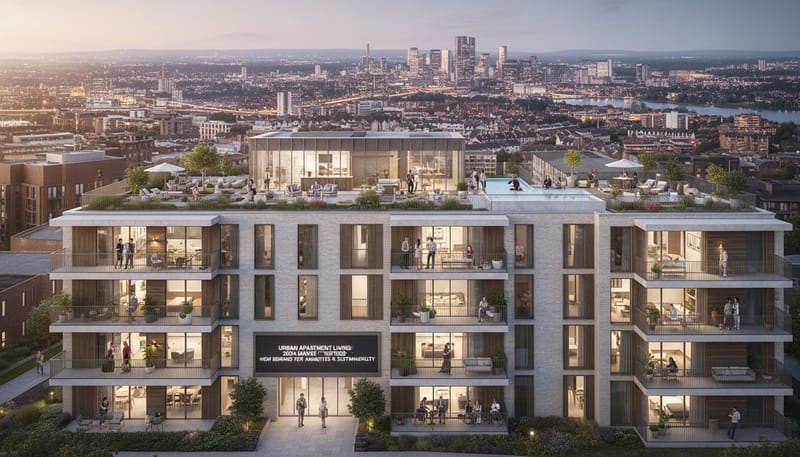
The new build apartment market in the UK occupies a distinctive and increasingly important position within the broader housing landscape. While the traditional aspiration for many British buyers remains a house with a garden, the reality of urban living, affordability constraints, demographic change, and evolving lifestyle preferences means that apartments now account for approximately 22% of all new build completions in England — and a far higher proportion in cities such as London (58%), Manchester (45%), and Birmingham (38%). The apartment market is also the segment most directly influenced by the explosive growth of the build-to-rent (BTR) sector, which has fundamentally altered the specification, design, and amenity expectations for flatted developments. Understanding these dynamics is essential for anyone considering buying, investing in, or simply following the new build apartment market in 2026.
This article provides a comprehensive analysis of the UK new build apartment market, drawing on data from the NHBC, British Property Federation, Molior London, the Land Registry, and primary research from leading developers and BTR operators. We examine the demand profile for apartments versus houses, the state of city centre development, how the build-to-rent sector is reshaping buyer expectations, current specification and design trends, the role of communal facilities, the thorny question of service charges and leasehold reform, and the outlook for the apartment market through the remainder of 2026 and into 2027. Whether you are a first-time buyer considering a city centre flat, a downsizer looking for a low-maintenance apartment, or an investor assessing yield opportunities, this guide covers the trends you need to understand.
The Flat vs House Debate: Market Dynamics in 2026
The balance between apartment and house demand has shifted over the past few years, influenced by post-pandemic preferences, mortgage market conditions, and the evolving needs of different buyer segments. After a dip in apartment demand during 2020–21, when the work-from-home shift sent buyers rushing towards houses with gardens, the apartment market has recovered significantly. Several factors are driving this recovery.
The recovery in apartment demand is driven primarily by three factors. First, affordability: with average new build house prices in England at £368,200, apartments at an average of £298,500 represent a more accessible entry point for first-time buyers, particularly in higher-cost regions. The price differential is even more pronounced in London, where the average new build flat is around £485,000 compared to £620,000+ for a new build house. Second, lifestyle: the return to urban living following the pandemic has been driven by younger buyers and professionals who value proximity to work, entertainment, and social opportunities over garden space. Third, the build-to-rent sector has introduced a level of amenity, design quality, and professional management that has elevated the perception and desirability of apartment living.
City Centre Development: The Key Markets
The new build apartment market is overwhelmingly an urban phenomenon, concentrated in city centres and their immediate fringes. The following cities represent the most active markets for new build apartments in the UK.
Dominated by major regeneration zones: Nine Elms, Barking Riverside, Canada Water, Meridian Water, and the Royal Docks. Strong international and BTR demand. Shared ownership a key route for first-time buyers.
The UK's most active apartment market outside London. Key areas include Deansgate, Ancoats, New Islington, and the Northern Gateway. Strong rental demand from professionals and students. Gross yields of 5.5–6.5%.
Transformed by HS2, Paradise, and Smithfield. The Jewellery Quarter, Digbeth, and Eastside are key apartment hotspots. Strong investor demand driven by HS2 connectivity expectations. Growing BTR sector.
South Bank regeneration driving a new wave of apartment development. Financial services and legal sector employment supporting demand. Excellent value vs other major UK cities. Yields of 5.8–6.5%.
Temple Quarter regeneration anchored by new Bristol Temple Meads station redevelopment. Strong tech and creative sector employment. Limited supply relative to demand makes this a competitive market.
Outstanding value compared to other major UK cities. Glasgow Harbour, Tradeston, and Sighthill delivering large-scale apartment schemes. Strong student and professional rental market. Yields of 6.0–7.5%.
For more detail on which regions offer the strongest overall market opportunities, see our guide to regional new build market hotspots in 2026.
Build-to-Rent: Reshaping Apartment Expectations
The build-to-rent (BTR) sector has grown from a niche concept to a major force in the UK apartment market. According to the British Property Federation, as of the end of 2025, there were approximately 102,000 completed BTR homes in the UK, with a further 58,000 under construction and 110,000 in planning. BTR now accounts for approximately 34% of all new build apartment completions, up from 22% in 2022. This growth has had a profound effect on the specification and amenity expectations of all apartment buyers, not just those renting.
The BTR sector has raised the bar for apartment living in several important ways. BTR developments typically feature higher-specification communal areas (lobbies, corridors, communal gardens), on-site amenities (gyms, co-working spaces, residents' lounges, roof terraces, parcel rooms), professional on-site management, faster maintenance response times, and pet-friendly policies. These features have become reference points for buyers of for-sale apartments, who increasingly expect similar standards even when purchasing rather than renting.
For apartment buyers, the BTR phenomenon has both positive and negative implications. On the positive side, it has driven up the overall quality of apartment design and has provided a competitive alternative that keeps for-sale developers honest on specification. On the negative side, the growth of BTR has absorbed a significant proportion of the apartment development pipeline that might otherwise have been for-sale, potentially constraining choice for buyers in some markets. There is also a question about the long-term impact on prices: in areas where BTR supply is high, the abundance of rental stock can reduce the urgency for some households to buy, potentially moderating price growth for for-sale apartments.
Apartment Specification Trends
The specification of new build apartments has evolved significantly in recent years, driven by buyer expectations, building regulations, and the competitive pressure from the BTR sector. The following analysis covers the key specification trends for 2026.
The Nationally Described Space Standard (NDSS), which sets minimum floor areas for new homes, is being adopted by an increasing number of local authorities as a condition of planning permission. Under NDSS, a one-bedroom apartment for two people must be at least 50 square metres, and a two-bedroom apartment for four people must be at least 70 square metres. While NDSS is not universal, the trend is clearly towards larger apartments than were typical a decade ago. Buyers should check whether a development complies with NDSS, as this provides assurance on space standards.
Post-pandemic, balconies and terraces have become near-essential features for apartment buyers. In the 2025 HBF survey, 84% of apartment buyers rated private outdoor space as very important or essential, up from 72% in 2020. Developers have responded by making balconies standard on the majority of new build apartments, with typical sizes of 5–8 square metres for one-bed flats and 8–12 square metres for two-bed units. Juliet balconies are increasingly seen as insufficient by buyers, who want usable outdoor space for seating and planting.
Kitchen quality is a key differentiator in the apartment market. Buyers expect integrated appliances (dishwasher, washer-dryer, fridge-freezer, oven, hob, and extractor) as standard. The trend is towards handleless cabinetry, quartz or composite worktops, and a premium aesthetic. Separate utility or laundry spaces within apartments are highly valued but rare due to space constraints; instead, developers are providing communal laundry facilities or integrated washer-dryers in kitchens.
Two-bedroom apartments are increasingly expected to have a bathroom and a separate en-suite or shower room to the master bedroom. Walk-in showers are preferred over baths in main bathrooms, particularly by younger buyers, though a bath is still valued in family-oriented two-bed units. Heated towel rails, large-format tiling, and quality sanitaryware are standard expectations.
Storage is consistently cited as the biggest deficiency in new build apartments. Buyers want built-in wardrobes in bedrooms, hall storage cupboards, and ideally additional storage either within the apartment or in a dedicated store room within the building. Developments that include individual storage units (lockers or cages in the basement) for bicycles, luggage, and seasonal items are rated particularly highly by buyers.
Communal Facilities: What Buyers Expect
The standard for communal facilities in new build apartment developments has risen dramatically, driven by the BTR sector and by buyer demand for a more holistic living experience. The following table shows the communal facilities most valued by apartment buyers in 2026.
The parcel/delivery room has seen the most dramatic rise in demand, reflecting the growth of online shopping and the practical challenge of receiving deliveries in a flatted development. Many apartment residents rely on neighbours, building managers, or collection points for deliveries, which is inconvenient and insecure. Purpose-built parcel rooms with smart locker systems are becoming a standard feature in higher-quality developments and are highly valued by residents.
Co-working and study spaces have also seen a significant rise in demand, driven by the hybrid working trend. For apartment residents who lack a dedicated home office room, a communal co-working space within the building provides a productive alternative to working at the kitchen table. These spaces typically feature desks, meeting pods, high-speed WiFi, printing facilities, and a professional environment. The demand is strongest among younger professionals living in one-bedroom apartments where space is at a premium.
Service Charges and Leasehold Reform
Service charges remain one of the most contentious issues in the apartment market. For buyers, the annual service charge — which covers the maintenance and management of communal areas, building insurance, and shared facilities — represents a significant ongoing cost that must be factored into the total cost of ownership. Average service charges for new build apartments in England range from approximately £1,800 per year for a basic development to £4,500 or more for a high-specification building with extensive communal facilities. In prime London, service charges can exceed £8,000 per year.
The Leasehold and Freehold Reform Act 2024, which is being implemented in phases through 2025 and 2026, introduces several important protections for apartment leaseholders. Key provisions include the extension of the standard new lease from 90 years to 990 years with zero ground rent, the right for leaseholders to take over management of their building more easily, greater transparency requirements for service charge accounts, and restrictions on the ability of freeholders to charge unreasonable fees. For new build apartment buyers, these reforms provide significantly greater security and control over the long-term costs of leasehold ownership.
When buying a new build apartment, always request a detailed service charge budget from the developer, not just the headline figure. Ask for a breakdown of what is included (buildings insurance, communal cleaning, lift maintenance, grounds maintenance, management fees, reserve fund contributions) and what is excluded (utility supplies to communal areas, concierge services, gym membership). Also ask about the reserve/sinking fund — a well-managed building should have a reserve fund for major future works such as roof replacement or lift refurbishment, and contributions to this fund are typically included in the service charge. The absence of a reserve fund should be a red flag, as it means leaseholders may face large one-off bills in the future.
The Investor Perspective
New build apartments remain the most popular property type for buy-to-let investors, offering a combination of strong rental demand, manageable maintenance requirements, and — in the right locations — attractive yields. However, the investment landscape has become more complex due to tax changes, regulation, and the competitive pressure from the BTR sector.
The key consideration for apartment investors in 2026 is the balance between yield and capital growth. Regional cities such as Manchester, Leeds, and Glasgow offer the highest gross yields, typically in the 5.5–6.5% range, but capital growth in these markets can be more volatile and is heavily dependent on local supply dynamics. London, by contrast, offers lower yields (typically 4.5–5.5% in zones 2–4) but historically stronger and more consistent capital growth. The right choice depends on the investor's objectives, time horizon, and risk appetite. For yield-focused investors with a shorter time horizon, regional cities are likely to outperform. For those focused on long-term capital preservation and growth, London and the prime South East may be more appropriate, despite the lower entry-point yield.
Investors should also pay close attention to the specific micro-location within a city. Not all apartment developments are created equal, and the difference between a well-located building with strong transport links, local amenities, and professional management, and a poorly located or over-supplied development can be significant in terms of rental demand, void rates, and long-term value. A useful rule of thumb is to focus on developments within a 10-minute walk of a major transport node (railway station, tram stop, or tube station) and within close proximity to a significant employment centre. Developments that meet these criteria tend to attract the strongest tenant demand and command premium rents.
Investors should note that the 5% stamp duty surcharge on additional properties (increased from 3% in the Autumn 2024 Budget) significantly impacts the upfront cost of investment. On a £250,000 apartment, the surcharge adds £12,500 to the purchase cost, which reduces the effective yield in the early years. However, for investors who are able to hold for the medium to long term, the combination of rental income, capital growth, and the low-maintenance characteristics of new build apartments remains attractive. Regional cities — particularly Manchester, Leeds, Glasgow, and Birmingham — continue to offer the best combination of yield and growth prospects for apartment investment.
Fire Safety and Cladding: The Post-Grenfell Landscape
The Grenfell Tower tragedy in 2017 and the subsequent inquiry and legislative response have fundamentally changed the fire safety landscape for apartment buildings in the UK. For buyers of new build apartments in 2026, the regulatory framework provides significantly greater protection than was the case before the tragedy, but awareness of the issues and their practical implications remains important.
The Building Safety Act 2022, now fully in force, introduced a new regulatory regime for higher-risk buildings (those over 18 metres or 7 storeys) including a requirement for a Building Safety Regulator to oversee the design, construction, and management of such buildings. All new residential buildings over 11 metres must have a second staircase, and the use of combustible materials in the external walls of buildings over 18 metres is banned. For buyers, this means that any new build apartment block built under the current regulations will have been subject to significantly more rigorous fire safety scrutiny than buildings constructed before the reforms.
The practical implications for buyers include the requirement for an EWS1 (External Wall System) form for buildings over 11 metres if they are to be mortgageable. For new build apartments built after the regulatory changes, this should be straightforward, as the building will have been designed and constructed to comply with the new fire safety requirements. However, buyers should still request confirmation from the developer that the building has received the appropriate fire safety certifications and that no combustible cladding or insulation materials have been used. The Building Safety Regulator maintains a public register of higher-risk buildings, and buyers can check this as part of their due diligence process.
Before purchasing a new build apartment, confirm the following with the developer:
- The building complies with current Building Regulations Part B (Fire Safety)
- No combustible cladding or insulation materials have been used in the external wall system
- The building has received sign-off from the Building Safety Regulator (for buildings over 18m)
- An EWS1 form is available or will be provided before completion
- The fire safety strategy for the building, including evacuation procedures, sprinkler systems, and compartmentation
- The ongoing fire safety management plan, including who is responsible for compliance
The Sustainability Angle: Green Apartments
Sustainability has become a key differentiator in the apartment market, and buyers are increasingly factoring environmental performance into their purchasing decisions. New build apartments built to the Future Homes Standard benefit from the same energy efficiency advantages as new build houses — air source heat pumps, high-performance insulation, triple glazing, and EPC A or B ratings as standard. However, apartment buildings also offer additional sustainability opportunities that are not available to individual houses, including shared ground source heat pump systems, rooftop solar PV arrays that serve the whole building, communal battery storage, rainwater harvesting systems, and green roofs that provide biodiversity and thermal performance benefits.
Several leading apartment developers have embraced sustainability as a core part of their proposition. Developments achieving BREEAM Excellent or Outstanding ratings are becoming more common in the premium segment, and some developers are pursuing Passivhaus certification, which requires ultra-low energy consumption achieved through exceptional fabric performance and mechanical ventilation with heat recovery. For buyers, the practical benefit is lower running costs — a well-designed, energy-efficient apartment can have energy bills of as little as £400–600 per year, a fraction of the cost of running an older flat or a period conversion. The green mortgage discounts available for EPC A or B rated homes provide an additional financial incentive.
The resale value implications of sustainability are also increasingly significant. As the rental sector faces tightening EPC requirements — with a target of EPC C for all rented properties by 2030 — apartments that already exceed these standards will be protected from future regulatory cost, while those that fall short may face devaluation. For owner-occupiers, the value premium for energy-efficient homes is growing, with RICS data showing that EPC A and B rated flats now command a price premium of 5–7% compared to equivalent properties rated D or below.
Frequently Asked Questions
New build apartments can be a good investment in the right location, but selectivity is essential. Focus on cities with strong employment growth, limited supply relative to demand, and good transport links. Regional cities such as Manchester, Leeds, and Birmingham offer the strongest yields, while London offers lower yields but potentially stronger capital growth over the long term. Always factor in service charges, the stamp duty surcharge, and potential void periods when calculating returns.
The Leasehold and Freehold Reform Act 2024 provides significant new protections for leaseholders. Key benefits include the right to extend your lease to 990 years at zero ground rent, easier collective enfranchisement (buying the freehold as a group), greater transparency on service charges, and restrictions on unreasonable charges. For new build apartment buyers, these reforms provide much greater security and long-term value protection. However, some provisions are being implemented in phases, so check which elements are in force at the time of your purchase.
Service charges cover the shared costs of running a building: maintenance of communal areas, building insurance, lift servicing, cleaning, grounds maintenance, and management fees. They are typically paid quarterly or monthly and are reviewed annually. For the first year of a new development, the developer sets the budget, after which the management company (appointed by the freeholder or residents' management company) prepares annual budgets. Always review the service charge budget before purchase, and check whether a reserve/sinking fund is in place for future major works.
This depends on your personal circumstances, financial situation, and how long you plan to stay. Buying is typically more advantageous if you plan to stay for at least 3–5 years, as it allows you to build equity and benefit from any price appreciation. The monthly cost of buying (mortgage plus service charge) is often comparable to renting a similar property, particularly in the current mortgage rate environment. Renting offers flexibility and avoids the upfront costs of purchase (deposit, stamp duty, legal fees). If you are new to an area and unsure about long-term plans, renting a BTR apartment can be a good way to experience the lifestyle before committing to purchase.
Key factors to consider include: floor area (check against NDSS standards), aspect and natural light, balcony or private outdoor space, storage provision, quality of communal areas and facilities, service charge level and what it includes, the management company and their track record, the building's EPC rating and energy costs, parking and EV charging provision, and the lease terms (length, ground rent, service charge cap provisions). Also consider the building's cladding and fire safety status — post-Grenfell reforms mean all new build apartments must comply with stringent fire safety requirements, but it is worth confirming this explicitly with the developer.
Conclusion
The UK new build apartment market in 2026 is more diverse, more professional, and more buyer-focused than at any point in its history. The influence of the build-to-rent sector has raised specification and amenity standards across the board, leasehold reform is providing greater protection and transparency for buyers, and the return to urban living has reinvigorated demand in city centres from Manchester to Glasgow to Bristol. For first-time buyers, apartments remain the most affordable route to home ownership in many urban areas, while for investors, the combination of strong rental demand and competitive yields in regional cities makes new build apartments a compelling asset class — provided due diligence is thorough.
The challenges should not be understated. Service charges are a significant ongoing cost that can erode the financial advantage of apartment living. The leasehold structure, while improving, still places apartment owners in a less autonomous position than freehold house owners. And the sheer volume of new apartment supply in some city centres — particularly Manchester and parts of east London — means that buyers and investors need to be selective about which developments they choose, focusing on quality of build, management track record, and location fundamentals rather than simply chasing the lowest price or the most eye-catching marketing.
For those considering an apartment purchase, the key is research. Understand the service charge, the lease, the management arrangements, and the long-term maintenance plans for the building. Visit the development, talk to existing residents if possible, and seek independent legal advice. The new build apartment market offers genuine value and lifestyle benefits in 2026, but as with any significant financial decision, informed buyers make better choices. Explore the latest new build apartments on our development search page, or read our broader spring 2026 market outlook for the full picture. For insight into what buyers across all property types are looking for, see our guide to new build demand trends in 2026.