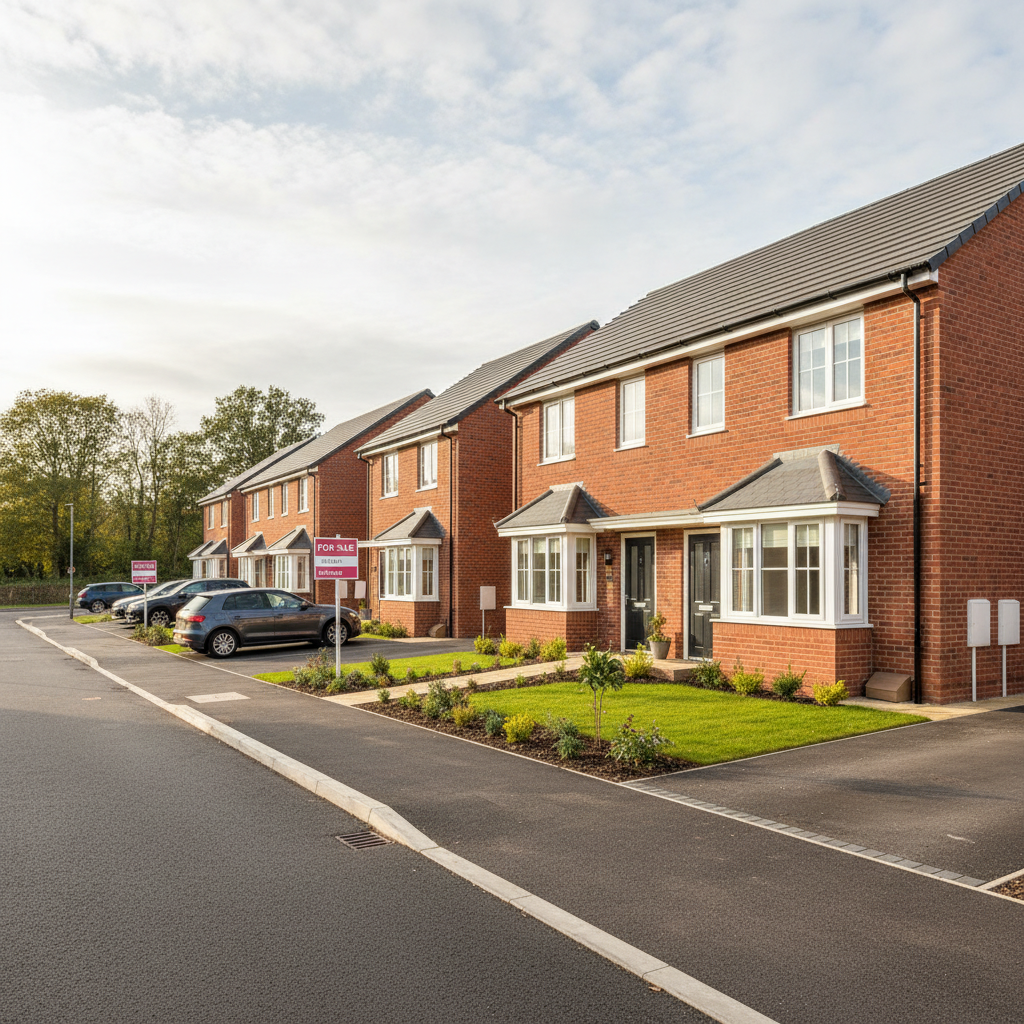
Understanding How Developer Sales Targets Work
To negotiate effectively with a new build developer, you need to understand the target structure that drives their behaviour. These targets are not simple — they operate at multiple levels within the organisation, and each level creates different types of pressure and opportunity for buyers.
National Company Targets
Every major UK housebuilder — Barratt Developments, Taylor Wimpey, Persimmon, Bellway, Vistry, Berkeley Group, and others — publishes forward guidance to the stock market. This guidance typically includes projected completion volumes (how many homes they expect to hand over to buyers), revenue targets, and average selling price targets. These numbers are scrutinised by analysts, fund managers, and financial journalists. Missing them has real consequences: share price drops, dividend concerns, and questions about management competence at the next results presentation.
The national target is broken down into half-year and quarterly targets. The company's interim results (half-year) are almost as important as full-year results, because they indicate whether the annual target is achievable. This means the mid-year point carries significant pressure, not just the year-end.
For a buyer, the national picture matters because it sets the overall tone. If a developer has publicly committed to completing 16,000 homes in a year and is tracking at 14,500 by the end of Q3, the final quarter will see extraordinary pressure to close the gap. You can track this by reading trading updates and analyst reports, which are freely available on the developer's investor relations website.
Regional Division Targets
Each major developer divides the UK into regional divisions — typically between 6 and 30 depending on the company's size. Each regional division has its own managing director, its own sales director, and its own targets. These regional targets are derived from the national plan but are adjusted based on the sites each region operates, local market conditions, and historical performance.
Regional variation is significant. The North West division of a developer might be comfortably ahead of target while the South East division is struggling. Or the Scotland region might have had a slow Q1 but recovered in Q2. These regional dynamics mean that the same developer can offer wildly different deals depending on which of their regions you are buying in.
You can sometimes gauge regional performance from the language used in trading updates. Phrases like "strong performance in the North" combined with "challenging conditions in London" tell you where the pressure — and therefore the deals — are likely to be found.
Site-Level Targets
Every development site has a business plan that includes a target sales rate, usually expressed as net reservations per week. A typical target might be 0.6 to 0.8 reservations per week for a mainstream housing development, or 0.3 to 0.5 per week for a premium development. These targets are set when the land is purchased and the site is planned, based on the expected market conditions, the pricing strategy, and the rate at which homes will be completed.
When a site consistently underperforms its target sales rate, the regional sales director gets involved. They will review the pricing, the marketing, the sales advisor's performance, and the competitive landscape. If the underperformance continues, the site will be authorised for enhanced incentives — better deals for buyers to stimulate demand.
As a buyer, you can assess site-level performance by:
- Visiting the site map: How many plots are marked as sold, reserved, or available? If a site launched six months ago and a large proportion is still available, sales are slower than expected.
- Checking the developer's website: How many properties are listed as available? Have prices been reduced since launch?
- Asking the sales advisor: "How has the site been selling?" Most advisors will be honest, because they know that you can see the site plan for yourself.
- Visiting multiple times: If you visit two weeks apart and the same plots are still available with no new reservations, sales are slow.
Individual Sales Advisor Targets
The person you deal with face-to-face — the sales advisor — has their own personal targets and commission structure. A typical arrangement might be:
- Base salary of £25,000 to £35,000
- Commission per reservation of £200 to £500
- Bonus for hitting monthly or quarterly target (e.g., an additional £1,000 to £3,000)
- Enhanced bonus for exceeding target (sometimes significantly more)
This means that the sales advisor has a personal financial incentive to secure your reservation. If they need one more reservation to hit their quarterly bonus, your visit could be worth an extra £1,000 to £3,000 to them personally. This does not mean they will reduce the price out of their own pocket — they cannot do that — but it means they will work harder to get their manager to approve a better deal for you, because they need your reservation to hit their bonus.
Understanding this dynamic helps you negotiate with empathy rather than aggression. The sales advisor is not your adversary — they are a potential ally who can advocate for your deal within their organisation.
What Happens When Targets Are Not Being Met
The internal process that kicks in when a developer is behind target follows a predictable pattern. Understanding this process helps you identify the right moment to negotiate and the right person to negotiate with.
Weeks 1-6 of the Quarter: Monitoring Phase
In the early weeks of a quarter, sales are monitored but there is no urgency. The assumption is that performance will pick up. Marketing campaigns are running, show homes are open, and the normal sales process is in effect. Incentives at this stage are limited to whatever standard package is currently advertised on the development.
Your leverage: Low to moderate. Standard incentives are available, but the sales team has no urgent need to go beyond them.
Weeks 7-9: Review Phase
By the mid-point of the quarter, regional sales directors are reviewing performance against target. Sites that are behind receive additional attention. The sales director may visit the site, meet with the sales team, and discuss what additional measures might help. Marketing may be increased, pricing may be reviewed, and the conversation about enhanced incentives begins internally.
Your leverage: Moderate. The sales team knows they are behind and is becoming more receptive to negotiation. If you express serious interest at this stage, they may proactively ask their manager what additional incentives can be offered.
Weeks 10-11: Pressure Phase
With two to three weeks left in the quarter, the numbers become urgent. If the site needs four more reservations to hit its quarterly target but is only generating one per week, something has to change. This is when enhanced incentive packages are formally authorised — the regional sales director approves a specific list of additional incentives that the sales team can offer to serious buyers.
Your leverage: High. The sales team has new tools at their disposal and is motivated to use them. This is the optimal time to begin serious negotiations. You are dealing with a team that has both the authority and the motivation to offer you a better deal.
Weeks 12-13: Final Push
The last two weeks of the quarter are the most intense. Every conversation with a potential buyer is a priority. Sales managers may be present on site to assist with negotiations and approve deals on the spot (rather than requiring the advisor to "go away and check"). The combination of authority, urgency, and motivation creates the most favourable conditions for the buyer.
Your leverage: Maximum. If you are a prepared buyer (mortgage in principle, solicitor ready, deposit available) who can commit quickly, you are exactly what the sales team needs. The deals available in the final two weeks of a quarter can be significantly better than those offered just four weeks earlier.
How to Identify End-of-Quarter Pressure
Knowing that end-of-quarter pressure exists is one thing — identifying when it is actually happening on the development you are interested in is another. Here are the signs to look for.
Enhanced Marketing Activity
Developers ramp up marketing spend when they need to boost sales. Look for:
- Email campaigns advertising "limited time" offers or "exclusive" incentive packages
- Social media posts promoting deals that were not previously mentioned
- Open day or launch events with refreshments and incentives for attendees
- Increased online advertising (Google Ads, Facebook, Instagram) for the development
- Brochures or flyers being distributed in the local area
If you are registered on a developer's mailing list (always register — it costs nothing), you will receive these communications directly. A sudden increase in the frequency and generosity of marketing messages is a reliable indicator of sales pressure.
Sales Team Language Changes
Pay attention to how the sales advisor communicates with you. In normal times, the language is measured: "We have some lovely homes available" and "I can put together a package for you." When pressure increases, the language becomes more urgent and more generous:
- "We have some fantastic offers available this month" — suggests enhanced incentives have been authorised
- "My manager is on site today if you'd like to discuss options" — the presence of a manager means they are ready to do deals
- "We could look at something special for you if you're in a position to move quickly" — a direct invitation to negotiate
- "We've just had a cancellation on a really popular plot" — creating urgency, but also potentially signalling that the site is not selling as well as expected
Website and Portal Changes
Check the developer's website and major property portals (Rightmove, Zoopla) for the development:
- Have prices been reduced? Developers sometimes adjust prices mid-quarter if sales are slow.
- Are new incentives being advertised that were not there before? A sudden appearance of "stamp duty paid" or "5% deposit contribution" is a clear signal.
- Have properties been relisted or re-promoted? Bumping listings on Rightmove costs money — they only do it when they need sales.
Competitor Activity
If you are looking at developments from multiple developers in the same area, compare their offers. When one developer increases incentives, competitors often follow suit within a few weeks. If Developer A is suddenly offering stamp duty paid and Developer B (whose quarter ends two weeks later) is not yet matching, Developer B may well come to the table if you ask.
What Incentives Become Available at Quarter-End
The range of incentives offered by developers varies, but at quarter-end the packages typically become more generous and more creative. Here is a comprehensive list of what may be available and what each incentive is worth in practice. For a full explanation of every type of incentive, see our guide on negotiating new build incentives.
Enhanced Part-Exchange
Part-exchange is where the developer buys your existing home as part of the deal, similar to a car trade-in. Standard part-exchange offers are typically 90% to 95% of the independently valued market price. At quarter-end, developers may increase this to 95% to 100% of market value, or even accept a higher valuation basis. On a £250,000 existing home, the difference between 90% and 98% is £20,000 — a substantial sum.
Some developers at quarter-end will also relax the criteria for part-exchange, accepting properties they might normally decline (leasehold flats, properties needing work, homes in less desirable locations). If you have been told your property does not qualify for part-exchange, it may be worth asking again at quarter-end.
Free Upgrades and Specification Enhancements
Upgrades are one of the most common incentives because they cost the developer significantly less than their retail value. Common upgrade packages include:
- Flooring throughout: Retail value £3,000 to £8,000 depending on the property size and materials chosen. Developer cost: approximately 40% to 50% of retail.
- Kitchen upgrade: Premium worktops, upgraded appliances, higher-specification units. Retail value £5,000 to £15,000. Developer cost: approximately 30% to 45% of retail.
- Bathroom upgrade: Premium tiles, upgraded sanitaryware, better fixtures. Retail value £2,000 to £5,000 per bathroom.
- Integrated appliances: Fridge-freezer, dishwasher, washer-dryer, wine cooler. Retail value £2,000 to £5,000.
- Turfed garden and landscaping: Retail value £1,500 to £4,000.
- Window blinds or shutters: Retail value £1,500 to £4,000.
At quarter-end, upgrade packages that might normally cost £5,000 to £10,000 may be offered free or at a significant discount. The total value of a comprehensive upgrade package can reach £15,000 to £25,000 at retail prices.
Deposit Contribution
Some developers will contribute to your deposit, typically 3% to 5% of the purchase price. On a £350,000 home, a 5% deposit contribution is worth £17,500. This is a significant amount of cash and can make the difference between affording a 90% mortgage versus needing a 95% mortgage — which typically means a better interest rate and lower monthly payments for the life of the loan.
Note: deposit contributions must be declared to your mortgage lender, and some lenders treat them differently. Always check with your mortgage broker or lender before relying on a deposit contribution as part of your purchasing plan.
Mortgage Rate Buydowns
Some developers negotiate with mortgage lenders to subsidise your interest rate for a fixed period. This might look like a 2-year fixed rate that is 0.5% to 1.0% lower than the lender's standard offering. On a £280,000 mortgage, a 1% rate reduction saves approximately £2,800 per year, or £5,600 over a two-year fixed period.
This incentive has become more popular in recent years as mortgage rates have risen. Developers know that affordability is a key concern for buyers, and a rate buydown directly addresses monthly payment anxiety.
Stamp Duty Paid
One of the most straightforward incentives: the developer pays your stamp duty land tax. For a £350,000 new build home (assuming you are not a first-time buyer), stamp duty could be around £7,500. Having this paid by the developer is a clear, easily understood saving.
For first-time buyers, the stamp duty saving is smaller due to the nil-rate band, which makes this incentive less impactful. In this case, you might negotiate to have the equivalent value redirected to another incentive (upgrades, for example).
Legal Fees Paid
Many developers offer to pay your conveyancing costs, typically £1,000 to £2,000 including disbursements. Some use a panel solicitor for this, while others will contribute a fixed amount toward the solicitor of your choice. While not the largest incentive in value terms, having legal fees paid reduces your upfront cash requirements.
Furniture Packs
Some developers, particularly those selling apartments, offer furniture packages as an incentive. These can range from basic furnishing (beds, sofas, dining table) worth £3,000 to £5,000, to fully furnished show-home standard packages worth £15,000 to £30,000. Furniture packs are particularly attractive if you are a first-time buyer without existing furniture or an investor looking to let the property quickly.
How to Approach the Negotiation: Step by Step
Knowing that end-of-quarter deals exist is only half the battle. You need to negotiate effectively to secure them. Here is a detailed, step-by-step approach.
Step 1: Prepare Before You Visit
Before you set foot in the show home during the final weeks of a quarter, have the following in place:
- Mortgage agreement in principle (AIP): This proves you can actually afford the property. It transforms you from a browser into a buyer in the sales team's eyes.
- Deposit confirmation: Know exactly how much you have available for a deposit and where it is held.
- Solicitor identified: Have a conveyancer ready to instruct. Even better, have already spoken to them about acting for you on a new build purchase.
- Research completed: Know the development, the available plots, the current pricing, and what incentives have been advertised.
- Comparable evidence: Check what similar properties in the area have sold for using the Land Registry. This gives you a factual basis for any price negotiation.
Step 2: Visit at the Right Time
As discussed, visit during a quiet period — midweek morning, poor weather, or late in the day. You want the sales advisor's full attention and the knowledge that you may be one of very few buyers they see that day.
Step 3: Build Rapport
Spend time with the sales advisor. View the show home, ask questions about the development, discuss the local area. The sales advisor is a person, not a machine, and they will work harder for someone they like and respect. Share your situation genuinely: "We've been looking for about three months, we've narrowed it down to this development and one other, and we're hoping to find the right deal to make our decision."
Step 4: Express Serious Intent
Make it clear that you are ready to buy, not just browsing. Key phrases include:
- "We have our mortgage agreement in principle and our deposit is ready."
- "We've instructed a solicitor and they're ready to start work."
- "We're looking to reserve this month if we can find the right terms."
- "We love the development and we've identified Plot 47 as our preferred option."
These statements tell the sales advisor that you are a highly likely conversion — someone who will actually complete the purchase, not just reserve and then pull out. Developers care about this because reservation cancellation rates can be 15% to 25%, and a cancellation at quarter-end is a disaster for their numbers.
Step 5: Ask What Is Available
Rather than leading with a demand, ask an open question: "What's the best package you can put together for us on Plot 47?" This invites the sales advisor to present whatever has been authorised, without you having to guess. They may surprise you with an offer that is better than you expected.
Listen carefully to the response. If the advisor says "I can offer you..." they are telling you what is within their personal authority. If they say "Let me check with my manager," there is more available — they just need approval.
Step 6: Negotiate Upward
Whatever the initial offer, ask for more. This is not aggressive — it is expected. The initial offer is rarely the best offer. Polite, specific requests work best:
- "That's a good start. Could you also include the flooring package?"
- "If we're committing today, could the stamp duty be covered as well?"
- "The kitchen upgrade is important to us. Is there any way to include the premium worktop option?"
Each request should be specific and reasonable. Asking for "more" is vague. Asking for "the Siemens integrated dishwasher and the Silestone worktop" shows you have done your homework and know what you want.
Step 7: Use the Right Scripts
Here are some negotiation scripts that have proven effective in end-of-quarter situations:
The informed buyer script: "I understand your financial year ends next month, and I know this is a busy time for your team. We're genuinely ready to proceed — we can have our reservation fee with you today and our solicitor will be instructed by Monday. What can you do to make this work for both of us?"
The competitive comparison script: "We're also looking at [competing development]. They've offered us [specific incentive]. We prefer your development, but the financial package there is currently better. Is there anything you can do to close the gap?"
The polite persistence script: "I appreciate the offer, but it's not quite enough for us to commit today. If you can add [specific item], we'll reserve right now. Can you speak to your manager about that?"
The completions urgency script: "We can complete within [X] weeks, which I think helps your position. Given that we're a certain completion this quarter, is there an enhanced package available for ready-to-proceed buyers?"
Step 8: Get Everything in Writing
Before you hand over your reservation fee, ensure that every agreed incentive is documented in writing. This should be on the developer's headed paper or included in the reservation agreement. Verbal promises are worth nothing — only written commitments are enforceable.
Check that the document specifies:
- The exact property (plot number, house type, address)
- The agreed purchase price
- Every incentive that has been agreed (upgrades listed individually, not just "upgrade package")
- The expected completion date
- Any conditions attached to the incentives (e.g., "subject to exchange within 28 days")
What Sales Teams Are Authorised to Offer vs What Needs Manager Approval
Understanding the hierarchy of decision-making within a developer's sales organisation helps you negotiate more effectively. Different levels of incentive require different levels of approval.
Sales Advisor Authority (Typically)
The person you deal with on the show home is usually authorised to offer:
- Standard advertised incentive packages (whatever is currently promoted on the website)
- Minor upgrades within a pre-approved list (e.g., different tile choices, additional sockets)
- Legal fees contribution (usually a standard offering)
- Information about available plots and pricing (but not price changes)
Sales Manager / Regional Sales Director Authority
For anything beyond the standard package, the sales advisor needs to refer to their manager. The sales manager can typically authorise:
- Enhanced upgrade packages beyond the standard offering
- Stamp duty contributions
- Deposit contributions (usually up to a defined percentage)
- Part-exchange terms (often involving a separate part-exchange team)
- Specific one-off requests (bespoke upgrades, special conditions)
Regional Managing Director Authority
Direct price reductions, large-scale incentive packages, and exceptional deals typically require approval from the regional MD. This level of approval is reserved for situations where the standard and enhanced incentive packages have not been sufficient to generate the required sales volume — in other words, when the site or region is significantly behind target.
If a sales advisor tells you "I'll need to speak to our regional director about that," you have pushed the negotiation to a level where significant concessions are being considered. This is a good sign — it means your request is being taken seriously at a senior level.
How Long Does Approval Take?
During the final weeks of a quarter, approval processes are expedited. A request that might take a week to process in mid-quarter can often be approved within 24 hours at quarter-end. If a sales advisor says "I'll come back to you by tomorrow," they usually mean it during this period.
At the very end of a quarter, regional managers may be present on site specifically to approve deals on the spot. If you visit a show home on the final weekend of a quarter and the sales manager is there, you are in a strong position to negotiate and get an answer immediately.
Ready-to-Move-In Stock: The Best Quarter-End Deals
The very best end-of-quarter deals are typically found on ready-to-move-in stock — completed homes that are standing empty and costing the developer money every day they remain unsold. Understanding why this stock exists and how to find it can lead to exceptional savings.
Why Ready Stock Exists
Completed but unsold homes exist for several reasons:
- Cancelled reservations: A buyer reserved the property but pulled out before exchange — perhaps their mortgage fell through, their chain collapsed, or they simply changed their mind. The home is now completed to specification but without a buyer.
- Spec builds: Developers sometimes build homes speculatively, without a reservation, to maintain construction momentum. If the market slows, these homes may not sell as quickly as planned.
- Show homes being released: When a development is nearing completion, show homes are sold off. These are fully furnished, immaculately presented, and often available with the furniture included.
- Overbuilding: Sometimes developers simply build more homes than the market can absorb at the set price, leaving completed stock unsold.
Why Developers Are Desperate to Sell Ready Stock
A completed, unsold home represents a significant financial burden for the developer:
- Capital tied up: The full construction cost (£150,000 to £300,000+ depending on the home) is sitting in the ground generating no return.
- Ongoing costs: Council tax, insurance, heating (to prevent damp and condensation), security, maintenance, and site management costs continue to accrue.
- Accounting impact: Unsold completed stock appears on the balance sheet as inventory, affecting the company's return on capital employed — a key metric watched by analysts.
- Perception issue: A development with visibly unsold homes can deter other buyers, creating a negative cycle.
At quarter-end, every completed unsold home is a drag on the numbers. Developers are strongly motivated to clear this stock, even at a discount, because the financial and accounting benefits of the sale outweigh the reduced margin.
How to Find Ready Stock
- Check the developer's website for properties marked as "ready to move in" or "available now"
- Search Rightmove and Zoopla for new build properties with immediate availability
- Ask the sales advisor directly: "Do you have any completed homes available for immediate occupation?"
- Visit developments that have been selling for 12+ months — later phases may be nearing completion while earlier phases may have cancelled reservations
How Much Can You Save on Ready Stock?
Savings on ready-to-move-in stock at quarter-end can be substantial. Depending on how long the property has been completed and unsold, and how much pressure the developer is under, discounts of 5% to 10% below the original asking price are achievable, either as a direct price reduction or through a combination of price cut and incentives. On a £400,000 home, that represents £20,000 to £40,000 — a life-changing amount of money.
Show homes being sold off can offer even better value, as they typically come fully furnished and with extensive landscaping. The furniture package alone can be worth £15,000 to £30,000.
How Much Can You Realistically Save?
The potential savings from end-of-quarter negotiation vary based on the property value, the developer's target pressure, and the specific development. Here are realistic ranges based on market experience:
Properties Under £250,000 (Starter Homes, Apartments)
Typical end-of-quarter savings: £5,000 to £12,000
This might include: stamp duty paid (£2,500 to £5,000), basic flooring package (£2,000 to £3,000), legal fees covered (£1,500), and minor kitchen upgrades (£1,000 to £2,000). Direct price reductions are less common at this level because the margins are already tighter.
Properties £250,000 to £400,000 (Family Homes)
Typical end-of-quarter savings: £10,000 to £20,000
This might include: stamp duty paid (£5,000 to £10,000), comprehensive flooring and upgrade package (£5,000 to £8,000), or a direct price reduction of £5,000 to £10,000 combined with upgrades. Enhanced part-exchange terms may also be available, adding further value.
Properties £400,000 to £600,000 (Premium Family Homes)
Typical end-of-quarter savings: £15,000 to £30,000
At this price level, the absolute values become significant. A 5% incentive package on a £500,000 home is £25,000. Developers building at this level (Redrow, David Wilson, Charles Church) are more willing to negotiate because their margins are healthier and the individual sale represents a larger share of their target.
Properties Over £600,000 (Executive Homes, London)
Typical end-of-quarter savings: £20,000 to £50,000+
The highest-value negotiations occur at the premium end of the market. Berkeley Group developments in London regularly see significant incentive packages at key reporting periods. A £750,000 apartment with £40,000 of incentives represents a 5.3% saving — enough to cover stamp duty, furnishing, and legal costs.
For a more detailed analysis of how incentive values compare with direct price discounts, see our guide on developer incentives versus price discounts.
Risks of Rushing: What to Watch Out For
End-of-quarter deals create urgency, and urgency can lead to mistakes. While the savings are real, you must protect yourself against the risks of moving too fast.
Mortgage Risks
If a developer pushes for a completion within their quarter but your mortgage application has not been fully processed, you risk:
- Having to accept a less favourable mortgage product because you do not have time to shop around
- The mortgage valuation revealing an issue (the property is valued below the purchase price) that requires renegotiation
- Missing the completion date and losing your reservation or facing penalties
Mitigation: have your mortgage agreement in principle before negotiating, and ask your broker how quickly a full application can be processed. Most brokers can turn around a new build mortgage application in 2 to 4 weeks if everything is in order.
Survey and Valuation Risks
Mortgage lenders will value the property as part of your application. If the lender's valuer assesses the property at less than the agreed purchase price (a "down-valuation"), you have a problem. This is particularly relevant when incentives are involved, because the lender may assess the "true" value of the property as the purchase price minus the incentive value.
For example, if you are paying £350,000 with £20,000 of incentives, the lender might value the property at £330,000 and lend based on that figure. This means you need a larger deposit to make up the difference.
Mitigation: discuss the incentive package with your mortgage broker before agreeing to it. Some structures (e.g., upgrades built into the specification) are less likely to trigger down-valuations than direct price reductions or cash contributions.
Legal Risks
Conveyancing takes time, and cutting corners to meet a deadline can expose you to risks:
- Your solicitor may not have time to conduct thorough searches (local authority, environmental, drainage)
- Issues with the lease (for apartments) may not be fully reviewed
- Restrictive covenants, estate management charges, or other encumbrances may be overlooked
- The NHBC warranty documentation may not be fully checked
Mitigation: instruct a solicitor who specialises in new build conveyancing and who is experienced with the pace required at quarter-end. Be upfront about the timeline from the start so they can allocate resources accordingly. For more on the hidden conditions that can be attached to incentives, see our guide on hidden conditions in new build incentives.
The "Now or Never" Pressure
Sales teams may create artificial urgency: "This offer is only available today" or "Another buyer is looking at this plot." While end-of-quarter pressure is real, the deal that is available on Tuesday is usually still available on Thursday. Do not let pressure tactics force you into a decision you are not comfortable with.
If you need 48 hours to review the terms with your solicitor and mortgage broker, say so. A genuine end-of-quarter deal will still be there in two days. If it is not, the developer was not as motivated as they appeared.
Combining Multiple Incentives: The Art of the Package Deal
The most skilled new build negotiators do not just secure one incentive — they build a comprehensive package that maximises total value. Here is how to approach this.
Start With the Highest-Value Items
Open your negotiation with the biggest requests: stamp duty paid, deposit contribution, or a direct price reduction. These are the items that cost the developer the most but also save you the most. If you start with small items ("Could I get a doorbell camera?"), you set the tone too low.
Layer Additional Items
Once the primary incentive is agreed, add secondary items: "That's great, thank you. Could we also look at the flooring package?" Each additional item should feel like a reasonable extension of the deal already on the table, not a completely new demand.
Know When to Stop
There is a point in every negotiation where pushing further becomes counterproductive. If the sales advisor's body language changes — they become less enthusiastic, start qualifying every response, or explicitly say "That's the best I can do" — it is time to accept the deal or walk away. Pushing beyond this point risks the entire deal collapsing.
Example Package Deals
Example 1: £300,000 Three-Bedroom Detached House
- Stamp duty paid: £5,000
- Flooring throughout: £4,500 retail value
- Kitchen upgrade (Silestone worktops, upgraded appliances): £6,000 retail value
- Legal fees paid: £1,500
- Turfed rear garden: £2,000
- Total package value: £19,000 (6.3% of purchase price)
Example 2: £450,000 Four-Bedroom Detached House
- 5% deposit contribution: £22,500
- Premium kitchen package: £8,000 retail value
- Flooring and window treatments: £6,000 retail value
- Landscaped garden with patio: £3,500
- Total package value: £40,000 (8.9% of purchase price)
When to Walk Away
Not every negotiation will result in a deal that works for you. Knowing when to walk away is as important as knowing how to negotiate.
Walk Away If:
- The developer refuses to put agreed terms in writing
- You are being pressured to exchange contracts before your solicitor has completed their checks
- The incentive package comes with conditions that undermine its value (e.g., you must use a specific solicitor or mortgage broker who may not act in your best interest)
- The overall cost, even with incentives, exceeds what similar properties in the area sell for
- Your gut feeling says something is not right — trust your instincts
The Power of Walking Away
Paradoxically, being willing to walk away often gets you the best deal. When you genuinely stand up and say "Thank you, but this isn't quite right for us," one of two things happens: either the sales advisor lets you go (in which case the deal truly was the best they could offer), or they call you back with an improved offer.
If you do walk away, leave your contact details and say: "If anything changes in the next few weeks, please call me. We really like the development and we'd love to make it work." This keeps the door open for the sales team to come back to you when the quarter-end pressure intensifies further.
Key Quarter-End Dates to Target
Here is a summary of the key quarter-end periods for the major UK developers, so you can plan your negotiation timing:
- March (end of Q1 for calendar year companies): Taylor Wimpey, Persimmon, Vistry — moderate pressure
- June (year-end for Barratt/David Wilson/Redrow, Q2 for calendar year companies): Very high pressure for Barratt, David Wilson, Redrow. Moderate for Taylor Wimpey, Persimmon, Vistry
- July (year-end for Bellway): Very high pressure for Bellway specifically
- September (end of Q3 for calendar year companies): Moderate to high pressure for Taylor Wimpey, Persimmon, Vistry
- October (year-end for Crest Nicholson): Very high pressure for Crest Nicholson specifically
- December (year-end for Taylor Wimpey/Persimmon/Vistry, half-year for Barratt/David Wilson): Maximum pressure across the widest range of developers simultaneously — the single best month of the year for deals
Final Thoughts: Making End-of-Quarter Timing Work for You
End-of-quarter deals on new build homes are real, significant, and achievable by any buyer who understands the dynamics and prepares accordingly. The key principles to remember are:
- Developer sales targets create predictable pressure points that benefit buyers
- The last two to four weeks of each quarter are when the best deals emerge
- Being prepared (mortgage AIP, solicitor, deposit) is essential — deals go to buyers who can move quickly
- Build rapport with the sales team and negotiate with specific, reasonable requests
- Ready-to-move-in stock offers the best value because it costs the developer money every day it remains unsold
- Get everything in writing before paying your reservation fee
- Do not let urgency override due diligence — protect yourself from mortgage, survey, and legal risks
- Be willing to walk away — it is often the most powerful negotiation tactic of all
For more detailed guidance on negotiation tactics, see our comprehensive guide on negotiating new build incentives, and for a full explanation of every type of incentive available, see hidden conditions in new build incentives.