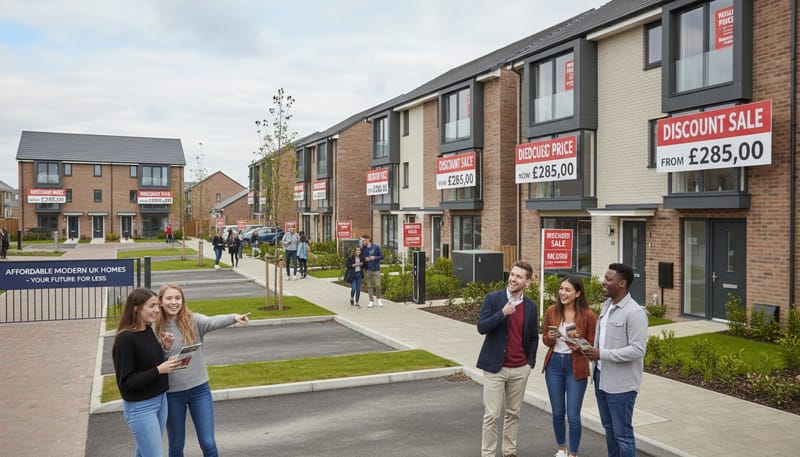
What Are Discount Market Sale Homes?
Discount Market Sale (DMS) is a type of affordable housing where new build properties are sold at a fixed percentage below their open market value — typically 20–30% less. Unlike shared ownership where you buy a partial share, DMS gives you full ownership of the property from day one, but with a covenant restricting future resales to the same discounted percentage below market value.
DMS homes are delivered primarily through Section 106 planning agreements. When developers receive planning permission for major new build schemes, local planning authorities typically require a proportion of homes to be “affordable.” DMS is one of several tenure types that can fulfil this obligation, alongside social rent, affordable rent, and shared ownership.
The appeal of DMS is its simplicity compared to shared ownership. You take out a standard mortgage for the discounted price, you own the freehold or long leasehold outright, and there are no rent payments to a housing association on a retained share. The discount is locked in perpetuity through a legal restriction on the property’s title, ensuring the home remains affordable for future generations.
In 2026, DMS remains an important part of the affordable housing landscape, particularly in areas where the government’s First Homes scheme hasn’t fully replaced existing Section 106 DMS provisions. Many local authorities continue to negotiate DMS allocations on new developments, and existing DMS properties regularly come up for resale on the secondary market.
How the Discounts Work
Understanding the mechanics of DMS pricing is essential before committing to a purchase. The discount is expressed as a percentage of the property’s open market value and is permanently attached to the home, not to the buyer.
The percentage discount — typically 20% but sometimes 25% or 30% depending on local policy — is set by the local planning authority in the Section 106 agreement. This discount percentage is permanently attached to the property through a restriction registered on the title at the Land Registry.
When you eventually sell, an independent RICS valuation determines the current market value, and you must sell at the same percentage discount. So if your home’s market value has risen to £360,000 and the covenant requires a 20% discount, you sell at £288,000. You still benefit from capital appreciation on the discounted amount — your £240,000 purchase becomes a £288,000 sale, a £48,000 gain.
Importantly, the discount applies to the sale price, not your equity. If you have paid down your mortgage significantly, you keep all of that equity. The covenant simply ensures that the next buyer also pays 20% below market value, maintaining the property’s affordable status for future generations.
Eligibility and Local Connection Requirements
DMS eligibility criteria are set by individual local authorities through their Section 106 agreements and affordable housing policies. Requirements vary significantly between areas, but common themes apply.
Local connection is usually the primary qualifying criterion. Most councils define this as having lived in the local authority area for a minimum period (often 12 months), working in the area, or having close family (parents, siblings, children) residing there. Some Section 106 agreements include cascade provisions — if no qualifying local applicants come forward within a set period, eligibility expands to neighbouring authority areas and eventually to anyone meeting the financial criteria.
Income caps vary considerably. Some authorities set strict maximums (e.g., household income must not exceed £60,000 or £80,000), while others simply require you to demonstrate that you cannot afford to buy at open market value in the area. The affordability test typically considers whether you could secure a mortgage for an equivalent open market property without the discount.
Existing property ownership: Most DMS schemes require you to be a first-time buyer or demonstrate that you do not currently own a home. Some authorities make exceptions for people who own a property elsewhere but cannot afford local market prices, particularly in high-value areas where local workers are being priced out.
How DMS Differs from First Homes
The government’s First Homes scheme, launched in 2021, shares DNA with DMS but operates with key differences. Understanding these distinctions helps you identify which products are available and most suitable.
First Homes effectively standardised and expanded the DMS concept with a national minimum 30% discount (compared to DMS’s typical 20%) and a price cap of £250,000 after discount (£420,000 in London). First Homes must represent at least 25% of all affordable housing secured through Section 106 on new developments.
However, DMS homes negotiated before the First Homes policy took effect continue under their original terms. Many existing DMS properties with 20% discounts are still available on the resale market, and some local authorities negotiate additional DMS units beyond the First Homes requirement where viability allows.
Section 106 and DMS Allocations
Understanding how DMS homes are created through the planning system helps you find them and navigate the purchase process.
Section 106 agreements are legally binding contracts between developers and local planning authorities. They specify the precise number, type, and tenure of affordable homes required on a development. For DMS allocations, the agreement will state the discount percentage, eligibility criteria, the local connection cascade, and the restrictive covenant terms.
The proportion of DMS homes on any given development depends on the council’s local plan policies and viability negotiations with the developer. In many areas, councils require 20–40% of homes on major developments to be affordable, with DMS forming part of this mix alongside Rent to Buy, shared ownership, and social rent.
DMS homes are typically indistinguishable from market sale homes on the same development. They are built to identical specifications, use the same materials, and enjoy the same communal facilities. The principle of “tenure blindness” means neighbours often don’t know which homes are DMS and which are open market.
Resale Restrictions and Long-Term Value
The permanent discount covenant is the defining feature of DMS and has important implications for your long-term financial planning.
You do benefit from capital appreciation, but only on the discounted amount. If property values grow 20% over your period of ownership, your DMS home’s resale price also grows 20% — you just start and end at the discounted level. This means your absolute gain in pounds is lower than an open market buyer would achieve, but your percentage return on the deposit invested is identical.
Who can buy from you? When you sell, the next buyer must also meet the DMS eligibility criteria defined in the Section 106 agreement. The council typically manages a waiting list or register of eligible applicants. If no eligible buyer comes forward within a marketing period (usually 3–6 months), some agreements allow the eligibility criteria to be relaxed or the cascade to widen.
Mortgage considerations: Most mainstream lenders will provide mortgages on DMS properties, though some treat the restriction as a non-standard feature requiring specialist underwriting. It is advisable to speak with a mortgage broker experienced in affordable housing products. The restriction does not affect your ability to remortgage the property, though lenders will value it at the discounted price.
Finding DMS Properties and the Application Process
Locating DMS homes requires different strategies for new build and resale properties.
New build DMS: When a new development includes DMS allocations, the developer markets them alongside other affordable products. The council’s housing team typically manages the eligibility verification process. You apply to the developer, who forwards your details to the council for local connection and affordability checks. Once approved, the purchase proceeds like a standard new build transaction.
Resale DMS: When existing DMS owners sell, the council manages the resale process to ensure the discount covenant is maintained and the next buyer meets eligibility criteria. Contact your local authority’s affordable housing or planning team to register interest in DMS resales.
Application timeline: New build DMS purchases typically take 8–16 weeks from expression of interest to exchange, including the eligibility verification period. Resale transactions may be faster if you are already registered and verified with the council.
DMS in Practice: Regional Examples
DMS homes are found across England, with availability concentrated in areas with active new build development and strong local plan affordable housing policies.
In London, DMS homes are particularly common in boroughs like Newham, Tower Hamlets, and Barking and Dagenham, where major regeneration schemes include significant affordable allocations. Discounts of 20–30% on London prices represent substantial savings — a 20% discount on a £450,000 flat saves £90,000.
Outside London, cities including Cambridge, Oxford, Bristol, Bath, and Brighton — where affordability pressures are acute — tend to have the most active DMS markets. Rural areas with strong local plan policies, particularly national parks and Areas of Outstanding Natural Beauty, also use DMS to maintain affordable housing for local workers.
Check your council’s affordable housing supplementary planning document (SPD) for details of their specific DMS policies, discount rates, and eligibility criteria. These documents are publicly available on council websites and provide the definitive guide to DMS in your area.
For related affordable homeownership options, see our guides on First Homes, Rent to Buy, shared ownership, and local connection eligibility criteria.