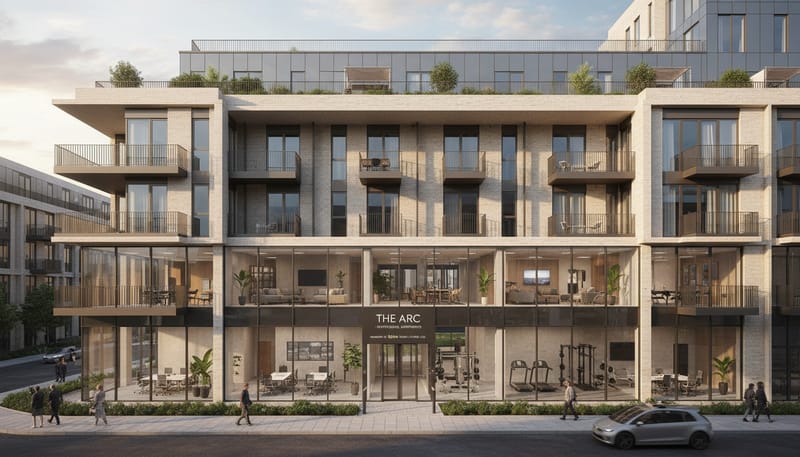
Build to Rent (BTR) has transformed from a niche concept into one of the most dynamic sectors in the United Kingdom's residential property market. What began as institutional investors importing the American multifamily housing model has evolved into a mainstream asset class that is reshaping how and where people live in British cities. With over 100,000 BTR homes either completed or under construction across the UK by early 2025, and a pipeline of another 100,000+ in planning, this sector represents a fundamental shift in the nation's housing landscape — one that creates significant opportunities for both institutional and individual investors.
For individual property investors, BTR offers a fascinating case study in how professional-grade property management, amenity-rich living, and purpose-built design can command rental premiums that traditional buy-to-let properties simply cannot match. Whether you are looking to invest directly in a BTR-focused new build scheme, participate through a real estate investment trust (REIT), or simply learn from the BTR model to improve your own portfolio, understanding this sector is essential for any serious property investor in 2025 and beyond. This guide explores the BTR landscape in depth, examining how the sector has grown, where the opportunities lie, and how you can position yourself to benefit from the UK's rental revolution.
The UK Build to Rent Sector: Growth and Scale
The BTR sector in the UK has experienced extraordinary growth over the past decade. According to data from the British Property Federation (BPF) and Savills, the number of completed BTR homes has grown from fewer than 10,000 in 2015 to over 100,000 by the start of 2025. The total pipeline — including completed, under construction, and in planning — now exceeds 250,000 homes, making BTR a significant contributor to UK housing delivery.
This growth has been driven by several converging factors: a structural shortage of quality rental housing, changing tenant preferences towards professionally managed accommodation, institutional appetite for stable income-producing assets, and government policy that increasingly recognises BTR as a key component of housing supply. The sector has proven resilient through economic turbulence, with BTR occupancy rates consistently exceeding 95% even during periods when the broader market faced uncertainty.
Regional Distribution of BTR
While London initially dominated the BTR landscape, the sector has increasingly shifted towards regional cities. Manchester, Birmingham, Leeds, Bristol, and Sheffield now account for a growing share of the BTR pipeline. Manchester leads the regional charge, with more BTR homes than any other city outside London, driven by strong rental demand from young professionals, excellent transport connectivity, and a vibrant cultural offering.
| City / Region | Completed | Under Construction | Avg Gross Yield |
|---|---|---|---|
| London | 35,000+ | 18,000+ | 3.5-4.5% |
| Manchester | 15,000+ | 8,000+ | 5.0-6.0% |
| Birmingham | 8,000+ | 6,000+ | 5.0-5.8% |
| Leeds | 5,500+ | 4,000+ | 5.2-6.2% |
| Bristol | 3,500+ | 3,000+ | 4.5-5.5% |
| Sheffield | 2,500+ | 2,500+ | 5.5-6.5% |
Institutional vs Individual Investment in BTR
The BTR sector has traditionally been dominated by institutional investors — pension funds, insurance companies, sovereign wealth funds, and specialist real estate investment firms. These organisations have the capital, expertise, and long-term horizons that suit the BTR model, which typically involves large upfront capital expenditure in exchange for stable, long-term income streams. Major institutional players in the UK BTR market include Legal & General, Greystar, Get Living, Moda Living, Grainger, and Quintain.
How Institutional Investors Approach BTR
Institutional investors typically develop or acquire entire buildings or portfolios, rather than individual units. Their investment thesis centres on several key principles: scale economies in management, brand-building through consistent service standards, operational efficiencies from purpose-built design, and the long-term stability of rental income as an asset class. Institutional investors typically accept lower initial yields (3.5-5%) in exchange for rental growth, operational efficiencies, and the illiquidity premium associated with large-scale ownership.
- Entire buildings or portfolios (100-500+ units)
- Forward funding from planning stage
- Professional on-site management teams
- Target: 3.5-5.0% initial yield + rental growth
- 10-30 year investment horizons
- Brand-led operations (Moda, Quintain, etc.)
- Purchase individual units in BTR-style schemes
- Buy shares in BTR-focused REITs
- Invest in BTR funds via platforms
- Target: 5.0-7.0% gross yield
- Benefit from shared amenities and management
- Lower ongoing management burden
Opportunities for Individual Investors
While you cannot replicate the institutional BTR model as an individual investor, there are several ways to participate in the sector's growth. The most direct route is purchasing individual apartments in developments that incorporate BTR-style features: purpose-built construction, shared amenities, and professional management services. Many new build developments now target both owner-occupiers and investors, offering a hybrid model that gives individual buyers access to institutional-quality management.
Some developers have created specific investment packages within larger BTR schemes, allowing individuals to purchase units that are then managed as part of the wider BTR operation. This can offer the best of both worlds: individual ownership with the benefits of scale management, shared amenities, and a professionally maintained building. However, it is essential to conduct thorough due diligence on these arrangements — our guide to evaluating new build developments for investment provides a comprehensive framework.
Alternatively, BTR-focused Real Estate Investment Trusts (REITs) offer liquid, diversified exposure to the sector without the responsibilities of direct property ownership. UK-listed BTR REITs include Grainger plc (the UK's largest listed residential landlord), The PRS REIT, and Residential Secure Income REIT. These vehicles offer the benefit of professional management, portfolio diversification across multiple locations, and the liquidity of a stock market listing.
Amenity-Rich Developments: The BTR Advantage
One of the defining features of BTR developments is their emphasis on shared amenities and lifestyle services. Unlike traditional buy-to-let properties, which offer little beyond the four walls of the individual unit, BTR schemes typically include a range of communal facilities that enhance the tenant experience and justify premium rents.
Common BTR Amenities
These amenities serve multiple purposes for investors: they attract and retain tenants, justify higher rents, reduce void periods, and contribute to the overall desirability of the development. Research by JLL suggests that BTR properties with comprehensive amenity packages command rental premiums of 10-20% over comparable properties without such facilities.
The Service Charge Trade-off
Amenities come at a cost, typically reflected in higher service charges. A BTR apartment with a full amenity suite might have a service charge of £2,500-£4,500 per year, compared to £1,200-£2,000 for a more basic new build flat. As an investor, you need to assess whether the rental premium generated by the amenities exceeds the additional service charge cost. In most well-designed BTR schemes, the answer is yes — but it is not universal, and poor amenity design or management can result in costs exceeding benefits.
Always request a detailed service charge budget breakdown, not just the headline figure. Understand what proportion goes to amenity operation, building management, insurance, sinking fund, and maintenance. Check whether the service charge is fixed or variable, and whether there are any escalation caps. A service charge that increases by 5-10% per year can significantly erode your net yield over time if rental growth does not keep pace.
Rental Premiums in BTR Developments
One of the most compelling arguments for BTR investment is the ability to command rental premiums over standard buy-to-let properties. These premiums derive from multiple sources: superior build quality, modern design and specification, shared amenities, professional management, and the "hassle-free" living experience that BTR offers tenants.
Quantifying the BTR Premium
| Property Type | Typical Monthly Rent (2-bed, Manchester) | Premium vs Standard |
|---|---|---|
| Standard BTL (older stock) | £950-£1,100 | Baseline |
| New Build (standard) | £1,100-£1,250 | +10-15% |
| BTR (amenity-rich) | £1,250-£1,450 | +20-30% |
| Premium BTR (rooftop, concierge) | £1,400-£1,700 | +30-45% |
The rental premium is not just about higher rents — it also translates into lower void rates and longer tenancy durations. BTR operators report average tenancy lengths of 2-3 years, compared to 18-24 months for traditional private rented properties. Longer tenancies mean less turnover, fewer void periods, reduced reletting costs, and more stable cash flow — all of which contribute to better net returns despite the higher operating costs.
What Tenants Value Most
Understanding what drives tenants to choose BTR — and pay premium rents — is essential for assessing whether a specific development's amenity proposition is well-calibrated. Research by Savills and JLL has identified the amenities and features that tenants rank most highly:
Forward Funding and Development Finance Models
For investors looking beyond individual unit purchases, understanding the financing models that underpin BTR development is important context. The dominant model in the institutional BTR space is forward funding, where an investor commits capital during the development phase, effectively funding construction in exchange for ownership of the completed building.
How Forward Funding Works
In a forward funding arrangement, the investor (typically an institution) agrees to purchase the completed development at a pre-agreed price and then funds construction in stages as it progresses. The developer receives regular funding drawdowns, eliminating the need for expensive development finance and reducing their risk. In return, the investor acquires the asset at a discount to its completed value and avoids the competitive bidding that often inflates prices for completed assets.
Forward Commit vs Forward Fund
A related model is forward commit, where the investor agrees to purchase the completed building at a fixed price but does not fund construction. The developer arranges their own development finance and bears the construction risk. The investor commits to purchasing upon completion, providing the developer with certainty of an exit. Forward commit typically results in a slightly higher purchase price for the investor (reflecting the developer's financing costs) but with lower construction risk.
For individual investors, direct participation in forward funding is not practical. However, understanding these structures helps when evaluating BTR-focused funds and REITs, as their investment strategies are often built around these models. It also provides context for why BTR assets can be acquired at attractive yields during the development phase compared to completed, stabilised buildings.
Single Family BTR: The Suburban Opportunity
While urban apartment blocks dominate the BTR headlines, an emerging sub-sector is attracting growing attention: single-family Build to Rent (SF-BTR), also known as suburban BTR. This involves the development of entire neighbourhoods of houses specifically designed and managed for the rental market.
SF-BTR targets a different demographic from urban BTR: families and couples who want the space and community feel of a house but prefer the flexibility and service quality of renting from a professional operator. Developments typically feature 2-4 bedroom houses with gardens, designed with rental market needs in mind (durable finishes, practical layouts, integrated technology) and managed as a cohesive community with shared amenities such as play areas, communal gardens, and co-working spaces.
Typical size: 1-3 bed apartments
Location: City centres, transport hubs
Avg rent: £1,000-£2,000/month
Service charge: £2,500-£4,500/yr
Avg tenancy: 2-3 years
Key amenities: Gym, co-working, concierge
Typical size: 2-4 bed houses
Location: Suburbs, commuter towns
Avg rent: £1,200-£2,500/month
Service charge: £800-£1,500/yr (estate charge)
Avg tenancy: 3-5 years
Key amenities: Gardens, play areas, community spaces
Major players in the SF-BTR space include Sigma Capital (acquired by PRS REIT), Legal & General's Suburban BTR platform, and Grainger's expanding suburban portfolio. The sub-sector is still in its early stages relative to urban BTR, but the growth trajectory is promising — the BPF estimates the SF-BTR pipeline has grown by over 50% year-on-year since 2022.
Government Policy and BTR
Government policy has been increasingly supportive of BTR development, recognising the sector's role in boosting housing supply and improving rental sector quality. Key policy developments affecting BTR include:
- National Planning Policy Framework (NPPF): Recognises BTR as a distinct housing type and requires local authorities to plan for its delivery. This has helped BTR schemes navigate the planning process more smoothly.
- Affordable Housing Contributions: BTR developments can offer 20% of units as Affordable Private Rent (at least 20% below market rent) instead of the traditional affordable housing models, providing more flexibility for scheme viability.
- Renters' Rights Bill 2025: The abolition of Section 21 "no-fault" evictions and the move to periodic tenancies affects all landlords, but BTR operators are generally better positioned to adapt given their professional management structures.
- Stamp Duty: The 5% additional property surcharge applies to individual BTR investors. However, purchases of 6+ units in a single transaction may qualify for Multiple Dwellings Relief or non-residential SDLT rates, benefiting bulk investors.
- Energy Efficiency: The government's ambition for all rental properties to achieve EPC C by 2030 benefits new build BTR, as these properties are typically rated A or B. See our guide to energy efficiency and investment returns for more detail.
Evaluating BTR Investment Opportunities
When assessing a specific BTR-focused development for investment, you should apply the standard due diligence framework covered in our evaluation guide, supplemented with BTR-specific considerations:
BTR-Specific Due Diligence Checklist
BTR Investment Through REITs and Funds
For investors who want exposure to the BTR sector without the commitment of direct property ownership, REITs and property funds offer an accessible alternative. These vehicles provide portfolio diversification, professional management, and liquidity that individual property ownership cannot match.
| REIT | Focus | Portfolio Size | Dividend Yield |
|---|---|---|---|
| Grainger plc | Urban BTR + PRS | 9,500+ homes | ~3.0% |
| The PRS REIT | Suburban family homes | 5,500+ homes | ~4.5% |
| Residential Secure Income REIT | Affordable + shared ownership | 3,000+ homes | ~5.5% |
REITs offer several advantages for BTR exposure: you can invest with relatively small amounts (a single share), diversify across multiple locations and development stages, and buy or sell through your stock broker or ISA/SIPP. However, REIT share prices are subject to stock market volatility and may trade at a premium or discount to their underlying net asset value. This introduces a different type of risk compared to direct property ownership.
Risks and Challenges in BTR Investment
While the BTR sector offers compelling opportunities, it is not without risks. Understanding these challenges is essential for making informed investment decisions.
The Future of BTR: Trends to Watch
The BTR sector continues to evolve rapidly. Several trends are shaping its future trajectory and creating new investment opportunities:
- Later Living BTR: Purpose-built rental communities for over-55s, combining independent living with care services. This addresses the UK's ageing population and the downsizing needs of asset-rich retirees.
- Co-living: A BTR variant featuring smaller private spaces with extensive shared facilities (kitchens, lounges, workspaces). Targets younger tenants willing to trade space for community and location.
- Net Zero BTR: Developments targeting net zero carbon in operation through heat pumps, solar panels, EV charging, and highly efficient building envelopes. These attract environmentally conscious tenants and future-proof against regulation.
- Flexible Tenancies: BTR operators are experimenting with flexible lease terms, furnished options, and all-inclusive rents (including utilities, broadband, and amenity access) to attract tenants who value simplicity.
- Technology Integration: Smart home technology, app-based property management, IoT sensors for maintenance, and digital community platforms are becoming standard in new BTR developments.
Frequently Asked Questions
Conclusion: Positioning for the BTR Opportunity
The Build to Rent sector represents one of the most significant structural shifts in UK residential property in a generation. For individual investors, it offers the opportunity to access institutional-quality developments, benefit from professional management, and command rental premiums that reflect the superior living experience BTR provides.
Whether you invest directly by purchasing units in BTR-focused new build schemes, or indirectly through REITs and property funds, the sector deserves a place in your investment research. The fundamentals are strong: the UK has a structural undersupply of quality rental housing, tenant expectations are rising, and professional management models are proving their ability to generate stable, growing income streams.
As with any property investment, thorough due diligence is essential. The amenity-rich, professionally managed BTR model can deliver excellent returns — but only if you invest in the right developments, at the right price, in the right locations. Apply the evaluation framework from our comprehensive investment evaluation guide, supplement it with the BTR-specific checks outlined above, and you will be well-positioned to capitalise on the UK's rental revolution.
For further reading on investment opportunities across the UK, explore our guides on regeneration areas offering investment opportunities and long-term wealth building through new build property.