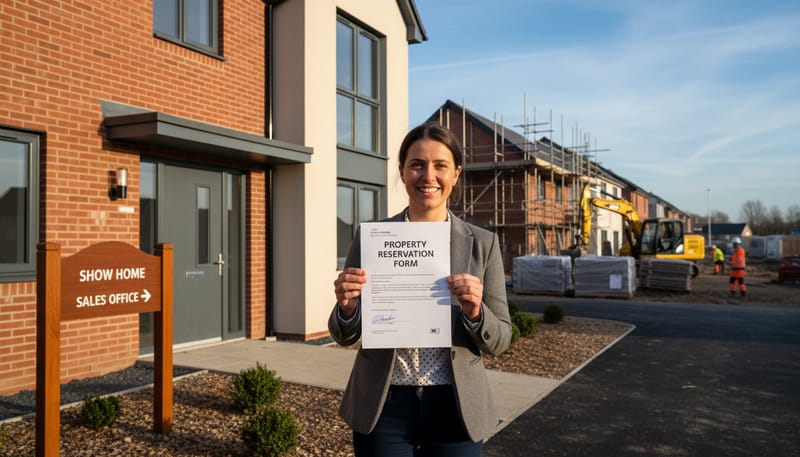
The Reservation Fee: What You've Actually Paid For
The reservation fee — typically £500 to £1,000 on most developments, though some premium builders charge up to £2,000 — does one thing: it takes the plot off the market while you arrange your purchase. It does not commit you legally to buying the property, and it does not count as your exchange deposit (though it's usually deducted from the deposit at exchange).
Is the Reservation Fee Refundable?
This depends entirely on the developer and the reservation agreement you signed. The key scenarios:
- You proceed to exchange within the deadline: The fee is deducted from your deposit — you don't lose anything
- You pull out due to a failed mortgage application: Some developers refund the fee, others don't. Check the reservation agreement carefully — the refund policy should be stated explicitly
- You pull out for personal reasons: Almost always non-refundable
- You miss the exchange deadline: The developer can cancel your reservation and keep the fee. In practice, many developers will extend the deadline if you're progressing (they'd rather sell to you than re-market the plot), but they're not obliged to
- The developer cancels or changes terms: Your fee should be refunded in full. If the developer alters the specification, price, or completion date significantly after reservation, you have grounds to request a full refund
Under the Consumer Code for Home Builders, developers must give you a clear pre-purchase information pack within their reservation terms. If they don't, you may have additional rights to cancel and reclaim your fee.
The 28-Day Timeline: What Happens When
Here's a realistic week-by-week breakdown of what needs to happen between reservation and exchange. Some of these run in parallel — you don't wait for one to finish before starting the next.
Days 1–3: Immediate Actions
- Instruct a solicitor/conveyancer. Don't wait. New build conveyancing takes longer than standard purchases because there are more documents to review (transfer deed, management company details, NHBC/warranty documentation, planning conditions). If you don't have a solicitor lined up, ask your mortgage broker or the developer for recommendations — but choose one with specific new build experience. A general conveyancer unfamiliar with new builds can cause serious delays.
- Submit your full mortgage application. If you have a mortgage agreement in principle (AIP), now convert it to a full application. Your broker will need the plot address, purchase price, and details of any incentives. If you don't have an AIP yet, this is urgent — getting a full mortgage offer within 28 days is tight.
- Confirm your deposit funds. You'll need the exchange deposit (typically 10% of the purchase price minus your reservation fee) available in your solicitor's client account before exchange. If any of this is coming from a gifted deposit, LISA, or savings account with notice periods, start the process now.
Days 3–10: Developer Documentation Arrives
- The developer's solicitor sends the contract pack. This includes the draft contract, title information, property details form, fixtures and fittings list, management company information (for flats/estates with communal areas), and the NHBC or equivalent warranty details.
- Your solicitor reviews and raises enquiries. This is where delays often start. Your solicitor will have questions about the contract terms, the management company structure, ground rent provisions, service charge estimates, completion notice periods, and more. The developer's solicitor responds — sometimes quickly, sometimes not.
- Searches are ordered. Your solicitor orders local authority searches, environmental searches, drainage searches, and any others required by your lender. On new build estates, there may also be mining searches or flood risk assessments depending on location. These take 1–3 weeks depending on the local authority.
Days 10–20: The Mortgage Valuation
- The lender instructs a valuation. Your mortgage lender will send a surveyor to value the property (or for off-plan purchases, conduct a desktop valuation based on plans and comparable sales). This typically takes 5–10 working days from the full application being submitted.
- The valuation report is reviewed. If the surveyor values the property at or above the purchase price, your mortgage offer should follow within a few days. If the valuation comes in below the purchase price (a "down-valuation"), you have a problem — see the section below.
- Mortgage offer issued. Once the lender is satisfied, they issue a formal mortgage offer. This is sent to you and your solicitor. Your solicitor needs this before they can exchange contracts.
Days 20–28: Final Checks and Exchange
- Your solicitor reports to you. They'll send a report summarising the contract terms, any issues they've found, and what you're agreeing to. Read this carefully — it covers things like the completion notice period, the long-stop date, ground rent terms, and service charge estimates.
- You sign the contract and transfer the deposit. Once you're happy with everything, you sign the contract (usually electronically or via post) and transfer the exchange deposit to your solicitor's client account.
- Contracts are exchanged. Your solicitor and the developer's solicitor exchange signed contracts. From this moment, the purchase is legally binding. See our detailed guide to exchange of contracts for what this means.
What If You Can't Exchange in 28 Days?
It happens more often than you'd think. Common reasons include:
- Slow mortgage processing: Lenders can take 3–4 weeks for a full offer, especially if your application is complex (self-employed income, multiple properties, unusual sources of deposit)
- Delayed searches: Some local authorities take 3–4 weeks to return search results. Your solicitor can't exchange without them (unless your lender accepts search insurance, which not all do).
- Outstanding solicitor enquiries: If the developer's solicitor is slow to respond, or your solicitor raises extensive queries, the back-and-forth can eat up the timeline.
- Deposit funds not ready: LISA withdrawals, gifted deposits requiring documentation, or savings in notice accounts can all cause delays.
Can You Get an Extension?
Usually yes, but it's not guaranteed. Here's what works:
- Communicate early. If you can see the deadline approaching and you're not ready, tell the sales advisor and your solicitor immediately. Don't wait until day 27.
- Show progress. Developers are far more likely to extend if you can demonstrate a mortgage offer is imminent, searches are nearly back, or your solicitor is close to finalising. If you haven't even submitted a mortgage application, they may not be sympathetic.
- Get it in writing. Any extension to the reservation deadline should be confirmed in writing (email is fine). Don't rely on verbal assurances.
Most developers will grant a 1–2 week extension if you're clearly making progress. They'd rather complete a sale than restart the marketing process. But if your purchase looks like it's falling apart, they may release the plot and keep your reservation fee.
The Down-Valuation Problem
A down-valuation is when the mortgage surveyor values the property below the agreed purchase price. On new builds, this happens more often than on resale properties because there are fewer direct comparables — particularly on new developments where the first phase is still being built.
If your property is valued at £285,000 but you're paying £300,000, the lender will only lend against £285,000. You'd need to find the extra £15,000 from somewhere, or:
- Ask the developer to reduce the price to match the valuation. This sometimes works, especially late in a phase or on plots that have been hard to sell.
- Challenge the valuation. Your broker can request a re-inspection or appeal, providing evidence of comparable sales that support the higher price.
- Apply to a different lender. Different lenders use different surveyors with different views. A second lender might value the property higher — but this takes time, which is a problem within a 28-day window.
- Walk away. If the valuation is significantly below the price and the developer won't budge, withdrawing may be the right decision. Whether you get your reservation fee back depends on the terms you signed.
Choosing Your Solicitor: Why New Build Experience Matters
New build conveyancing is genuinely different from standard property conveyancing. A solicitor who mainly handles resale purchases may not be familiar with:
- NHBC Buildmark warranties and what they do and don't cover
- Management company structures — freehold vs leasehold vs freehold with estate rentcharge
- Completion notice clauses — how much notice the developer gives you before completion, and what happens if you're not ready
- Long-stop dates — the backstop date by which the developer must complete construction, failing which you can withdraw
- Incentive documentation — how developer incentives need to be declared to the lender
- Snagging provisions — what rights you have to identify and get defects fixed after completion
The developer may recommend a solicitor from their panel. Using them can speed things up (they're already familiar with the development), but they may not scrutinise the contract as thoroughly as a fully independent solicitor. The choice is yours — just make sure whoever you choose has handled new build transactions before.
Choosing Your Extras and Upgrades
Most developers give you a window — often the same 28 days — to choose any optional upgrades: kitchen finishes, bathroom tiles, flooring, electrical socket positions, garden landscaping. These choices are documented in a "customer choices" or "selections" form that becomes part of the contract.
- Make choices early. Some upgrades have long lead times. If you wait until week 3 to choose your kitchen tiles, you might miss the cut-off for your build stage.
- Understand what's included vs extra. The base specification is included in the purchase price. Anything above that is an upgrade — paid for separately or covered by a developer incentive package.
- Get the specification in writing. The exact specification (brand, model, colour of kitchen units, worktops, appliances, bathroom fittings, etc.) should be documented in the contract. If it just says "white kitchen" with no further detail, push for specifics.
If the developer is offering free upgrades as part of an incentive package, make sure the value is itemised and included in the reservation agreement.
The Reservation Agreement Checklist
Before you leave the sales office on reservation day, make sure you have or have confirmed:
- A signed reservation agreement stating the plot number, purchase price, any agreed incentives, reservation fee amount, and the exchange deadline
- The refund policy for the reservation fee — under what circumstances you get it back
- The developer's solicitor details so your solicitor can request the contract pack immediately
- The specification sheet for your plot — what's included as standard
- The anticipated completion date (or completion window if the property is still being built)
- Details of any scheme being used (Shared Ownership, First Homes, Own New Rate) and any scheme-specific paperwork required
- The sales advisor's direct contact details — you'll need to chase progress regularly over the next 28 days
Common Mistakes in the Reservation Period
- Waiting to instruct a solicitor. Every day counts. Instruct one before you leave the sales office if possible. Some buyers wait a week to "think about it" — that's a quarter of your timeline gone.
- Not having a mortgage AIP. Walking into a sales office without an agreement in principle means your 28 days starts with a 2-week mortgage application process. Get your AIP before you start viewing.
- Ignoring the contract report. When your solicitor sends you the contract report, read it. It contains critical information about what you're buying, what obligations you're taking on, and what risks exist. Don't just sign it blindly.
- Assuming the completion date is fixed. On new builds, completion dates frequently move. The contract should include a "completion notice" clause (how much notice the developer gives you) and a "long-stop date" (the absolute latest they can complete). Understand both.
- Not budgeting for exchange costs. You'll need the exchange deposit (usually 10% of purchase price) plus solicitor fees, search fees, and potentially mortgage arrangement fees before exchange. On a £300,000 property, that could be £30,000+ in deposit alone.
What Happens After Exchange?
Once contracts are exchanged, the pressure lifts significantly. You're legally committed, but so is the developer. The next milestone is completion day — when you pay the remaining balance and get the keys.
Between exchange and completion, you may need to:
- Keep your mortgage offer valid (offers typically last 3–6 months)
- Arrange buildings insurance from the exchange date (a lender requirement)
- Monitor construction progress if the property isn't finished yet
- Arrange a snagging inspection close to the completion date
For the full picture of the entire buying journey, see our complete step-by-step guide to the new build buying process.