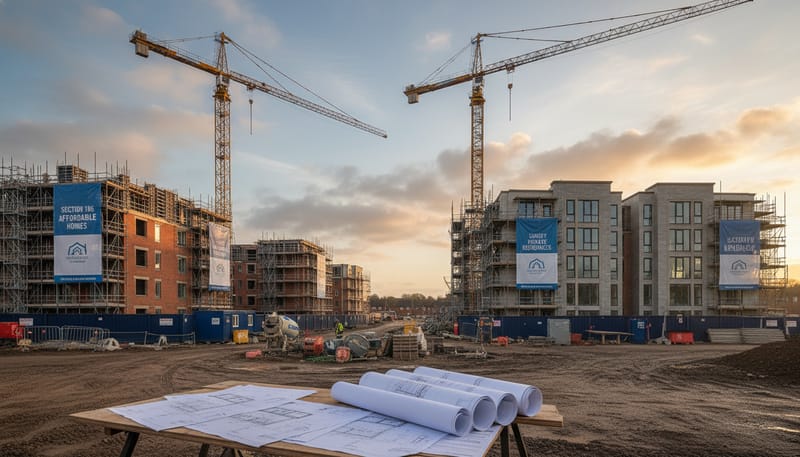
What Is Section 106?
Section 106 of the Town and Country Planning Act 1990 is one of the most consequential pieces of planning legislation in England and Wales. It gives local planning authorities the power to negotiate legally binding agreements with developers as a condition of granting planning permission. These agreements — formally known as “planning obligations” but universally referred to as “Section 106 agreements” or simply “S106” — require developers to deliver certain community benefits alongside their commercial developments. The most significant of these benefits, in terms of both financial value and social impact, is the delivery of affordable housing.
Every major new build housing development in England is shaped by Section 106. When a developer applies for planning permission to build a residential scheme above a certain size threshold (typically 10 or more homes, or sites of 0.5 hectares or more), the local authority will negotiate a Section 106 agreement requiring a proportion of those homes to be delivered as affordable housing. This is not a voluntary contribution — it is a legal obligation that forms part of the planning permission itself, and failure to comply can result in enforcement action.
Section 106 is the single largest source of new affordable housing in England. In 2024–25, approximately 26,000 affordable homes were delivered through S106 obligations, representing around 44% of all new affordable housing completions. These homes span a range of tenures — social rent, affordable rent, shared ownership, First Homes, and intermediate housing — and are allocated to people in housing need through local authority and housing association allocation systems.
Understanding how Section 106 works is essential for anyone interested in accessing affordable new build homes, and equally important for anyone buying on a new build development where some of the homes are affordable tenure. The presence of S106 homes on a development does not affect the quality or value of market-price homes — they are built to the same specifications and are often indistinguishable from their open-market neighbours — but it does shape the character of the community and the allocation of communal spaces and infrastructure.
How Affordable Housing Obligations Work
The process of securing affordable housing through Section 106 begins long before the first brick is laid. It involves multiple stages of negotiation, assessment, and legal documentation that determine how many affordable homes will be built, what tenure they will be, who will manage them, and how they will be allocated.
Policy Basis
Each local authority sets its affordable housing requirements in its Local Plan — the statutory development plan that guides all planning decisions in the area. The Local Plan specifies the percentage of affordable housing required on qualifying sites, the preferred tenure mix (for example, 70% affordable rent and 30% shared ownership), and any site-specific considerations such as thresholds for different site sizes or locations.
The National Planning Policy Framework (NPPF) provides the overarching national policy context, stating that local authorities should require affordable housing contributions on major developments and that at least 25% of affordable homes delivered through Section 106 should be First Homes. However, local authorities have significant discretion in how they implement these requirements, leading to wide variation across the country.
Affordable Housing Percentage Requirements by Council
The percentage of affordable housing that local authorities require on new build sites varies dramatically across England, reflecting differences in housing need, land values, and local political priorities. Understanding the requirement in your area helps you anticipate what proportion of a new development will be affordable tenure and what types of homes might be available.
In London, the Mayor’s London Plan sets a strategic target of 50% affordable housing across all new developments, with a “threshold approach” that fast-tracks planning applications where the developer offers at least 35% affordable (or 50% on public land). Individual London boroughs then set their own policies within this framework, with some (such as Tower Hamlets, Islington, and Southwark) seeking 50% affordable on individual sites.
Outside London, requirements typically range from 20% to 40%. Wealthier southern and eastern authorities with high land values (such as South Cambridgeshire, Oxfordshire districts, and Surrey boroughs) tend to set higher thresholds because stronger market conditions make delivery more viable. Northern and midland authorities often set lower thresholds, reflecting both lower land values and the need to incentivise development in areas with weaker market demand.
Types of Affordable Housing Delivered Through Section 106
Section 106 agreements deliver a mix of affordable housing tenures, each serving different groups and offering different levels of affordability. The specific mix on any given site is determined by the local authority’s policy, the S106 negotiation, and the preferences of the registered provider (housing association) that will take on the homes.
Since June 2021, national planning policy requires that at least 25% of all affordable homes delivered through Section 106 must be First Homes. The remaining 75% is determined by the local authority’s policy, but typically comprises a mix of social rent or affordable rent (for the lowest-income households) and shared ownership (for moderate-income households seeking an ownership route). For detailed guidance on each of these tenure types, see our guides on First Homes and shared ownership versus other schemes.
Viability Assessments: The Controversial Mechanism
Perhaps the most contentious aspect of Section 106 is the viability assessment — a financial appraisal that developers can submit to argue that delivering the full affordable housing requirement would make their scheme economically unviable. If accepted by the local authority, a viability assessment can result in a reduced affordable housing contribution, sometimes significantly so.
The viability assessment process has been heavily criticised by housing charities, campaigners, and the House of Commons Housing, Communities and Local Government Committee. Key criticisms include:
Opacity: Historically, viability assessments were treated as commercially confidential, meaning the public and community groups could not see the financial assumptions underlying decisions that directly affected their neighbourhoods. Reforms in 2018 improved transparency by requiring assessments to be published in most cases, but the technical complexity of the documents means they remain largely impenetrable to non-specialists.
Land value assumptions: The single most contentious input in any viability assessment is the assumed value of the land. Developers typically argue for a “benchmark land value” that reflects the price they paid for the site, which often includes a premium that assumed planning permission without full affordable housing obligations. Critics argue that land should be valued on the basis that it carries the full policy cost of affordable housing — in other words, developers should factor affordable housing costs into the price they pay for land, rather than using viability assessments to reduce obligations after the event.
Developer profit margins: Viability assessments typically assume a developer profit margin of 15–20% of gross development value (GDV). Critics argue this is excessive, particularly for risk-free components of schemes, and that lower margin assumptions would release more value for affordable housing delivery.
Review Mechanisms
To address the concern that developers might game viability assessments, many S106 agreements now include review mechanisms. These require the developer to submit updated viability information at specified trigger points during the development (typically when a certain percentage of homes have been sold). If the scheme proves more profitable than originally projected, the review mechanism can require additional affordable housing contributions — either as additional on-site homes or as a financial contribution towards off-site provision.
How Buyers Access Section 106 Affordable Homes
The route to accessing a Section 106 affordable home depends on the tenure type. Each has a distinct allocation mechanism designed to ensure homes reach those in genuine need.
Social Rent and Affordable Rent
These homes are allocated through your local authority’s housing register (waiting list) and Choice-Based Lettings system. To access them, you must register with the council, be assessed for housing need, and be placed in a priority band. The homes delivered through S106 are typically transferred to a housing association nominated by the council, but allocations are made through the council’s system. This means the same application process described in our guide to local authority housing schemes applies to S106 rental homes.
Shared Ownership
S106 shared ownership homes are marketed and sold by the registered housing association that takes on the units. You can find them through Share to Buy (sharetobuy.com), the national portal for affordable homeownership, or by contacting housing associations directly. You will need to meet the standard shared ownership eligibility criteria: household income under £80,000 (£90,000 in London), first-time buyer or unable to afford on the open market, and able to obtain a mortgage for your share.
First Homes
First Homes delivered through S106 are typically marketed by the developer through their own sales channels. However, the allocation must follow a priority cascade: first priority to local residents who meet the eligibility criteria, then to other eligible first-time buyers. Local authorities may add additional local connection tests and can set lower income caps or higher discounts. Check the planning permission documents for the specific development to understand the First Homes criteria that apply.
Pros and Cons of Section 106 Affordable Housing
Section 106 is a powerful mechanism for delivering affordable housing, but it has significant limitations that affect both the quantity and quality of homes delivered.
The Future of Section 106
Section 106 is likely to undergo significant reform in the coming years. The government’s Planning and Infrastructure Bill, expected to progress through Parliament in 2026, proposes replacing both Section 106 and the Community Infrastructure Levy (CIL) with a new Infrastructure Levy. This single levy would be charged as a percentage of the development value and would be used to fund both infrastructure and affordable housing.
The stated aim of the reform is to simplify the planning obligations process, reduce negotiation time, and capture more land value for public benefit. However, housing charities and affordable housing providers have expressed concerns that a fixed-rate levy might deliver fewer affordable homes than the current negotiated S106 system, particularly on complex or high-cost sites where bespoke agreements currently secure better outcomes.
The transition is likely to be gradual, with Section 106 remaining in operation for several years alongside the new levy as it is phased in. For anyone currently seeking affordable housing on new build developments, Section 106 remains the most important mechanism to understand.
For broader context on how affordable housing is delivered across the UK, explore our guides on local authority housing schemes, Community Land Trusts, and the First Homes scheme. If you are buying a market-price home on a development that includes S106 affordable housing, rest assured that these homes are built to identical quality standards — but if you want to verify that for yourself, our snagging inspection guide covers what to check on any new build.