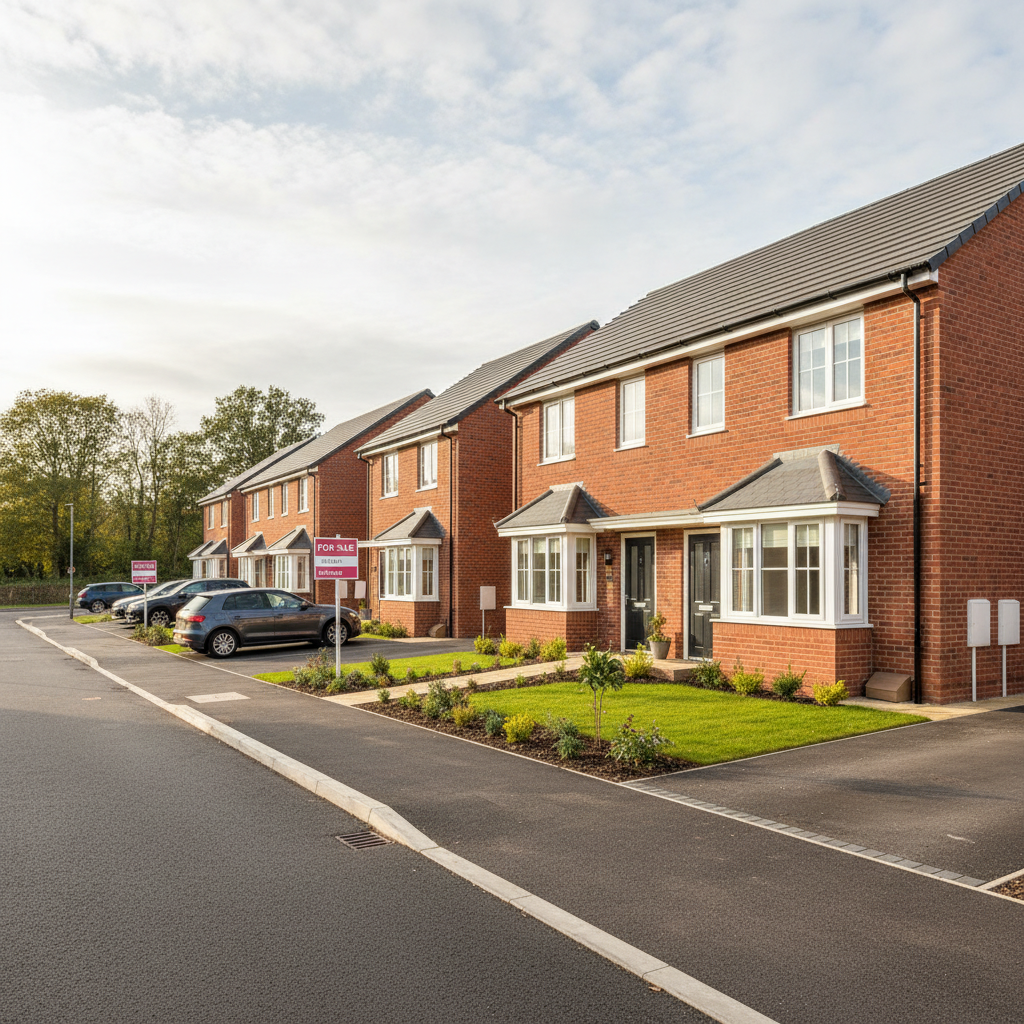
National Overview: What Do New Builds Cost in 2026?
Before drilling into regional data, let us establish the national baseline. According to our analysis of HM Land Registry price paid data for the twelve months to September 2025 (the most recent complete dataset), the average price of a new build property in England and Wales was approximately £368,500. This compares to an average resale property price of approximately £298,700, giving a national new build premium of around 23.4%.
However, averages can be misleading. The national figure is heavily influenced by the mix of properties being built (more flats in London, more houses in the Midlands and North), by regional price differentials, and by the specification of homes (a luxury apartment in Canary Wharf and a starter home in County Durham both count as "new builds" but are barely comparable). To get a meaningful picture, we need to disaggregate the data.
Average New Build Prices by Property Type (National)
| Property Type | Average New Build Price (2025/26) | Average New Build Price (2024/25) | Annual Change | Share of New Build Sales |
|---|---|---|---|---|
| Detached | £498,200 | £481,600 | +3.4% | 28% |
| Semi-detached | £332,100 | £319,800 | +3.8% | 22% |
| Terraced | £298,400 | £288,600 | +3.4% | 18% |
| Flat/Maisonette | £287,600 | £280,200 | +2.6% | 32% |
Flats account for the largest single share of new build transactions (32%), driven primarily by London and other major city centres where apartment-led development dominates. Detached houses, while the most expensive, make up a significant 28% share — reflecting the large volume of family home development across the Midlands, South West, and northern regions. Price growth has been relatively uniform across types, though flats have lagged slightly — a pattern consistent with lingering effects of the building safety crisis, which has disproportionately affected apartment blocks.
Regional Price Breakdown: Every Region in Detail
The UK housing market is fundamentally regional. A new build that costs £230,000 in Sunderland could cost £550,000 for the equivalent specification in outer London. Understanding regional pricing is therefore essential. The following sections provide detailed breakdowns for each region.
London
| Property Type | Average New Build Price | Average Resale Price | Premium |
|---|---|---|---|
| Detached | £1,124,000 | £978,000 | 14.9% |
| Semi-detached | £682,000 | £598,000 | 14.0% |
| Terraced | £586,000 | £524,000 | 11.8% |
| Flat/Maisonette | £468,000 | £452,000 | 3.5% |
| All types | £548,200 | £523,600 | 4.7% |
London is unique in having the lowest new build premium of any region, particularly for flats (just 3.5%). This is because the capital has experienced a sustained oversupply of new build apartments — particularly in areas like Nine Elms, the Isle of Dogs, Stratford, and Barking Riverside — where thousands of units have come to market simultaneously. Developers have had to price competitively, and many offer substantial incentive packages (furniture, stamp duty contributions, ground rent holidays) to attract buyers. For a flat buyer in London, a new build can actually represent reasonable value compared to the existing stock — particularly when energy efficiency, warranty protection, and the absence of cladding concerns are factored in.
New build houses in London carry a more significant premium (11-15%), but the absolute numbers mean these are luxury purchases — the average new build detached house in London costs over £1.1 million.
South East
| Property Type | Average New Build Price | Average Resale Price | Premium |
|---|---|---|---|
| Detached | £618,000 | £524,000 | 17.9% |
| Semi-detached | £412,000 | £348,000 | 18.4% |
| Terraced | £368,000 | £298,000 | 23.5% |
| Flat/Maisonette | £318,000 | £248,000 | 28.2% |
| All types | £438,700 | £362,400 | 21.1% |
The South East carries a moderate premium overall, but with significant variation between houses and flats. New build flats carry a notably higher premium (28.2%), partly reflecting the higher specifications of purpose-built new blocks compared to older converted flats that make up a significant proportion of the existing stock. Locations such as Reading, Milton Keynes, Basingstoke, and Crawley — all with strong transport links to London — are particularly active for new build development and offer relatively better value than more rural South East locations.
South West
| Property Type | Average New Build Price | Average Resale Price | Premium |
|---|---|---|---|
| Detached | £512,000 | £428,000 | 19.6% |
| Semi-detached | £348,000 | £286,000 | 21.7% |
| Terraced | £318,000 | £262,000 | 21.4% |
| Flat/Maisonette | £268,000 | £208,000 | 28.8% |
| All types | £385,400 | £318,200 | 21.1% |
The South West has seen robust new build price growth of 3.6% year-on-year, supported by continued migration from London and the South East (the "race for space" effect, which has persisted even as hybrid working patterns stabilise). Bristol, Bath, Exeter, and the M4/M5 corridor are hotspots for development. Planning constraints in areas of outstanding natural beauty (AONB) and the national parks (Dartmoor, Exmoor, Cotswolds) limit supply and support premium pricing in those locations.
East of England
| Property Type | Average New Build Price | Average Resale Price | Premium |
|---|---|---|---|
| Detached | £568,000 | £476,000 | 19.3% |
| Semi-detached | £386,000 | £318,000 | 21.4% |
| Terraced | £342,000 | £278,000 | 23.0% |
| Flat/Maisonette | £284,000 | £218,000 | 30.3% |
| All types | £412,300 | £342,100 | 20.5% |
The East of England has been one of the most active regions for new build development over the past decade, with major developments in Cambridgeshire, Hertfordshire, Essex, and Norfolk. Towns like Ely, St Neots, Chelmsford, and Colchester have seen substantial growth in new housing estates. The region's proximity to London, combined with relatively more affordable pricing, continues to attract both developers and buyers.
East Midlands
| Property Type | Average New Build Price | Average Resale Price | Premium |
|---|---|---|---|
| Detached | £398,000 | £318,000 | 25.2% |
| Semi-detached | £268,000 | £212,000 | 26.4% |
| Terraced | £232,000 | £178,000 | 30.3% |
| Flat/Maisonette | £198,000 | £142,000 | 39.4% |
| All types | £298,600 | £236,400 | 26.3% |
The East Midlands combines relatively affordable pricing with strong price growth (+4.1% year-on-year). Leicester, Nottingham, Derby, and Northampton are all major centres for new build development. The region has benefited from significant infrastructure investment (including HS2-related development around Toton and East Midlands Airport) and a strong logistics and distribution sector that supports employment growth and housing demand.
West Midlands
| Property Type | Average New Build Price | Average Resale Price | Premium |
|---|---|---|---|
| Detached | £428,000 | £342,000 | 25.1% |
| Semi-detached | £282,000 | £224,000 | 25.9% |
| Terraced | £242,000 | £186,000 | 30.1% |
| Flat/Maisonette | £212,000 | £148,000 | 43.2% |
| All types | £312,400 | £248,700 | 25.6% |
Birmingham, Britain's second city, has been undergoing a significant transformation and is the focus of major new build development — particularly in the city centre (apartments) and outer suburbs (family housing). The legacy of the 2022 Commonwealth Games, ongoing transport improvements (including the Midland Metro extension), and the city's growing reputation as a technology and professional services hub are all supporting demand. Solihull, Coventry, and Wolverhampton also have active new build markets.
North West
| Property Type | Average New Build Price | Average Resale Price | Premium |
|---|---|---|---|
| Detached | £382,000 | £298,000 | 28.2% |
| Semi-detached | £252,000 | £194,000 | 29.9% |
| Terraced | £218,000 | £158,000 | 38.0% |
| Flat/Maisonette | £198,000 | £138,000 | 43.5% |
| All types | £278,500 | £212,300 | 31.2% |
The North West — and Manchester in particular — has been one of the UK's most dynamic property markets. Manchester's city centre has seen extraordinary apartment development, while the wider Greater Manchester conurbation (including Salford, Trafford, Stockport, and Bolton) has extensive family housing development. Liverpool's waterfront and city centre regeneration continues, and Cheshire offers premium new build opportunities. The region recorded the second-highest price growth nationally (+4.6%).
Yorkshire and the Humber
| Property Type | Average New Build Price | Average Resale Price | Premium |
|---|---|---|---|
| Detached | £368,000 | £286,000 | 28.7% |
| Semi-detached | £238,000 | £182,000 | 30.8% |
| Terraced | £208,000 | £148,000 | 40.5% |
| Flat/Maisonette | £178,000 | £124,000 | 43.5% |
| All types | £264,800 | £204,600 | 29.4% |
Leeds, Sheffield, York, and Hull are all centres of significant new build activity. Leeds in particular has emerged as a major destination for both residential and build-to-rent development, driven by its growing financial services and digital sectors. Sheffield offers some of the best value new builds in the country — a new build semi-detached can be found for under £240,000 in many locations. York, by contrast, commands premium pricing due to its historic appeal and constrained supply.
North East
| Property Type | Average New Build Price | Average Resale Price | Premium |
|---|---|---|---|
| Detached | £328,000 | £236,000 | 39.0% |
| Semi-detached | £212,000 | £148,000 | 43.2% |
| Terraced | £178,000 | £112,000 | 58.9% |
| Flat/Maisonette | £152,000 | £96,000 | 58.3% |
| All types | £228,400 | £162,800 | 40.3% |
The North East has the highest percentage premium but the lowest absolute prices in the country. The very high percentage premiums for terraced houses and flats (approaching 60%) reflect the extremely low base prices of existing stock in areas like Sunderland, Hartlepool, and parts of County Durham, rather than excessive new build pricing. In absolute terms, the average new build premium in the North East is approximately £65,600 — the lowest of any region. For first-time buyers, the region offers remarkable accessibility: a new build semi-detached house at £212,000 with a 5% deposit requires a deposit of just £10,600.
For the strongest price growth in the country (+5.1% year-on-year), the North East combines affordability with momentum, making it an increasingly attractive proposition for both owner-occupiers and investors.
Scotland and Wales
| Region | Average New Build Price | Average Resale Price | Premium | YoY Growth |
|---|---|---|---|---|
| Scotland | £254,200 | £192,500 | 32.1% | +3.4% |
| Wales | £262,800 | £208,400 | 26.1% | +3.9% |
Scotland's new build market is concentrated around Edinburgh, Glasgow, and Aberdeen, with Edinburgh commanding the highest prices (average new build around £340,000). Scotland benefits from its own Land and Buildings Transaction Tax (LBTT) regime, which is structured somewhat differently from English stamp duty. Wales has also introduced its own Land Transaction Tax (LTT). Both nations have different Help to Buy schemes and shared equity arrangements that affect new build affordability.
Price Per Square Foot: The Most Honest Comparison
Raw price data only tells you part of the story. A £350,000 new build that offers 1,200 sq ft of living space is fundamentally different from a £350,000 new build that offers 850 sq ft. Price per square foot (psf) is the most honest way to compare properties — both new builds against each other and new builds against resales.
Average New Build Price Per Square Foot by Region
| Region | Avg. New Build £/sq ft | Avg. Resale £/sq ft | Premium (psf basis) |
|---|---|---|---|
| London | £648 | £562 | 15.3% |
| South East | £412 | £348 | 18.4% |
| South West | £362 | £298 | 21.5% |
| East of England | £388 | £318 | 22.0% |
| East Midlands | £268 | £212 | 26.4% |
| West Midlands | £282 | £224 | 25.9% |
| North West | £258 | £196 | 31.6% |
| Yorkshire & Humber | £242 | £186 | 30.1% |
| North East | £218 | £152 | 43.4% |
| Scotland | £236 | £178 | 32.6% |
| Wales | £242 | £188 | 28.7% |
The price per square foot analysis reveals some interesting nuances. London's new build premium on a psf basis (15.3%) is significantly higher than on a headline price basis (4.7%), because new build flats in London tend to be smaller than the existing stock (modern one-bed apartments are typically 450-550 sq ft, compared to 550-700+ sq ft for older converted flats). This means that while the total price may be similar, you are getting less space per pound in a new build. This is an important consideration for London buyers in particular.
Conversely, in regions where new builds are primarily houses (the Midlands and North), the psf premium is broadly similar to the headline premium, because new build houses tend to be comparable in size to — or sometimes larger than — their resale equivalents.
How to Calculate and Compare Price Per Square Foot
To compare properties on a like-for-like basis:
- Get the internal floor area of the new build from the developer's specification sheet or the Energy Performance Certificate (EPC), which always states the total internal floor area in square metres. Convert to square feet by multiplying by 10.764.
- Divide the asking price by the floor area to get the price per square foot. For example: £350,000 / 1,100 sq ft = £318 per sq ft.
- Repeat for comparable resale properties in the same area. Use Land Registry data (available free at gov.uk) for recent sale prices, and EPC data (also free) for floor areas.
- Compare the psf figures. A new build premium of 15-25% on a psf basis is generally considered normal and justifiable (see the section below on what the premium pays for). A premium above 30% may warrant further scrutiny.
The New Build Premium Explained: What Are You Actually Paying For?
The premium that new builds command over resale properties is often criticised, but it is important to understand what it reflects. Not all of the premium is profit margin for the developer — much of it represents genuine value that a new build offers over an older property:
Tangible Value Components
- Energy efficiency: New builds are typically rated EPC A or B, compared to EPC D or E for the average existing home. This translates to significantly lower energy bills — our analysis suggests savings of approximately £800-1,200 per year for a typical three-bedroom house, depending on the specification and energy prices. Over a 10-year ownership period, this alone could be worth £8,000-12,000. See our guide on new build energy efficiency and EPC ratings for more detail.
- NHBC warranty (or equivalent): New builds come with a 10-year structural warranty (typically NHBC Buildmark) plus a 2-year defects period during which the developer is responsible for remedying any issues. This provides valuable protection against structural defects that would be an uninsured risk on a resale property.
- Modern building regulations: New homes are built to current Building Regulations, which cover structural integrity, fire safety, accessibility, sound insulation, ventilation, and thermal performance. These standards are significantly more stringent than those that applied when most of the existing housing stock was built.
- Lower maintenance costs: A new home requires minimal maintenance in its early years. No roof repairs, no boiler replacements, no rewiring, no replumbing. The Homeowners Alliance estimates that the average older home requires approximately £2,000-3,500 per year in maintenance and repair costs — a figure that is near zero for a new build in its first 5-10 years.
- Fixtures and fittings: Most new builds include a fitted kitchen, bathroom suites, built-in wardrobes, turf to gardens, and often appliances. In many cases, developers also offer optional upgrades or furniture packages as incentives. Fitting out a resale property to a comparable standard could easily cost £15,000-30,000.
- No chain: Buying a new build means buying from a developer with no onward chain. This significantly reduces the risk of the transaction collapsing and speeds up the process. The value of certainty should not be underestimated.
Intangible and Structural Components
- Developer profit margin: Major housebuilders typically target gross margins of 20-25% on each home. This is the component of the premium that most directly reflects the developer's commercial return. It is worth noting that this margin is before the cost of land, planning, infrastructure, and sales/marketing — the developer's net margin is typically much lower (around 10-15% pre-tax).
- Section 106 and CIL contributions: Developers are required to make contributions to local infrastructure and affordable housing provision through Section 106 agreements and the Community Infrastructure Levy (CIL). These costs are ultimately passed through to the buyer as part of the purchase price, but they fund genuine community benefits such as schools, roads, parks, and affordable homes.
- Marketing and sales costs: The cost of show homes, sales centres, marketing materials, and sales staff is typically 3-5% of the selling price. This is another component that is embedded in the price but does not directly benefit the buyer.
Is the Premium Worth It?
Our analysis suggests that the tangible value components (energy savings, warranty, lower maintenance, fixtures) account for approximately £30,000-50,000 of value over a 10-year ownership period for a typical family home. This means that a new build premium of up to approximately 15-20% can be largely justified by quantifiable benefits alone. Premiums above this level include a greater proportion of developer margin and marketing costs.
However, value is ultimately subjective. If you value the certainty of a new home, the absence of maintenance worries, and modern energy efficiency, the premium may be well worth paying. If you prioritise character, location (the best plots are often already built on), and maximising space per pound, a resale property may be the better choice. For a comprehensive comparison, see our article on the true cost of buying a new build home.
How to Research Fair Value: A Step-by-Step Guide
Whether you are buying a new build or any other property, researching fair value is essential. Here is a systematic approach using freely available data:
Step 1: Check Land Registry Price Paid Data
The HM Land Registry publishes data on every residential property transaction in England and Wales, typically within 2-3 months of completion. You can search this data free of charge at gov.uk/search-house-prices. Look for:
- Recent sales of new builds on the same development — this tells you what other buyers have actually paid (as opposed to the developer's asking price, which may be higher).
- Recent sales of comparable resale properties in the same postcode area — this allows you to calculate the premium you are being asked to pay.
- Trends over time — are prices on the development rising, falling, or stable? If several units have sold at progressively lower prices, it may indicate that the developer is discounting to move stock.
Step 2: Analyse EPC Data for Floor Areas
Every property that has been sold or let in England and Wales has an Energy Performance Certificate, which includes the total internal floor area in square metres. You can search EPC data free at epc.opendatacommunities.org. This allows you to calculate price per square foot for both new builds and resales, enabling a like-for-like comparison.
Step 3: Check What the Developer Paid for the Land
Land Registry also records the price paid for land. While this can be more difficult to find (as land is often purchased through company transactions), it can sometimes reveal the land cost per plot — and therefore the proportion of the selling price that represents land value versus build cost and margin.
Step 4: Request the Developer's Price List and Specification
Developers are generally willing to provide a full price list for all plots on a development, along with detailed specifications. This allows you to compare prices across different house types and positions on the site. Corner plots, plots backing onto open space, and plots away from main roads typically command premiums of 2-5%.
Step 5: Factor in Incentives
Developer incentives can significantly reduce the effective purchase price. Common incentives include:
- Stamp duty contribution: Typically £5,000-15,000 towards your stamp duty bill.
- Deposit contribution: Up to 5% of the purchase price in some cases.
- Mortgage rate buy-down: The developer pays a lump sum to the lender to reduce your interest rate for a fixed period (typically 2-3 years).
- Furniture package: Typically worth £5,000-15,000, covering curtains, blinds, white goods, and sometimes fitted furniture.
- Flooring upgrade: Free carpet and/or engineered wood flooring throughout.
- Part exchange: The developer purchases your existing home, typically at 90-95% of independently assessed market value.
When comparing a new build price to a resale, always account for the net value of incentives. A new build priced at £350,000 with a £10,000 stamp duty contribution and a £8,000 furniture package has an effective net cost of around £332,000 — which may compare very favourably to a resale at £310,000 that requires £20,000+ of work. For detailed strategies on maximising incentives, see our guide on how to avoid overpaying for a new build home.
Step 6: Get an Independent Valuation
If you are taking a mortgage, the lender will commission an independent valuation of the property. This is your most important safeguard against overpaying. If the valuer assesses the property at less than the agreed purchase price (a "down-valuation"), it indicates that the price may be above market value. In this situation, you have several options:
- Negotiate a price reduction with the developer.
- Increase your deposit to cover the shortfall.
- Appeal the valuation (if you have evidence of comparable sales at higher prices).
- Walk away from the transaction (though you may lose your reservation fee, typically £500-1,000).
Down-valuations on new builds have become somewhat more common during 2024-2025 as valuers have taken a more cautious approach following the market correction. If you experience a down-valuation, do not panic — it is a negotiating opportunity, not a disaster.
Five-Year Price Trends: How Have New Build Prices Changed?
Understanding historical trends helps contextualise current pricing. The following table shows the trajectory of average new build prices by region over the past five years:
| Region | 2021 | 2022 | 2023 | 2024 | 2025/26 | 5-Year Change |
|---|---|---|---|---|---|---|
| London | £518,000 | £558,000 | £536,000 | £540,600 | £548,200 | +5.8% |
| South East | £398,000 | £438,000 | £418,000 | £426,700 | £438,700 | +10.2% |
| South West | £338,000 | £382,000 | £368,000 | £372,000 | £385,400 | +14.0% |
| East of England | £376,000 | £412,000 | £398,000 | £402,400 | £412,300 | +9.7% |
| East Midlands | £256,000 | £292,000 | £278,000 | £286,800 | £298,600 | +16.6% |
| West Midlands | £268,000 | £306,000 | £294,000 | £300,800 | £312,400 | +16.6% |
| North West | £232,000 | £268,000 | £258,000 | £266,200 | £278,500 | +20.0% |
| Yorkshire | £222,000 | £256,000 | £246,000 | £254,100 | £264,800 | +19.3% |
| North East | £188,000 | £218,000 | £212,000 | £217,300 | £228,400 | +21.5% |
| Scotland | £216,000 | £246,000 | £238,000 | £245,800 | £254,200 | +17.7% |
| Wales | £222,000 | £258,000 | £248,000 | £252,800 | £262,800 | +18.4% |
The five-year trends confirm the North-South divergence that has characterised the market since 2022. London new builds have appreciated by just 5.8% over five years — barely above inflation — while the North East has seen 21.5% growth. The North West (+20.0%), Yorkshire (+19.3%), and Wales (+18.4%) have also significantly outperformed. This pattern is likely to continue in the medium term, as northern regions benefit from stronger affordability dynamics and continued investment.
Most and Least Affordable Areas for New Builds
Affordability is best measured not by absolute price but by the ratio of house prices to local earnings. Using ONS earnings data and our new build price analysis, we can identify the most and least affordable areas for new build purchases:
Most Affordable Areas (Lowest Price-to-Earnings Ratio)
| Rank | Area | Avg. New Build Price | Median Earnings | Price/Earnings Ratio |
|---|---|---|---|---|
| 1 | County Durham | £196,000 | £29,200 | 6.7x |
| 2 | Hartlepool | £198,000 | £28,800 | 6.9x |
| 3 | Sunderland | £204,000 | £29,600 | 6.9x |
| 4 | Burnley | £192,000 | £27,400 | 7.0x |
| 5 | Stoke-on-Trent | £208,000 | £29,200 | 7.1x |
Least Affordable Areas (Highest Price-to-Earnings Ratio)
| Rank | Area | Avg. New Build Price | Median Earnings | Price/Earnings Ratio |
|---|---|---|---|---|
| 1 | Kensington & Chelsea | £1,680,000 | £42,800 | 39.3x |
| 2 | Westminster | £1,420,000 | £43,600 | 32.6x |
| 3 | Camden | £892,000 | £41,200 | 21.7x |
| 4 | Bath & NE Somerset | £518,000 | £33,400 | 15.5x |
| 5 | Oxford | £512,000 | £34,200 | 15.0x |
The affordability gap between the most and least affordable areas is staggering — a price-to-earnings ratio of 6.7x in County Durham versus 39.3x in Kensington & Chelsea. Even excluding the extreme prime London boroughs, the gap between places like Bath (15.5x) and Burnley (7.0x) illustrates the vastly different challenges facing buyers in different parts of the country.
For first-time buyers, areas with price-to-earnings ratios below 8x are generally considered more accessible, particularly with mortgage multiples of 4.5x available. This broadly encompasses much of the North East, parts of Yorkshire, the North West (outside Manchester), and parts of the East Midlands.
Conclusion: Making Informed Pricing Decisions
New build pricing in 2026 is nuanced, regional, and depends heavily on property type and specification. The key takeaways from this analysis are:
- The national average new build premium of 23.4% is broadly justifiable when tangible benefits (energy efficiency, warranty, lower maintenance, fixtures) are quantified — but premiums above 30% warrant careful scrutiny, particularly on a price-per-square-foot basis.
- Regional variations are enormous. London new builds offer the smallest premium (and arguably the best relative value for flats), while northern regions have the highest percentage premiums but the lowest absolute prices and best affordability.
- Always compare on a price-per-square-foot basis rather than headline price alone. This is the fairest way to assess whether you are getting value for money.
- Factor in incentives. Developer incentives can reduce the effective cost by £10,000-30,000 and should always be negotiated and included in your value assessment.
- Use free data sources (Land Registry, EPC database) to research comparable sales and floor areas before making an offer.
- The independent mortgage valuation is your safety net. If the valuer assesses the property below the asking price, it is a signal that the price may be above market value — use this as a negotiating tool.
For more guidance on the buying process, explore our comprehensive guides on the true cost of buying a new build, avoiding overpaying, and negotiating the best deal. And for the latest market data, see our Winter 2026 Market Report.