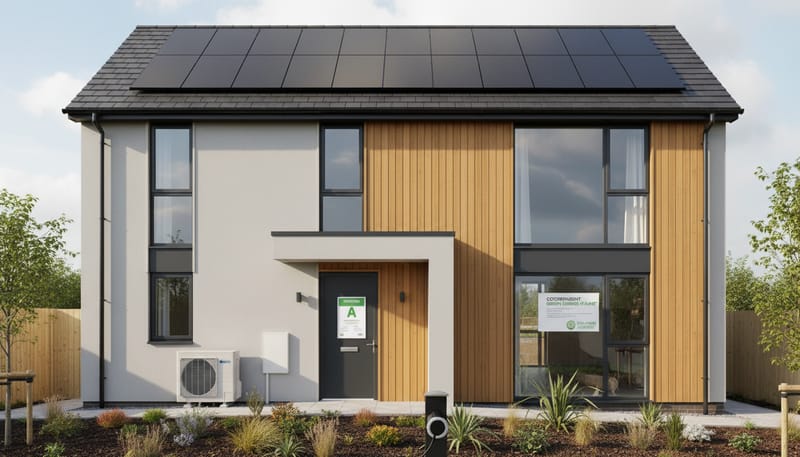
The Energy Efficiency Landscape for New Build Homes in 2026
Energy efficiency has become one of the most important considerations for anyone buying a new build home in the UK. With energy prices remaining significantly higher than pre-2022 levels, building regulations evolving rapidly, and government grants available to support low-carbon technology adoption, understanding the energy efficiency landscape is essential for making informed purchasing decisions and maximising the financial benefits available to you.
New build homes in the UK are already substantially more energy-efficient than the existing housing stock. The average new build achieves an Energy Performance Certificate (EPC) rating of B, compared to a D for the typical existing home. This means new build residents enjoy significantly lower energy bills — typically 50–60% less than occupants of older properties of equivalent size. However, the regulatory framework is evolving to push new builds even further towards net zero carbon performance, and several government grant schemes can help buyers and homeowners enhance their home’s energy credentials beyond the baseline standards.
This guide covers every relevant government energy efficiency grant currently available to new build homeowners, explains which grants apply specifically to new builds versus existing homes, explores the transformative impact of the Future Homes Standard, and provides practical guidance on how to access financial support for heat pumps, solar panels, and other low-carbon technologies.
Current Government Energy Efficiency Grants
The UK government operates several energy efficiency grant schemes, each with different eligibility criteria, technology coverage, and application processes. It is important to understand that most of these schemes were designed primarily for the existing housing stock (retrofitting older, less efficient homes), and their applicability to new builds is often limited or indirect. However, some grants are relevant to new build homeowners, particularly those looking to add renewable energy systems beyond the baseline specification.
Boiler Upgrade Scheme (BUS)
The Boiler Upgrade Scheme, launched in April 2022 and extended to March 2028, provides upfront grants to help homeowners in England and Wales replace fossil fuel heating systems with low-carbon heat pumps. The scheme covers air source heat pumps, ground source heat pumps, and biomass boilers in certain rural off-gas-grid situations.
Relevance to new builds: The BUS grant is primarily designed for homes replacing an existing fossil fuel heating system. New build homes that are constructed with a heat pump from the outset (which will become mandatory under the Future Homes Standard) are not eligible for BUS because there is no existing system being replaced. However, if you purchase a new build that was built with a gas boiler under previous regulations and later wish to switch to a heat pump, you may be eligible at that point. The key criterion is that the property must have an existing heating system that is being replaced, and it must have an EPC with no outstanding recommendations for loft or cavity wall insulation (these are typically met by default on new builds).
ECO4 (Energy Company Obligation 4)
ECO4 is a government-mandated scheme requiring large energy suppliers (British Gas, EDF, E.ON, OVO, Octopus, and Scottish Power) to fund energy efficiency improvements in homes occupied by people on low incomes or receiving certain benefits. Running from April 2022 to March 2026, ECO4 provides measures including insulation (loft, cavity wall, solid wall, underfloor), heating system upgrades, and smart heating controls.
Relevance to new builds: ECO4 is focused almost entirely on the existing housing stock, targeting homes with low EPC ratings (D, E, F, or G). New builds, which typically achieve EPC B or better, do not qualify for ECO4 measures. The scheme is not relevant for new build homeowners except in the extremely unlikely scenario of a new build receiving an unusually poor EPC rating due to construction defects.
Great British Insulation Scheme (GBIS)
Launched in 2023 as a successor to the ECO+ scheme, the Great British Insulation Scheme targets homes in council tax bands A to D in England (or equivalents in Scotland and Wales) that have inadequate insulation. The scheme provides free or heavily subsidised cavity wall insulation, loft insulation, room-in-roof insulation, and solid wall insulation.
Relevance to new builds: Like ECO4, GBIS is designed for existing homes with poor insulation. New build homes are constructed with insulation levels that meet or exceed current building regulations, which far surpass the thresholds targeted by GBIS. This scheme is not applicable to new build homeowners.
Solar Panel Incentives and Smart Export Guarantee
Solar photovoltaic (PV) panels are increasingly common on new build homes, driven by both building regulations and buyer demand. While the generous Feed-in Tariff (FiT) scheme closed to new applicants in March 2019, its successor — the Smart Export Guarantee (SEG) — provides a route for new build homeowners with solar panels to earn money from surplus electricity exported to the grid.
How the Smart Export Guarantee Works
The SEG requires all electricity suppliers with more than 150,000 customers to offer a tariff that pays small-scale generators (including homeowners with solar panels) for electricity they export to the grid. The rate is set by each supplier and varies significantly, but typical SEG tariffs in 2026 range from 4p to 15p per kilowatt hour (kWh), depending on the supplier and the tariff type (fixed, variable, or time-of-use).
For a typical new build with a 3.5–4 kWp solar PV system, this translates to annual SEG income of approximately £100 to £300, in addition to the savings from using the electricity generated directly (which can reduce annual electricity bills by £400 to £700 depending on consumption patterns and system size). The combination of self-consumption savings and SEG income means a solar PV system on a new build can deliver total annual financial benefits of £500 to £1,000.
VAT Relief on Energy-Saving Materials
Since April 2022, the VAT rate on energy-saving materials installed in residential properties has been reduced to 0% (from the previous 5%). This applies to solar panels, heat pumps, insulation, battery storage systems, EV charging points, and other energy-saving measures. For new build homeowners adding solar panels or battery storage systems after purchase, this VAT relief provides a meaningful cost reduction. A £6,000 solar PV installation that previously attracted £300 VAT now incurs zero VAT — a direct saving that improves the payback period.
This 0% VAT rate applies across the UK and is currently scheduled to remain in place until March 2027, though it may be extended. It applies to both the materials and the installation labour costs for qualifying energy-saving measures.
The Future Homes Standard: Transforming New Build Energy Performance
The most significant development in new build energy efficiency is the Future Homes Standard (FHS), which came into force in 2025 and represents the most dramatic change to building regulations energy requirements in over a decade. The FHS requires that all new homes built from 2025 onwards produce 75–80% fewer carbon emissions than homes built to the previous 2013 building regulations standard.
Key Requirements of the Future Homes Standard
The FHS introduces several major changes to Part L (Conservation of Fuel and Power) and Part F (Ventilation) of the Building Regulations:
No new gas boilers: The FHS effectively bans gas boilers in new homes. All new builds must use low-carbon heating systems, primarily air source heat pumps, though ground source heat pumps, heat networks, and electric heating systems are also permitted. This is the single most impactful change, as gas boilers have been the standard heating system in UK new builds for decades.
Enhanced fabric standards: The FHS requires significantly improved thermal insulation and airtightness, reducing heat loss through walls, floors, roofs, windows, and doors. U-values (the measure of heat loss through building elements) are tightened across all building components, and airtightness requirements are substantially increased compared to previous regulations.
Improved ventilation: To complement the enhanced airtightness, the FHS introduces stricter ventilation requirements. Many new builds will feature Mechanical Ventilation with Heat Recovery (MVHR) systems, which extract stale air and recover its heat to warm incoming fresh air. MVHR systems can recover up to 90% of the heat from extracted air, dramatically reducing the energy needed for heating.
Solar PV as standard: While not technically mandated by the FHS alone, the carbon reduction targets are so stringent that most developers include solar PV as standard to meet the required performance levels. This means most new builds completed from 2026 onwards will come with solar panels pre-installed.
EPC Ratings and SAP Calculations for New Builds
Every new build home in the UK must have an Energy Performance Certificate (EPC) produced before it can be sold or let. The EPC rates the home’s energy efficiency on a scale from A (most efficient) to G (least efficient) and is based on the Standard Assessment Procedure (SAP) — the government’s methodology for calculating the energy and environmental performance of dwellings.
SAP calculations take into account the home’s construction materials, insulation levels, heating system type and efficiency, ventilation approach, solar gains, lighting, and any renewable energy generation (such as solar PV). The result is expressed as a SAP score between 1 and 100+ (scores above 100 are possible for homes that generate more energy than they consume).
For new build buyers, the EPC and SAP score provide a reliable indicator of the home’s energy running costs and environmental performance. When comparing new build developments, always ask for the predicted SAP score and EPC rating for the specific house type you are considering. Developments built to the Future Homes Standard should achieve EPC A ratings with SAP scores of 92 or above. For guidance on what to check when viewing new build homes, see our snagging and quality guide.
New Builds vs Retrofitting: Energy Efficiency Compared
One of the strongest arguments for buying a new build rather than an existing home is the significantly better energy performance. But how do the numbers actually compare? Here is a detailed comparison of energy costs and carbon emissions between new builds and typical existing homes.
A three-bedroom new build completed to the Future Homes Standard typically costs £500 to £800 per year to heat and power. An equivalent 1990s-era home, even one that has been partially upgraded with modern insulation and a condensing boiler, typically costs £1,200 to £1,800. A pre-1930s solid-walled property without significant retrofitting can cost £2,000 to £3,000 or more. These figures are based on energy prices at the Ofgem price cap level effective from January 2026.
The energy cost savings of a new build over an older property therefore amount to £700 to £2,200 per year for a typical three-bedroom home. Over a 25-year mortgage term, this translates to total savings of £17,500 to £55,000 — a sum that can significantly offset any price premium associated with buying new. This comparison is a powerful tool when deciding between new and existing homes, and is worth discussing with your mortgage broker when assessing affordability.
Retrofitting an older home to achieve equivalent energy performance to a new build is technically possible but extremely expensive. Deep retrofitting — involving external or internal wall insulation, floor insulation, triple glazing, MVHR, and a heat pump — typically costs £30,000 to £60,000 for a semi-detached house and £50,000 to £100,000 for a detached property. Government grants (BUS, ECO4, GBIS) cover only a fraction of these costs and are subject to eligibility restrictions. For most homebuyers, purchasing a well-specified new build is a far more cost-effective route to energy-efficient living than buying and retrofitting an older property.
Regional Energy Efficiency Schemes: Scotland, Wales, and Northern Ireland
Each devolved nation operates its own energy efficiency programmes alongside the UK-wide schemes, reflecting their different housing stocks, fuel mixes, and policy priorities.
Scotland
Home Energy Scotland (HES) is the Scottish Government’s one-stop advisory service for energy efficiency. HES provides free, impartial advice on energy saving, renewable energy, and available funding. Critically, HES also administers interest-free loans of up to £7,500 for energy efficiency measures and renewable energy installations, including heat pumps, solar PV, battery storage, and insulation. These loans are available to owner-occupiers of all property types, including new builds, making Scotland the most generous devolved nation in terms of support for new build homeowners adding renewable energy systems.
Scotland also operates the Warmer Homes Scotland scheme, which provides free energy efficiency measures (insulation, heating, draught-proofing) to qualifying households on low incomes. This scheme is not relevant to new builds but serves as a safety net for residents of the existing housing stock.
Scotland’s building regulations have their own equivalent of the Future Homes Standard, with the New Build Heat Standard requiring all new homes from 2024 to use zero direct emissions heating systems. This makes Scotland slightly ahead of England in phasing out fossil fuel heating in new construction.
Wales
The Welsh Government operates the Nest scheme, which provides free energy efficiency improvements to eligible households (those receiving means-tested benefits or living in energy-inefficient homes). The Optimised Retrofit Programme (ORP) is a more strategic initiative that funds whole-house retrofitting through local authorities and housing associations, with the aim of developing scalable approaches to decarbonising the Welsh housing stock.
For new build homeowners in Wales, the ECO4 and BUS schemes operate across Great Britain (England, Scotland, and Wales), so the same UK-wide grants are available. The Welsh Government has also signalled its intention to adopt building regulations comparable to the Future Homes Standard, though the timeline may differ slightly from England.
Northern Ireland
Northern Ireland operates the Northern Ireland Sustainable Energy Programme (NISEP) and the Affordable Warmth Scheme, both focused on improving energy efficiency in existing homes for low-income households. Northern Ireland has a higher proportion of homes heated by oil rather than gas, which creates different challenges and opportunities for the transition to low-carbon heating.
The BUS grant is not available in Northern Ireland, which is a significant gap in support for heat pump adoption. The Northern Ireland Executive has indicated that equivalent support measures will be introduced, but as of early 2026, detailed proposals have not been finalised. New build homeowners in Northern Ireland who wish to install heat pumps must currently do so without the benefit of the BUS grant.
How to Access Energy Efficiency Grants
If you are a new build homeowner looking to access energy efficiency grants — either for adding renewable energy systems to an existing new build or for future-proofing your home beyond the regulatory baseline — here is a practical guide to the application process.
For new build homeowners, the most impactful action you can take is to ensure your home is specified with the best possible energy systems from the outset. If you are buying off-plan, ask your developer about upgrading to a larger solar PV array, adding battery storage, or specifying a higher-grade heat pump. These upgrades are far cheaper and less disruptive to install during construction than after completion.
For broader guidance on government support for new build homeowners, see our guides on First Homes, Own New Rate, and local authority housing schemes. For advice on checking the quality of energy installations in your new build, our snagging inspection guide covers what to look for.